
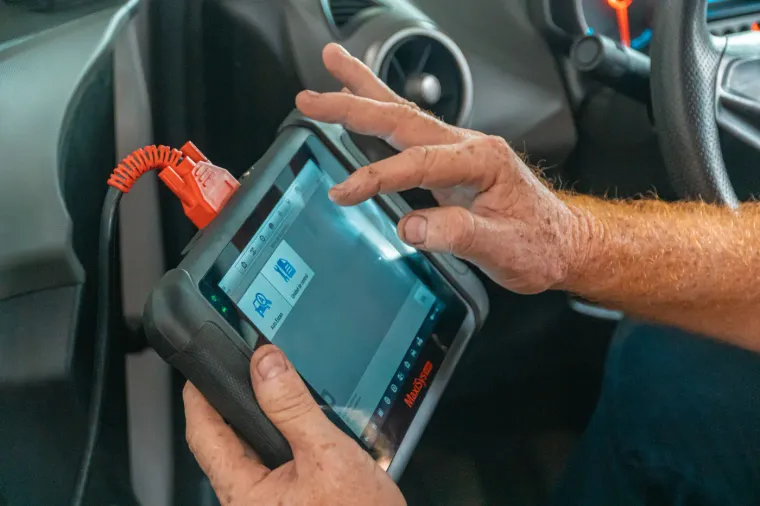
A trouble code tells you what the computer noticed, not what is broken. We read the codes, look at live data, and test the actual circuit before anything gets replaced. Diagnostic time is $120 an hour, quoted before we start, because the most expensive repair is the one that didn't fix the problem.
Here's the thing about a check engine light: the code is a symptom, not a diagnosis. An oxygen sensor code doesn't mean the sensor is bad — it might mean a vacuum leak, an exhaust leak, a chafed wire, or a fuel delivery problem the sensor is correctly reporting. Shops and parts stores that go straight from code to part are playing the parts cannon, and the customer pays for every miss. Our approach is the boring, correct one: read the codes, look at live data, and test the circuit before condemning anything. The part number comes out at the end of the testing, not the start. We're AMVIC licensed, we're at 12940 53 Street NW in Edmonton, and we see vehicles from Sherwood Park, St. Albert, Leduc, Spruce Grove, Fort Saskatchewan, Beaumont and Nisku. Call (780) 482-2424.

How We Diagnose a Check Engine Light in Edmonton
The hour does not go into staring at a code. It starts with every stored and pending code plus the freeze-frame data, the snapshot of what the engine was doing when the fault set: road speed, coolant temperature, engine load, fuel trims. Then live data with the engine running and under load, because a sensor that reads plausibly at idle often stops making sense at 2,500 rpm. Then the actual test — back-probing the circuit, checking voltage drop, reading pressure or signal right at the component. The toolset matters here: factory-level scan tools, a lab scope for signals a code reader can't see, a smoke machine for vacuum and EVAP leaks, and wiring diagrams for tracing circuits properly. We scan every module, not just the engine. You get written findings with a repair quote, and afterward we verify the fix held and the codes stay gone. If a job needs manufacturer-only online programming or key and immobilizer work, we say so up front instead of charging you to discover it.
What Testing a Lean Code or an Oxygen Sensor Code Looks Like
Take P0171, a lean code. The first number that matters is fuel trim, read at idle and again at 2,500 rpm. Trim that runs high at idle and settles down at speed points at unmetered air getting in past the sensor, so the intake goes on the smoke machine and the boots, PCV plumbing and gaskets get checked. Trim that stays high across the whole range points at fuel delivery or an airflow sensor reading low, so we compare airflow against calculated load and check fuel pressure under load rather than at idle. Oxygen sensor codes get the scope: the signal wire back-probed to see whether the sensor is switching, and the heater circuit and its ground checked before the sensor is blamed, because a harness rubbing on a bracket sets the same code. A part gets condemned when a measurement says so — a sensor that will not switch with its heater circuit and ground proven good. P0420 is the code we most often see a converter sold off, so before anyone quotes one we take temperature readings across the cat and look upstream for a leak. Our exhaust repair page covers the converter job itself.
What a Free Code Scan at the Parts Store Can't See
A handheld reader plugs into the same port we do, and for a generic powertrain code it gives you the same number. What it cannot do is put a meter or a scope on the circuit, push smoke through the intake, or watch live data with the engine loaded, which is where most faults actually show themselves. Most handheld readers see generic engine codes only, so an ABS, airbag, transmission or body module fault never appears, and people drive away with a clean scan and a light still on the dash. The manufacturer-specific codes, the ones that name the actual circuit rather than the system that complained, usually don't come through either, and those are often the whole shortcut. Two things are worth knowing before you spend anything. If the scan comes back as a loose fuel cap and your cap was loose, tighten it, drive it a few days and keep your money. And don't clear the code before you bring the vehicle in: clearing wipes the freeze-frame that makes the diagnosis faster and cheaper, and it resets the readiness monitors, so the fault has to set all over again before anyone can see it.
What Diagnostic Time Costs in Edmonton
Diagnostic time is $120 an hour and we quote it before we start. There's no flat rate on this across the city, so treat the comparison as a general market range rather than our quote: Edmonton shop rates generally sit around $140 to $180 an hour. What moves the number is not the badge on the vehicle but how the fault behaves. A code that is present and repeatable in the bay is usually settled inside the hour; one that shows up once a week is not, and we say so before we start rather than after. One thing to check before you pay us at all: emissions-related components often carry extended manufacturer coverage, and an open recall costs you nothing at the dealer, so if your vehicle is newer, find that out first. Guessing is expensive in a specific way. Replacing a part off an untested code buys you a new part, the original fault still there, and the testing still ahead of you.
When the Fault Only Happens Sometimes: Diagnosing Intermittent Problems
The hardest job in this trade is a fault that isn't happening while we're looking at it. There is nothing live to measure, so the work starts from what the vehicle recorded: stored codes against pending ones, the freeze-frame values from the moment it set, and which readiness monitors have run since. After that it is reproduction, and how we go about it depends on when your problem happens. A fault that only appears on a -30 start has to be caught on a cold start, so we book it first thing and ask you to bring it in cold rather than warming it up in the driveway. A fault that appears on the highway gets a road test with live data recording, so the moment is captured rather than remembered. A suspect connector gets wiggle and load tested with the scope still hooked up. This is the work that runs past the first hour, so it is billed as time and we agree the next block with you before spending it. Battery drains and no-starts have their own testing order, which our auto electrical and no-start page covers.
What an ABS, Airbag or Transmission Light Actually Means
Not every warning light is a check engine light, and the ones that aren't get ignored the longest. An ABS or traction control light means the system has faulted and stepped out of the way: you keep normal braking and lose the part that helps you on ice, which matters more on a January morning here than it would anywhere warm. The usual cause is a single wheel speed sensor or its wiring, sitting in the one spot on the vehicle that takes the most salt and gravel. An airbag light means the restraint system has logged a fault and may not deploy, and the usual suspects are a seat belt buckle switch, a clock spring in the steering column, or a connector under a seat that got kicked loose. Transmission codes and limp mode are frequently a solenoid, a speed sensor or a wiring fault long before the gearbox is the problem, which is worth knowing before anyone quotes you a transmission. And there's a practical reason not to live with one: once a module's lamp is already lit, the next fault it logs has nowhere left to announce itself.
Why an Edmonton Cold Snap Sets Codes That Vanish in a Chinook
Deep cold sets codes that have nothing left to show for themselves once the weather turns. EVAP faults are the classic: frost or ice in a purge or vent valve, or a fuel tank pressure sensor reading oddly at -35, sets a light that will not reproduce at plus 5. Low system voltage is the other one. A battery that is marginal at -32 drags voltage down far enough during cranking that modules all over the vehicle log faults they would never set in July, and the scan comes back with half a dozen codes from healthy systems — which is why the charging system gets tested before any of them get chased. Cold also stiffens connector seals and finds whatever corrosion the salt spray left there last winter. If your light came on during a cold snap, read it while the cold is still here, because a code that clears itself in a chinook takes its freeze-frame data with it. Our check engine light guide covers solid versus flashing and when it's safe to keep driving.
Signs you need this service
- The check engine light is on — steady means get it checked soon, flashing means stop driving
- The vehicle runs rough, idles poorly, stalls, or hesitates
- Fuel economy has dropped for no obvious reason
- ABS, traction control, or airbag warning lights are on
- The vehicle is stuck in limp mode — low power, held in one gear
- Hard starting, long cranking, or intermittent no-starts
- An EVAP or fuel cap code keeps coming back after you've tightened the cap
- The fault only happens on a cold morning, or only after half an hour of driving
- Parts have already been replaced, the same code came back, and nobody could tell you why
What's included
- Full-system code scan, stored and pending — engine, transmission, ABS, airbag, body and gateway modules — with the freeze-frame data from the moment each fault set
- Live data analysis with the engine running and under load: fuel trims, sensor behaviour, misfire counters
- Circuit-level testing before anything is replaced, including voltage drop, back-probing and lab scope work on signals a code reader can't see
- Smoke testing for vacuum and EVAP leaks
- Fuel, ignition and misfire diagnosis — which cylinder, and why
- Electrical and wiring diagnosis, including parasitic drain testing with the modules asleep
- Road testing with live data recording, and cold-start testing for faults that only appear at -30
- A straight answer on whether the repair needs manufacturer-only programming or key and immobilizer work, before you spend anything chasing it
- Written findings with a repair quote, yours whether or not we do the work
- Verification after the repair that the fix held and the codes stay gone
Frequently asked questions
My check engine light is flashing. Can I drive it?
No — pull over when it's safe and shut it down. A flashing light means an active misfire dumping raw fuel into the catalytic converter, which can overheat and destroy it within minutes. That turns a spark plug or coil repair into a converter replacement costing thousands. A steady light is less urgent, but get it read soon.
How much does a diagnostic cost in Edmonton?
$120 an hour, quoted before we start. Most problems are found inside the first hour. When one isn't, we stop and tell you what has been ruled out, what is left to test and roughly how much more time it needs, and you decide from there. We don't keep spending past what you approved and hand you the bill afterward. The findings are yours in writing whether or not we do the repair, so you can take them elsewhere if you want to.
Do I need to leave the vehicle for a diagnostic?
Usually, yes. Plan on dropping it off rather than waiting for it. A code that is present and repeatable is often settled in an hour, but a road test with data recording takes as long as the fault takes to appear, and a cold-start fault has to be booked first thing with the vehicle brought in cold. We're open Monday to Friday 8:30am to 6:00pm and Saturday 10:00am to 2:00pm. Call (780) 482-2424 and tell us when the problem actually happens, because that changes how we book it.
Do you charge if you can't find the problem?
Yes. You are paying for the testing, and that holds whether it ends in a cause or a much shorter list of suspects. What we won't do is keep billing quietly. If the first hour eliminates things without landing on an answer, we stop, tell you what has been ruled out and what going further would take, and you decide. Intermittent faults are the ones that end this way, and the written findings still narrow the next attempt.
Can I just keep driving with the light on?
Depends what set it. Some codes are minor. Others — running lean, misfires, overheating-related codes — do cumulative damage or burn extra fuel every day. The honest answer is you don't know which kind you have until it's read and diagnosed, so at minimum find out what the code is before deciding to ignore it.
Will disconnecting the battery make the light go away?
It clears the code, and if the problem is real the light comes back — usually with less data for whoever diagnoses it next. It also resets the computer's learned values, so the vehicle may idle and shift oddly for a while afterward. Fix the cause; the light takes care of itself.
My light came on during a cold snap. Is that normal?
Common, yes; normal, not exactly. Deep cold exposes weak thermostats, tired batteries, and marginal sensors. The most frequent one we see is P0128, a thermostat stuck open so the engine never fully warms up. It feels harmless, but it means poor heat, worse fuel economy, and extra engine wear all winter. Cheap fix, worth doing.
Another shop already replaced two parts and the same code is back. Will you start over?
Yes, from the data rather than from the last guess. We pull codes and freeze-frame fresh, look at what is on the vehicle now, and test the circuit ourselves, because a part that was replaced is not a part that was ruled out. New parts are occasionally faulty out of the box or wired back in wrong. If the last shop had the right part and the wrong cause, we'll tell you that too. Bring whatever paperwork you have; knowing what has been changed saves time you would otherwise pay for.
Known problems we repair
Deep guides on the failures we see most — symptoms, honest costs, and repair options.
BMW N20 / N26 2.0L Turbo (2011-2017)
BMW N20 / N26 Timing Chain Failure: Symptoms, Costs, and What to Do About It
Ford 5.4L Triton 3-Valve V8 (2004-2014 F-150, Super Duty, Expedition, Navigator)
Ford 5.4L Triton Cam Phaser Failure: The Cold-Start Rattle Explained, and What Fixing It Really Costs
Ram 2500/3500 6.7L Cummins — 68RFE 6-Speed (2007.5–2024)
Dodge Ram 68RFE Transmission Problems: What Fails, What It Costs, and What to Do About It
GM 5.3L V8 — Vortec 5300 & EcoTec3 (2007–present)
GM 5.3L V8 AFM/DFM Lifter Failure and Oil Consumption: The Straight Story
Ford 3.5L EcoBoost V6 (2011-2020)
Ford 3.5L EcoBoost Timing Chain and Cam Phaser Problems: Symptoms, Affected Years, and Repair Costs in Canada
Ram / Dodge / Jeep 5.7L HEMI V8 (2009–2024)
The 5.7 HEMI Tick: Lifter and Camshaft Failure in Ram, Dodge and Jeep V8s
Nissan Jatco CVT (2003-2020)
Nissan CVT Transmission Failure (Jatco): Symptoms, Years Affected, and Repair Costs in Canada
Hyundai/Kia Theta II 2.4L GDI & 2.0T GDI (2011–2019)
Hyundai/Kia Theta II Engine Failure (2011–2019): Rod Knock, Seizure, and What It Actually Costs to Fix in Canada
GM 6.6L Duramax LML/LGH (2011-2016)
Duramax LML CP4 Injection Pump Failure: What Every 2011-2016 Owner Needs to Know
VW/Audi 2.0T TSI, EA888 Gen 1/2 (2008–2013)
VW/Audi 2.0T TSI Timing Chain Tensioner Failure: The Cold-Start Problem That Can Kill the Engine
Chrysler/Dodge/Jeep/Ram 3.6L Pentastar V6 (2011-present)
Chrysler 3.6L Pentastar V6 Problems: The Tick, Early Cylinder Head Failure and Oil Cooler Leaks
No-start — any make or model
Car Won't Start in Edmonton: What the Sounds Mean, What It Costs, and When to Tow
Check engine light — any make
Check Engine Light On in Edmonton: Solid vs Flashing, Real Causes, and Honest Costs
Brake noise — any make
Grinding Brakes in Edmonton: What the Noise Means and What It Costs to Fix
Overheating — any make
Engine Overheating in Edmonton: What to Do Right Now, What Causes It, and What It Costs
Transmission — any make
Transmission Won't Shift in Edmonton: Cold-Weather Shifting, Slipping, Limp Mode, and Honest Costs
Related services
Book your vehicle diagnostics & check engine light
Call for a straight answer on cost and timing, or book online.