
The short answer
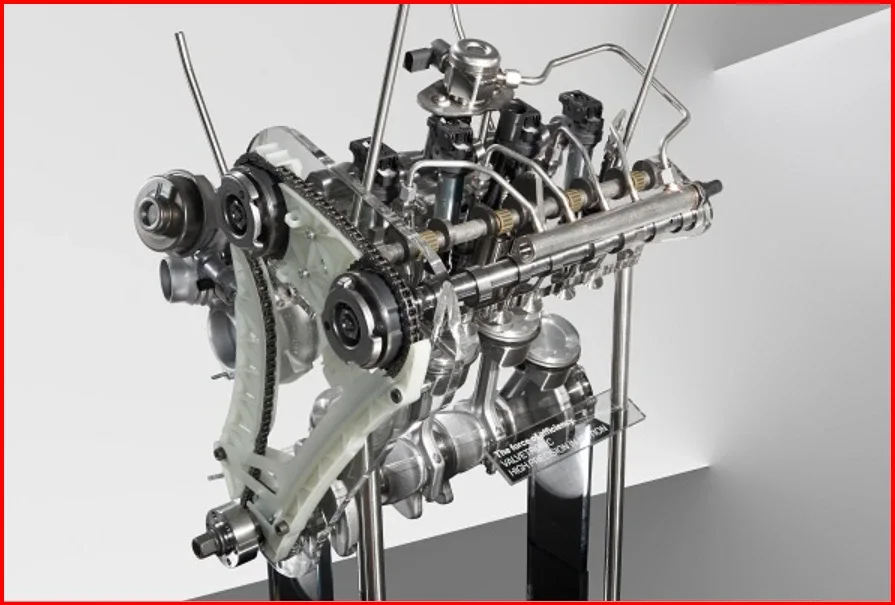
The 2.0L turbo four-cylinder in most 2012-2016 BMWs — the N20 and its N26 twin — has a well-documented timing chain problem. The plastic chain guides go brittle and break apart, and if the chain jumps or snaps, the engine is usually destroyed. Caught early, it is a manageable repair; caught late, you are shopping for an engine.
Symptoms, from first warning to failure
High-pitched whine or whirring from the front of the engine
The classic first sign. Owners often describe it as a supercharger-like whine that rises and falls with engine RPM, coming from the front or passenger side of the engine bay. It is the chain running against worn or damaged guide surfaces. Plenty of N20s have driven months with this noise, but it is the engine telling you the guides are wearing — get it inspected before it becomes something worse.
Rattle on cold start
A metallic rattle for the first second or two after a cold start, before oil pressure builds and the hydraulic tensioner takes up slack. A brief noise once in a while is common on many chain-driven engines, but on an N20 a cold-start rattle that gets longer or louder over time is a warning sign, especially through an Edmonton winter where cold starts are hard on everything.
Check engine light with timing or VANOS fault codes
As the chain develops slack, the camshaft and crankshaft positions drift out of correlation. Typical codes include P0016/P0017 (crank/cam correlation) and various VANOS timing faults. A scan that shows camshaft timing deviation beyond spec is strong evidence the chain and guides are worn. Do not just clear the code and keep driving.
Plastic or metal debris in the oil filter housing or oil pan
Broken guide material ends up in the oil. A technician doing an oil change can spot amber or black plastic fragments in the filter housing, and dropping the oil pan will show larger pieces. Debris is proof the guides are already breaking apart — at that point chain replacement is urgent, not optional.
Rough running, misfires, or a drivetrain malfunction warning
When timing has drifted far enough, the engine runs poorly: hesitation, misfires, reduced power, and the iDrive "Drivetrain malfunction" message. The car may go into limp mode. At this stage the chain may have already skipped a tooth. Stop driving it and have it towed in — the difference between a chain job and a destroyed engine can be a few kilometres.
Low oil pressure warning
The N20 also has a separate oil pump drive chain lower in the engine, and guide debris can clog the oil pickup. Either one can cut oil pressure without warning. If the red low-oil-pressure light comes on, shut the engine off immediately and have the car towed. Running an engine without oil pressure destroys the bearings in seconds.
Sudden loud clatter, engine stalls or cranks but will not start
This is the chain jumping several teeth or snapping outright. The N20 is an interference engine, so the pistons strike the open valves — bent valves, damaged head, sometimes cracked pistons. If the engine died with a bang or clatter and now cranks over unevenly or not at all, do not keep cranking it. At this point the conversation is usually about a replacement engine.
Affected models
| Model | Years | Notes |
|---|---|---|
| 328i / 328i xDrive (F30 sedan, F31 wagon, F34 Gran Turismo) | 2012-2016 | The highest-volume N20 car and the one we see fail most often. Vehicles built before roughly January 2015 carry the original guide design and are the highest-risk group. |
| 320i / 320i xDrive (F30) | 2013-2018 | North American 320i models kept the N20 right to the end of F30 production, even after the 330i switched to the newer B46/B48 in 2017. Later builds have the revised chain components; 2013 to early-2015 builds are the risk group. |
| 428i / 428i xDrive (F32/F33/F36 4 Series) | 2014-2016 | Same engine as the 328i. Replaced by the B46-powered 430i for 2017. |
| 228i (F22/F23 2 Series) | 2014-2016 | Same N20 as the 328i; became the 230i with the newer engine family for 2017. |
| 528i / 528i xDrive (F10 5 Series) | 2012-2016 | The N20 in a heavier car works harder. Same failure pattern, same fix. |
| X1 xDrive28i / sDrive28i (E84) | 2012-2015 | Canadian E84 X1s got the N20 from 2012. Almost all of these fall in the pre-revision build window, so treat any unserviced example as at-risk. |
| X3 xDrive28i (F25) | 2013-2017 | The 28i switched from the six-cylinder N52 to the N20 for the 2013 model year. 2013-2014 builds are the main risk group; 2016-2017 builds have the updated parts. |
| X4 xDrive28i (F26) | 2015-2018 | Most were built after the January 2015 parts revision, so failure rates are lower, but they are not immune — oil neglect still kills guides. |
| Z4 sDrive28i (E89) | 2012-2016 | Same N20 story. Lower-mileage seasonal cars fail later in calendar time, but the plastic still ages. |
| X5 xDrive40e (F15 plug-in hybrid) | 2016-2018 | Uses an N20-based engine built after the revision. Low reported failure rates, listed here for completeness. |
| N26-equipped 328i / 428i / 228i (US SULEV states) | 2013-2016 | The N26 is the N20's near-identical twin built for strict US emissions states. Its timing chain hardware is the same, and it was named in the same class action. These cars show up in Alberta as US imports, so check the engine code on imported vehicles. |
What actually goes wrong
When BMW replaced the naturally aspirated six-cylinder with the N20 2.0L turbo four in its "28i" models starting in 2011, the timing chain was sold as a lifetime part — no scheduled replacement interval, ever. On paper that is fine; plenty of chain-driven engines genuinely go the distance. The N20's problem is not the chain itself so much as what holds it in place: the guide rails and tensioner rail are plastic, and on engines built before roughly January 2015 that plastic goes brittle with heat cycles and age. The guides crack, chunks break off, and the chain develops slack the hydraulic tensioner can no longer control.
From there, two failure paths open up. The first is mechanical: with the guides broken, the chain can jump teeth on the sprockets or snap outright. The N20 is an interference engine — the pistons and valves occupy the same space at different times — so the moment timing is lost, pistons hit open valves. The result is bent valves, a damaged cylinder head, sometimes damaged pistons, and very often an engine that costs more to rebuild than to replace.
The second path is oil starvation, and it is sneakier. Broken guide fragments fall into the oil pan, where they can block the oil pump pickup. The N20 also has a second, shorter chain low in the engine that drives the oil pump, with its own wear-prone components — this oil pump drive chain was specifically named alongside the timing chain in the US class action. Lose either one and the engine loses oil pressure while running, which wipes out the crankshaft bearings in seconds. We have seen engines destroyed this way with a timing chain that never actually snapped.
Failures show up surprisingly early for a "lifetime" part. Documented cases start around 60,000 km, with the bulk falling between roughly 80,000 and 150,000 km on pre-2015 builds. Long oil change intervals make it worse: degraded oil accelerates guide wear, and BMW's condition-based service system stretched oil changes far longer than this engine tolerates well. In January 2015 BMW revised the timing chain components, and engines built after that date fail at a much lower rate — which is also why a proper repair today installs the updated-design parts, not replacements for the originals.
BMW never issued a safety recall for this — not in the United States, and not in Canada. What happened instead was a class action: Gelis et al. v. BMW, filed in the US District Court of New Jersey in 2017, alleging the timing chain and oil pump drive chain modules in 2012-2015 N20 and N26 vehicles were defective. BMW settled in early 2020, with final court approval in 2021. The settlement gave US owners an extended warranty of 7 years or 70,000 miles on the timing chain and oil pump drive chain modules, plus partial reimbursement for past repairs. Two things matter for readers here: that coverage applied to US-market vehicles, with no equivalent program for Canadian cars, and even in the US the 7-year window has now expired for every eligible vehicle. In 2026, if your N20 lets go, the repair bill is yours.
How the failure happens
Hover the diagram — or tap a part below — to see what it does and how it fails.
What it costs to fix
Typical ranges in Canadian dollars — every vehicle is quoted individually.
Inspection and diagnosis
$150 - $350 CAD
A proper N20 chain check: scan camshaft timing correlation values, listen for guide noise, and inspect the oil filter housing and oil pan for plastic debris. Cheap insurance if you are hearing a whine or buying a used N20 car. On many cars the verdict is "healthy, recheck in a year" — you should not be sold a chain job without evidence.
Proactive timing chain replacement
$2,000 - $3,500 CAD
Chain, guides, tensioner, and hardware replaced with the revised-design parts before anything fails, typically 12-15 hours of labour at an independent shop. Expect roughly $4,500-$6,500 at a dealer for the same job. Adding the oil pump drive chain while everything is apart typically adds a few hundred dollars and is worth doing — the labour overlaps heavily.
Chain failure with valve damage — head repair
$4,500 - $8,000 CAD
If the chain jumped or snapped, this covers removing the cylinder head, replacing bent valves, machining, gaskets, and the full chain kit — assuming the pistons and bottom end survived, which a teardown has to confirm first. On a high-kilometre engine this money is often better spent on the next tier down the page.
Genuine OEM replacement engine (through Eskimo Auto & Truck Parts)
$5,000 - $9,000 CAD installed
A tested genuine OEM N20 engine typically runs $2,000-$4,500 depending on mileage, plus roughly 15-25 hours of labour, fluids, and the odds-and-ends (mounts, gaskets, sensors) that make sense to do during a swap. Through our sister company, Eskimo Auto & Truck Parts, we have direct access to a large inventory of genuine OEM BMW engines, and we prefer donors built after January 2015 or with a documented chain service — the smart way to avoid buying the same problem twice.
New or remanufactured engine from BMW
$15,000 - $20,000+ CAD installed
Technically available, rarely sensible. On most N20-era cars this exceeds what the whole vehicle is worth. We quote it for completeness, but we have a hard time recommending it over a good genuine OEM engine with the updated chain design.
Repair it, or replace it?
If your engine is still healthy, the math is simple: a proactive chain replacement at $2,000-$3,500 is the cheapest this problem will ever be. On a pre-2015 build past about 100,000 km that you plan to keep, we think it is money well spent — you are buying the revised parts and removing the single biggest financial risk hanging over the car. If you are not sure, start with an inspection; timing correlation data and a look for debris in the oil system will tell you whether the chain job is needed now or can wait.
Once a chain has actually let go, slow down before authorizing anything. The honest first step is a teardown or borescope inspection to establish what died: bent valves only, or pistons and bottom-end damage too. A head repair in the $4,500-$8,000 range only makes sense if the bottom end is confirmed good — and on an engine that has also swallowed guide debris through its oil system, that confirmation is not guaranteed. Plenty of shops have repaired a head only to have the customer back with a rod knock a few months later.
For high-kilometre cars — say 150,000 km and up — a genuine OEM engine swap usually beats an in-place repair. For roughly the same money as a head rebuild, or a little more, you get a complete running engine instead of a repaired top end sitting on a bottom end of unknown condition. The genuine OEM route makes the most sense when the rest of the car is worth keeping: straight body, healthy transmission, no rust horror show underneath. These cars are worth enough on the used market that a $6,000-$8,000 swap is often clearly justified against replacing the whole vehicle.
And sometimes the right answer is to walk away. If the car needs a chain-failure engine plus tires, brakes, and suspension work, and its running value would barely cover the repair bill, we will tell you that straight. In that case the car itself still holds real value in its parts — which is a conversation our sister company, Eskimo Auto & Truck Parts, can have with you the same day.
How we fix this in Edmonton
Engine Repair & Replacement in Edmonton
A bad engine doesn't automatically mean a new vehicle. We diagnose before we condemn — and then we can fix it every way there is: rebuild it in-house, install a remanufactured ATK engine, or fit a genuine OEM engine sourced through our sister company, Eskimo Auto & Truck Parts.
See the service →Vehicle Diagnostics & Check Engine Light in Edmonton
A trouble code tells you what the computer noticed, not what is broken. We read the codes, look at live data, and test the actual circuit before anything gets replaced. Diagnostic time is $120 an hour, quoted before we start, because the most expensive repair is the one that didn't fix the problem.
See the service →BMW Repair in Edmonton
BMW builds a good car with a short list of very specific weak points, and most of what rolls in here is on that list: N20 timing chain guides, oil filter housing and valve cover gaskets on the N54 and N55, electric water pumps, VANOS solenoids and cooling system plastic that our winters age fast. We scan at module level, tell you which of those your car actually has, and quote in writing before anything comes apart. If your BMW genuinely needs dealer-only programming, we will tell you that instead of billing you to find out.
See the service →The genuine OEM parts option
This is where being tied to one of Edmonton's largest parts operations changes the math. Our sister company, Eskimo Auto & Truck Parts in Edmonton, gives us direct access to a huge inventory of genuine OEM engines, transmissions, and body parts, with shipping available across Canada and the USA. When an N20 lets go, we can quickly source the right tested genuine OEM engine — typically $2,000-$4,500 depending on mileage — and we screen donors the way you would want: preferring engines built after the January 2015 chain revision or with documented chain service, so the replacement does not carry the same weak point as the engine it is replacing. One company sources the engine, the other installs it, and the two work as one team. If you are repairing the car yourself or working with another shop, Eskimo Auto & Truck Parts supplies the same genuine OEM engines direct.
Browse inventory at Eskimo Auto & Truck Parts →How to make yours last longer
- Ignore BMW's stretched service intervals and change the oil every 8,000 km or 6 months with a proper LL-01 spec 5W-30. The condition-based service system will happily let you run 15,000 km or more between changes, and degraded oil is exactly what accelerates guide and tensioner wear on this engine.
- Check your oil level monthly through the iDrive menu — most N20 cars have no dipstick, and low oil makes the tensioner's job harder, especially on cold starts. Top up promptly; these engines are known to use some oil between changes.
- Take new noises seriously. A whine that rises with RPM or a cold-start rattle that is getting longer costs $150-$350 to diagnose. Waiting until the check engine light or the drivetrain malfunction message shows up can turn a $3,000 repair into a $7,000 one.
- Ask whoever changes your oil to look for plastic fragments in the oil filter housing every single time. It takes thirty seconds and it is the earliest hard evidence of guide breakup.
- If your car was built before January 2015 and is past about 100,000 km with no chain service history, budget for proactive replacement — and have the oil pump drive chain done in the same job while the labour overlaps.
- Be gentle on cold starts in winter. At -30°C, oil takes time to reach the tensioner and the top of the engine. Let the engine settle for a few seconds after start-up and keep RPM modest until the temperature gauge starts moving.
Frequently asked questions
Which BMW years have N20 timing chain problems?
Engines built from 2011 until roughly January 2015 carry the original guide design and are the highest-risk group — that covers most 2012-2015 model year cars (328i, 528i, X1, X3, 428i, 228i, Z4 and others). BMW revised the timing chain components in January 2015, and later builds fail at a much lower rate. The N26, the near-identical version sold in strict US emissions states, has the same issue in the same years.
Was there a recall for the BMW N20 timing chain?
No. There was never a safety recall in Canada or the US. A US class action (Gelis v. BMW, settled 2020, final approval 2021) gave American owners an extended warranty of 7 years or 70,000 miles on the timing chain and oil pump drive chain modules, plus some reimbursement for past repairs. That coverage never applied to Canadian-market cars, and even in the US it has now expired for every eligible vehicle.
What does N20 timing chain failure sound like?
The early sign is a high-pitched whine or whirring from the front of the engine that rises with RPM — often mistaken for a supercharger or accessory noise. Cold-start rattle that lasts a second or two and gets worse over time is another warning. By the time you hear loud clattering or the engine dies, the chain has usually already jumped or snapped.
How much does an N20 timing chain replacement cost in Canada?
At an independent shop, a complete job — chain, guides, tensioner, and hardware, all in the revised design — typically runs $2,000-$3,500 CAD, depending on the model and what else is found once the engine is open. Dealers commonly charge $4,500-$6,500 for the same work. Adding the oil pump drive chain at the same time adds a few hundred dollars and is worth it.
At what mileage should I replace the timing chain proactively?
There is no official interval — BMW calls it a lifetime part. In practice, failures on pre-2015 builds cluster between roughly 80,000 and 150,000 km. Our guidance: if your car was built before January 2015, is past 100,000 km, and has no chain service history, get it inspected and budget for replacement. An inspection first is fair — some engines check out fine and can be rechecked annually.
Can I keep driving with a whining timing chain?
You can, but you are gambling the entire engine to postpone a repair. The N20 is an interference engine: if the chain jumps or snaps, pistons hit valves and the typical outcome is a $5,000-$9,000 engine replacement instead of a $2,000-$3,500 chain job. If the noise is new, book an inspection. If you get a low oil pressure warning or the engine starts running rough, stop driving and tow it.
My BMW was built after January 2015 — is it safe?
Much safer, not bulletproof. The revised components brought failure rates way down, but they still live in a hot, hard-working turbo engine, and long oil change intervals or chronically low oil will wear any chain system. Keep oil changes to 8,000 km or 6 months and treat any new front-of-engine noise as worth a look.
Should the oil pump drive chain be replaced at the same time?
Yes. The N20 has a second chain low in the engine driving the oil pump, and it was named alongside the timing chain in the US class action. If it fails, the engine loses oil pressure while running, which destroys bearings in seconds. Since the labour overlaps heavily with a timing chain job, doing both at once is much cheaper than doing them separately — and far cheaper than the failure.
Is a genuine OEM engine a good fix after N20 timing chain failure?
Often it is the smartest one, especially on higher-kilometre cars. A tested genuine OEM engine installed typically runs $5,000-$9,000 CAD, which is comparable to a cylinder head repair — except you get a complete engine instead of a rebuilt top end on a bottom end that swallowed debris. The key is donor selection: we source engines through our sister company, Eskimo Auto & Truck Parts, and look for post-January-2015 builds or engines with documented chain service, so you are not inheriting the same problem.
Real job from our shop
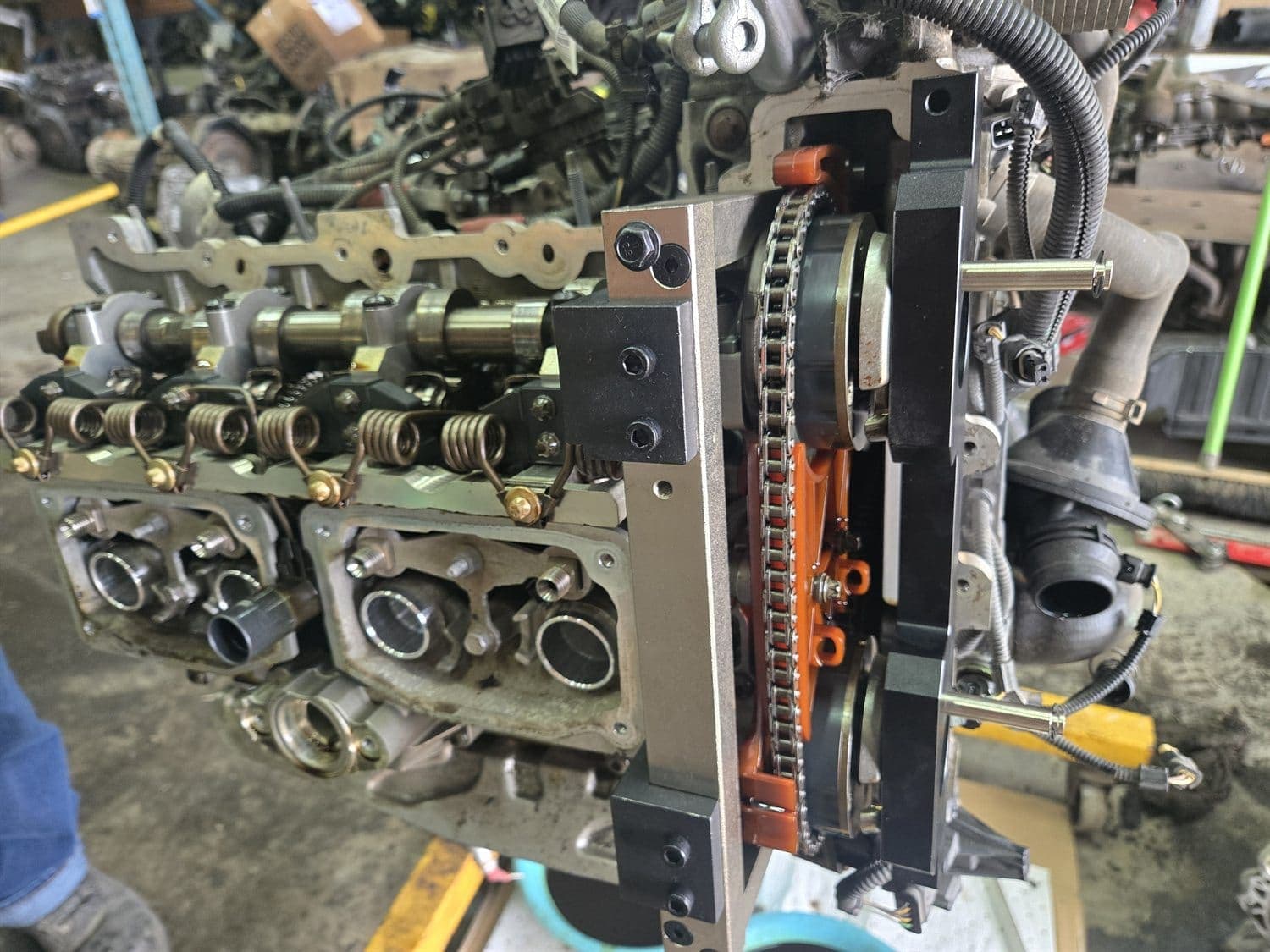
BMW N20 rebuild + timing chain — 2016 X3 xDrive28i
- Came in:
- A 2016 X3 with the N20's known weak point: the timing chain. The plastic guides go brittle, the chain wears and can jump — and on this interference engine that means bent valves and a destroyed engine in a heartbeat.
- We found:
- The 2.0T needed to be gone through, and the timing chain done properly — the part of the job where a shortcut wrecks the engine.
- Result:
- Done right, the N20 is a good engine. This is the kind of European work a lot of general shops send out — we did it in-house, which keeps the cost sane and the whole job under our control.
Dealing with this problem right now?
Edmonton and area: bring it in and we'll confirm the diagnosis before any work. Anywhere else in Canada or the USA: our sister company ships the genuine OEM parts to your shop.