
The short answer
Ford's 3.5L EcoBoost V6 is a strong, proven engine with two well-known valvetrain weak spots, and they belong to two different generations. The first generation (2011-2016 F-150, plus early Expedition, Navigator and Transit) wears out its single long timing chain, especially when oil changes get stretched. The second generation (2017-2020 F-150, 2018-2020 Expedition and Navigator) fixed the chain but developed a cold-start cam phaser rattle that Ford addressed with service bulletins and an extended-coverage program that has since expired. This guide explains both problems in plain language, what they cost to fix in Canada, and when a genuine OEM engine makes more sense than a repair.
Symptoms, from first warning to failure
Rattle for two to five seconds on cold start
The classic first sign on both generations. After the truck sits overnight — or six-plus hours, which Ford's own bulletin uses as the trigger condition — the engine starts with a rattle, tick or 'marbles in a can' noise from the top front of the engine that fades within a few seconds. On Gen 1 engines it points to a worn chain and guides; on Gen 2 it is almost always the cam phasers. Edmonton winters make this very easy to hear, since every start after a cold soak is a test.
Light ticking or knocking at warm idle
On 2017-2020 trucks, worn phasers can also produce a soft typewriter-style tick or knock at idle after the engine is fully warmed up. It is easy to dismiss as injector noise, which the 3.5L EcoBoost makes plenty of anyway. The difference is that phaser noise tends to get gradually louder over months, while normal injector tick stays constant.
Oil-change history you cannot account for
Not a noise, but a genuine early warning. If you just bought a used 2011-2016 EcoBoost and the seller could not produce oil-change records, assume the chain has more wear than the odometre suggests. Degraded oil is the single biggest factor in how fast these chains wear.
Check engine light with P0016, P0017, P0018 or P0019
These are crankshaft-to-camshaft correlation codes, and on a Gen 1 engine they are the textbook signature of a stretched timing chain: the chain has elongated enough that the cams no longer line up with the crank within the tolerance the computer allows. Occasionally a sticking VCT solenoid sets the same codes, which is a far cheaper fix, so proper diagnosis matters before anyone quotes you a timing job.
Rattle that lasts longer or shows up on warm restarts
When the noise stretches past a few seconds, or starts appearing on restarts after short stops, the wear has progressed. On Gen 2 trucks this usually means the phasers are no longer holding their locked position reliably; on Gen 1 trucks it can mean the tensioner is running out of travel trying to take up chain slack.
Auto start-stop refuses to restart, or code P164C
Ford's bulletin for the 2017-2020 phaser issue specifically lists an intermittent no-restart during auto start-stop operation, with or without diagnostic code P164C stored. If your truck occasionally hesitates or fails to fire back up when the start-stop system releases the brake, have the phasers looked at rather than just switching the feature off.
Rough idle, hesitation, or worsening fuel economy
As cam timing drifts from chain or phaser wear, the engine runs outside its designed valve timing. Drivers usually notice a lazier throttle, a slightly lumpy idle, and fuel consumption creeping up. None of this strands you on its own, but it means the wear is now affecting how the engine runs, not just how it sounds.
Continuous rattle, loss of power, or limp mode
A rattle that never goes away, combined with a flashing check engine light or reduced power, means the timing system can no longer keep the cams where they belong. Stop driving it and get it towed or driven gently straight to a shop. On a Gen 1 engine this is the stage right before the chain skips a tooth.
Jumped timing: stalling, cranks-but-no-start, or metal in the oil
The worst-case ending. If a badly worn chain jumps on the sprockets, the engine may stall and refuse to restart, and valve-to-piston contact becomes a real risk. Metal flake in the oil or filter from ground-down guides and phaser lock pins is the same story. At this point you are pricing engine work, not a timing kit, and a genuine OEM engine is usually the sensible path.
Affected models
| Model | Years | Notes |
|---|---|---|
| Ford F-150 3.5L EcoBoost (Gen 1) | 2011-2016 | The core timing chain stretch years. A single long primary chain drives both cylinder banks, and it wears at the pins until the computer sets correlation codes (P0016-P0019) and the cold-start rattle appears. Trucks with stretched oil intervals can need chains as early as roughly 150,000-200,000 km; well-maintained ones often go 250,000 km or more without trouble. |
| Ford F-150 3.5L EcoBoost, incl. Raptor (Gen 2) | 2017-2020 | Chain stretch largely solved by the redesigned dual-chain drive, but these years developed the cold-start cam phaser rattle. Ford's bulletin covers trucks built on or before November 30, 2019 — so most 2017-2019s and early-build 2020s. Addressed by TSB (currently 23-2143) and Customer Satisfaction Program 21N03, which expired January 1, 2023. |
| Ford F-150 3.5L EcoBoost | 2021 onward | Built with the updated phaser design that went into production around December 2019. Complaints are far less common and Ford has not issued an equivalent phaser bulletin for these years as of mid-2026. Standard advice still applies: keep the oil fresh, since the entire VCT system runs on oil pressure. |
| Ford Expedition (Gen 1 3.5L EcoBoost) | 2015-2017 | Same first-generation engine and single-chain layout as the 2011-2016 F-150, so the same chain-stretch pattern applies. These are heavy vehicles that often tow, which works the oil harder and makes honest maintenance history even more important. |
| Ford Expedition (Gen 2 3.5L EcoBoost) | 2018-2020 | Included by name in Ford's cam phaser bulletin and in Customer Satisfaction Program 21N03 alongside the 2017-2020 F-150. Same cold-start rattle, same repair: all four VCT units replaced with updated parts. |
| Lincoln Navigator (Gen 1 3.5L EcoBoost) | 2015-2017 | Shares the first-generation engine with the Expedition and F-150 of those years, and the same timing chain wear pattern. Parts interchange heavily with the Ford models, which keeps genuine OEM parts easy to source. |
| Lincoln Navigator (Gen 2 3.5L EcoBoost) | 2018-2020 | Covered by the same phaser TSB and Customer Satisfaction Program 21N03 as the 2018-2020 Expedition. The higher-output tune does not change the diagnosis or the fix. |
| Ford Transit 3.5L EcoBoost | 2015-2019 (and later) | The EcoBoost option in the Transit uses the first-generation architecture, so chain stretch is the concern — and work vans are exactly the vehicles whose oil changes get skipped. Owner reports indicate the Transit's EcoBoost carried over largely unchanged into 2020-plus vans, so we treat those the same way: judge by oil history and cold-start noise, not model year alone. |
What actually goes wrong
First, get the generations straight, because the internet constantly mixes them up. Ford built two distinct versions of the 3.5L EcoBoost for its trucks and big SUVs. The first generation ran in the F-150 from 2011 to 2016, in the Expedition and Navigator from 2015 to 2017, and in the Transit from 2015. The second generation arrived in the 2017 F-150 and the 2018 Expedition and Navigator. They have different timing hardware and different failure patterns, so the right diagnosis — and the right repair bill — depends entirely on which one is sitting in your driveway.
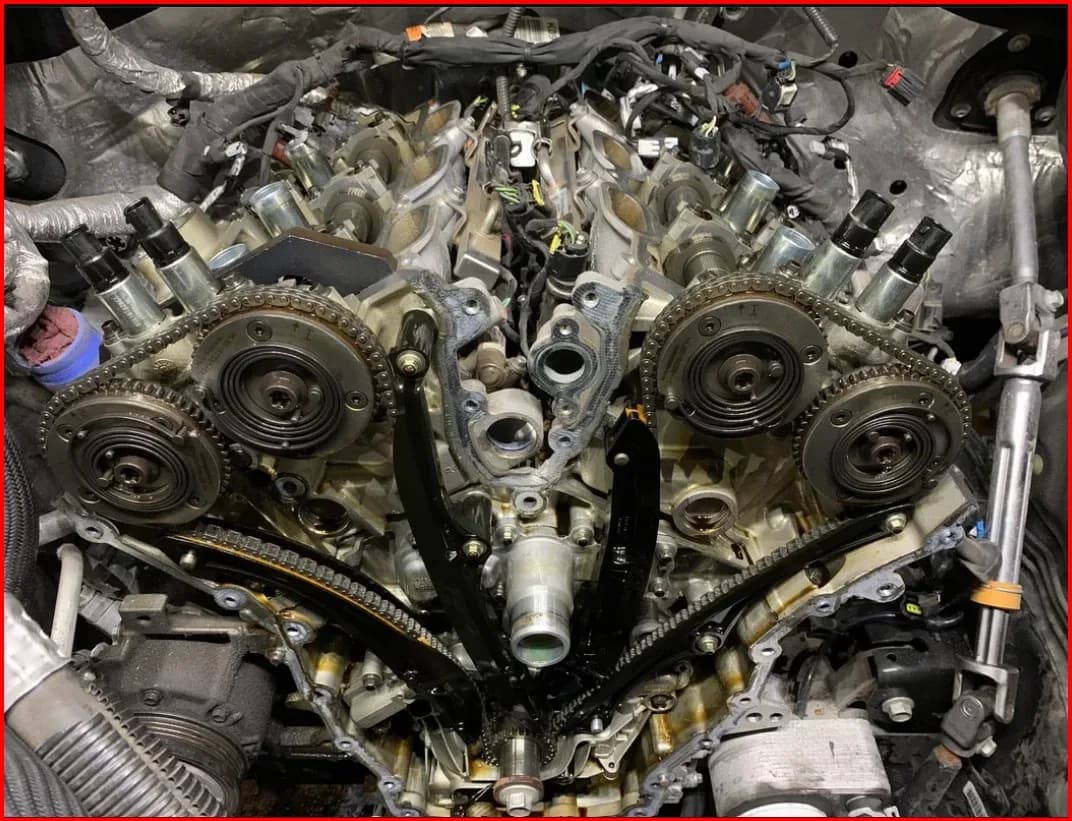
The first-generation problem is timing chain stretch. The engine uses one long primary chain to drive all four camshafts across both cylinder banks, and that long, hard-working chain is the weak point. 'Stretch' is a bit of a misleading word: the metal does not actually elongate like taffy. The chain wears microscopically at every pin and roller, and multiplied over a hundred-plus links, that wear adds up to a chain that is effectively longer than it was. The tensioner takes up slack for a while, but eventually the cams start lagging behind the crankshaft. The computer sees the correlation drift and sets P0016-series codes, you hear the slack chain rattle against its guides on cold starts, and in the end stage the chain can jump a tooth — which is how a noise problem becomes an engine problem.
Oil is the whole story on Gen 1. This is a turbocharged, direct-injection engine: it runs its oil hot, and fuel washing past the rings dilutes the oil between changes. Degraded, fuel-thinned oil stops protecting the chain pins, and wear accelerates dramatically. That is why two identical 2013 F-150s can be worlds apart — the one that got quality synthetic every 8,000 kilometres may be quiet at 300,000 km, while the one that ran the oil-life monitor to the limit on bargain oil needed a chain at 160,000 km. When we do the job properly, it is not just a chain: chains, guides, tensioners, cam phasers, VCT solenoids and seals all go in together, because the labour to open the front of the engine is the expensive part and you never want to pay it twice.
The second-generation engine fixed the chain. Ford redesigned the cam drive around two shorter chains — one per cylinder bank — with beefier side plates, and chain stretch complaints essentially disappeared. The new weak point turned out to be the cam phasers, formally the variable camshaft timing (VCT) units. These are hydraulic units on the end of each camshaft that swivel cam timing on oil pressure while you drive. Inside is a locking mechanism that is supposed to hold the phaser in a fixed position at shutdown and startup, before oil pressure comes up. As the units wear, they stop holding that position, and for the first few seconds of a cold start the phasers clatter until oil pressure catches up. That is the infamous 2-5 second startup rattle on 2017-2020 trucks after a cold soak of six hours or more. Ford's bulletin also links worn phasers to an intermittent failure to restart during auto start-stop operation, sometimes with code P164C stored.
Ford's response is worth understanding, because it tells you what you can and cannot claim today. There was never a safety recall for either problem. For the Gen 2 rattle, Ford issued a chain of technical service bulletins — currently TSB 23-2143, which superseded 22-2200 and earlier 20-2315 — instructing dealers to replace all four VCT units with an updated design on 2017-2020 F-150s and 2018-2020 Expeditions and Navigators built on or before November 30, 2019. Alongside that, Customer Satisfaction Program 21B10 reflashed the engine computer to change the shutdown strategy and reduce the rattle, and Customer Satisfaction Program 21N03 extended warranty coverage on the phasers — but that coverage ended January 1, 2023. In 2026, every one of these repairs is out of pocket.
So where does that leave an owner today? Honestly: the Gen 2 rattle, by itself, is more annoyance than emergency. Plenty of trucks have rattled at startup for years without further drama, and the updated parts fixed trucks that were repaired. But a rattle plus drivability symptoms — codes, start-stop failures, warm-idle knock getting louder — means the wear is progressing and the job should be booked, not watched. On Gen 1 engines the calculus is less forgiving: correlation codes mean the chain is measurably worn, and the failure mode at the end of that road can take the whole engine with it. Alberta is actually a good place to catch both problems early, because our long, cold overnight soaks make the startup rattle impossible to miss from about October through April.
How the failure happens
Hover the diagram — or tap a part below — to see what it does and how it fails.
What it costs to fix
Typical ranges in Canadian dollars — every vehicle is quoted individually.
Proper diagnosis and an honest oil service
$150-$350 CAD
A cold-start listen (ideally with a recording of the noise from your phone), a scan for correlation and VCT codes, and a fresh fill of quality synthetic in the correct grade. This does not fix worn hardware, but it tells you which problem you actually have — chain, phasers, or just a sticking solenoid — before anyone spends thousands of your dollars.
VCT solenoid replacement
$300-$800 CAD
The variable-cam-timing solenoids that control oil flow to the phasers can stick and mimic early chain or phaser symptoms, including correlation codes. They are accessible without opening the timing cover, so this is the cheap possibility worth ruling out first when codes appear without much noise.
Cam phaser replacement (Gen 2, 2017-2020)
$2,500-$5,000 CAD
Replacing all four VCT units with the updated design per Ford's bulletin, typically with fresh chain guides and seals while everything is apart. Canadian dealer quotes commonly land around $3,500-$4,500; a good independent shop can usually do it for less. The extended-coverage program that once paid for this expired January 1, 2023, so budget for the full amount.
Full timing rebuild (Gen 1, 2011-2016 era)
$2,800-$5,500 CAD
Chains, guides, tensioners, phasers, solenoids and seals in one go. The OEM-grade parts kit typically runs $800-$1,500; the rest is labour, because the front of the engine comes apart and on these trucks that is a long day or two of work. Doing it piecemeal is false economy — you do not want to pay that labour twice.
Genuine OEM replacement engine (through Eskimo Auto & Truck Parts)
$5,500-$9,000 CAD installed
On a high-kilometre engine, or one that has already jumped time or is showing other problems (tired turbos, heavy carbon), a complete tested genuine OEM engine is often the more reliable choice than a timing rebuild. A genuine OEM 3.5L EcoBoost long block typically runs $2,500-$5,500 depending on year, output and kilometres, plus installation. Our sister company, Eskimo Auto & Truck Parts here in Edmonton, stocks tested genuine OEM EcoBoost engines and ships across Canada and the USA.
Remanufactured or new crate engine
$10,000-$16,000+ CAD installed
The nuclear option: a reman long block with warranty, or a new Ford crate engine, plus installation. It makes sense on a newer, otherwise-valuable truck you intend to keep for many years, and rarely makes sense on a 2011-2014 whose market value is close to the invoice.
Repair it, or replace it?
Start with the truck's total health, not just the noise. A Gen 1 timing rebuild only makes sense if the rest of the engine is worth attaching it to. If compression is good, the turbos are healthy and the oil history is believable, a $3,000-$5,000 timing job on a truck under roughly 250,000 km is money well spent — these engines routinely go a long way once the timing system is renewed.
On 2017-2020 trucks with the phaser rattle and no other symptoms, you have time. The noise alone does not usually mean imminent failure. Get it diagnosed, get a quote, and budget for the job — but if the truck starts failing to restart on start-stop, sets codes, or the rattle grows into a warm-idle knock, move it up the priority list.
Do the math against the truck's value. Typical Alberta trucks pile on 20,000-30,000 km a year, so a 2012-2014 EcoBoost is often past 300,000 km by now. When the repair quote passes about half of what the truck is worth, put the money toward a tested genuine OEM engine — or a different truck — rather than a timing kit on a tired engine.
Never do half the job. On a Gen 1 engine, replacing phasers or a tensioner without chains and guides (or vice versa) wastes the labour of opening the engine. On a Gen 2, the fix Ford itself specifies is all four VCT units, not one or two. Quotes that look suspiciously cheap usually get there by leaving parts out.
A genuine OEM engine is often the smart play above 250,000 km. If the engine already jumped time, shows metal in the oil, or needs turbos and carbon cleaning on top of timing work, a complete lower-kilometre genuine OEM engine typically costs about the same as the pile of individual repairs and resets the clock on everything at once. For Gen 2 trucks, a takeout engine from a vehicle built after November 30, 2019 already has the updated phaser design — worth asking for specifically.
Think about resale honestly. A documented timing or phaser job with receipts adds real value to a used EcoBoost truck, because every informed buyer knows about these problems and listens for the rattle on a cold start. An undocumented rattle, meanwhile, is the first thing a buyer's mechanic will flag, and it will cost you more in negotiation than the repair would have.
How we fix this in Edmonton
Engine Repair & Replacement in Edmonton
A bad engine doesn't automatically mean a new vehicle. We diagnose before we condemn — and then we can fix it every way there is: rebuild it in-house, install a remanufactured ATK engine, or fit a genuine OEM engine sourced through our sister company, Eskimo Auto & Truck Parts.
See the service →Vehicle Diagnostics & Check Engine Light in Edmonton
A trouble code tells you what the computer noticed, not what is broken. We read the codes, look at live data, and test the actual circuit before anything gets replaced. Diagnostic time is $120 an hour, quoted before we start, because the most expensive repair is the one that didn't fix the problem.
See the service →Oil Change in Edmonton
An oil change is the cheapest insurance your engine will ever get — if it's the right oil. We pour the exact spec your manual calls for, look the vehicle over properly while it's up, and we believe in the oil we use enough to sell it: the same Liqui Moly range is in our online shop.
See the service →The genuine OEM parts option
If the math points toward an engine rather than a timing kit, that is exactly what our sister company is for. Eskimo Auto & Truck Parts is one of Edmonton's largest parts operations, specializing in genuine OEM parts, including complete tested 3.5L EcoBoost engines from F-150s, Expeditions, Navigators and Transits, with kilometres documented so you know what you are getting. For 2017-2020 trucks, ask about takeout engines from vehicles built after November 2019 — they carry Ford's updated cam phaser design from the factory. Beyond engines, they stock the supporting parts these jobs often need: turbochargers, valve covers, front timing covers, oil pans, wiring harnesses and accessories, all genuine Ford. Parts ship across Canada and the USA, and if we are doing the repair at the shop, we source and install genuine OEM parts directly from their inventory, so you get the right part fast with one team behind the whole job.
Browse inventory at Eskimo Auto & Truck Parts →How to make yours last longer
- Change the oil every 8,000 km or six months with a quality full synthetic in the grade shown on the oil filler cap — and ignore the oil-life monitor when it tries to push you toward 15,000 km. Fuel dilution and turbo heat degrade the oil well before the monitor thinks so, and fresh oil is the single cheapest thing you can do for both the chain and the phasers.
- Shorten that interval further if the truck tows, idles a lot, or does mostly short cold trips — all standard Alberta duty. Severe service is the normal condition here, not the exception.
- Listen on cold starts, especially in winter. A two-second rattle that appears where there was silence is your earliest and cheapest warning. Record it on your phone; a mechanic can tell a lot from a good cold-start video.
- Deal with small codes early. A $400 VCT solenoid fixed promptly keeps cam timing controlled; the same solenoid ignored for a year lets the phasers hammer and the wear compound.
- Plug in the block heater below about -15°C. It will not fix worn parts, but warmer oil reaches the chain and phasers faster on startup, which is exactly when the damage happens.
- On a 2017-2020 truck, ask a Ford dealer to check the vehicle's service history for Customer Satisfaction Programs 21N03 and 21B10. If the phasers were already replaced under the program, you have the updated parts; if not, at least you know where you stand.
- Keep every oil-change receipt. On these engines, maintenance records are worth real money at resale and take the guesswork out of diagnosis.
Frequently asked questions
What does the 3.5 EcoBoost cam phaser rattle sound like?
A metallic clatter or 'typewriter' rattle from the top front of the engine, lasting about two to five seconds right after a cold start — typically after the truck has sat six hours or more. It fades as oil pressure comes up. On badly worn engines you may also hear a lighter knock at warm idle. If your noise is a constant tick that never changes, that is more likely injector noise, which is normal on these engines.
Is it safe to keep driving with the cold-start rattle?
Usually yes, for a while — with caveats. On a 2017-2020 truck, the phaser rattle alone has run for years on many trucks without failure, so it is a budget-and-plan situation rather than a park-it-now situation. On a 2011-2016 engine, the same noise points at a worn chain, which is less forgiving. And on either generation, a rattle that lasts longer than a few seconds, a check engine light with P0016-P0019 codes, or any loss of power means stop watching and start fixing.
Was there a recall for the Ford cam phaser problem?
No. There was never a safety recall for either the Gen 1 timing chain or the Gen 2 cam phaser issue. Ford handled the phaser problem through technical service bulletins (the current one is TSB 23-2143, which replaced earlier bulletins going back to 20-2315) and two Customer Satisfaction Programs: 21B10, a computer reflash to reduce the rattle, and 21N03, which extended warranty coverage on the phasers for 2017-2020 F-150s and 2018-2020 Expeditions and Navigators. That extended coverage ended January 1, 2023, so the repair is now out of pocket.
How much does cam phaser replacement cost in Canada?
Typically $2,500-$5,000 CAD depending on who does it and what else gets replaced while the engine is open. Canadian dealer quotes commonly come in around $3,500-$4,500; independent shops are usually somewhat less. The proper repair per Ford's own bulletin is all four VCT units with the updated design, and most good shops will recommend fresh guides and seals at the same time since the labour is already paid.
How long do 3.5 EcoBoost timing chains last?
It depends almost entirely on oil care. First-generation engines (2011-2016 F-150 and related trucks) with neglected or extended oil changes have needed chains as early as roughly 150,000-200,000 km, while well-maintained examples often pass 250,000-300,000 km quietly. Second-generation engines (2017 onward) use a much more durable dual-chain design, and chain stretch is rare on them — the phasers became the weak point instead.
Which years of the 3.5 EcoBoost should I avoid?
None of them are unbuyable, but know what you are shopping for. The 2011-2016 F-150 (and 2015-2017 Expedition/Navigator) carries the timing chain stretch risk, so oil-change records matter more than the odometre. The 2017-2020 trucks carry the phaser rattle risk unless already repaired under Ford's program or built after November 30, 2019, when updated phasers went into production. A 2017-2020 truck with documentation showing the 21N03 phaser replacement is arguably one of the better used buys, since the known weak part is already updated.
Do oil changes really make that much difference?
On this engine, yes — more than almost any other factor. It is turbocharged and direct-injected, which means hot oil and fuel dilution between changes. Degraded oil is what accelerates chain pin wear on Gen 1 engines, and the phasers on every generation are hydraulic components that live and die on clean oil at proper pressure. Every high-kilometre, quiet 3.5 EcoBoost we see has the same thing in common: short intervals with quality synthetic.
My 2020 F-150 was built after November 2019 — do I still need to worry?
Much less. Ford's phaser bulletin applies to trucks built on or before November 30, 2019, which is when the updated phaser design entered production. Later builds — including all 2021-and-up trucks — got the revised parts from the factory, and complaints on them are far less common, with no equivalent bulletin issued as of mid-2026. You can confirm your build date on the driver's door jamb sticker.
Is a genuine OEM engine a better choice than fixing the timing system?
Above roughly 250,000 km, or when the engine has other problems stacking up, it often is. A full timing rebuild runs $2,800-$5,500 CAD, and if the truck also needs turbos or has jumped time, the total climbs quickly past what a complete tested genuine OEM engine costs installed — typically $5,500-$9,000 CAD. A genuine OEM engine also resets the clock on everything at once. Our sister company, Eskimo Auto & Truck Parts in Edmonton, stocks tested 3.5 EcoBoost engines with documented kilometres and ships across Canada and the USA.
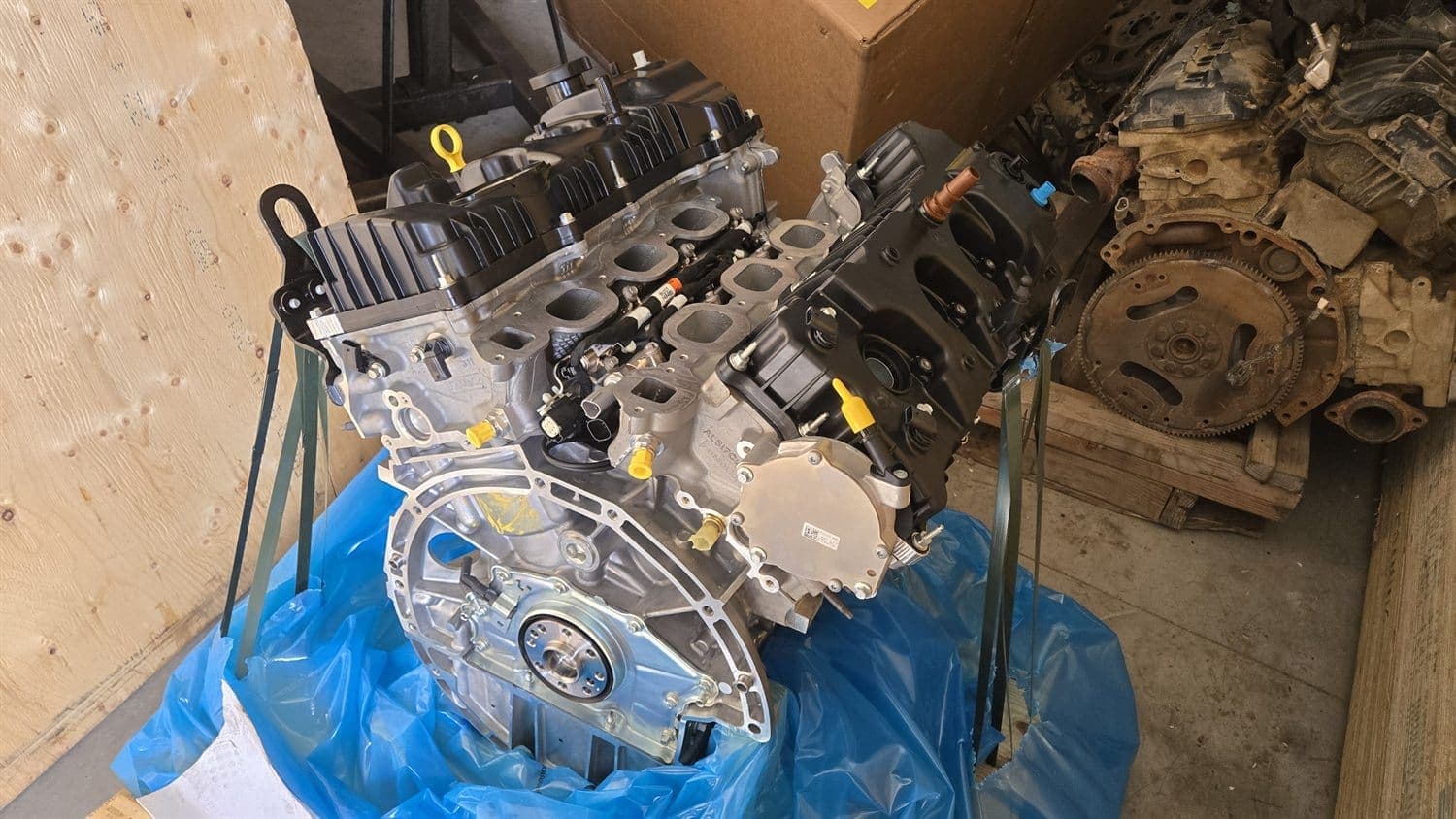
Real job from our shop
New OEM 3.5 EcoBoost engine — 2018 Ford Transit 350
- Came in:
- A 2018 Transit 350 that earns its living needed an engine — and a van like that has to stay on the road.
- We found:
- With the numbers on the table, the right call here wasn't a genuine OEM engine or a rebuild — it was a brand-new one, with factory-new internals and no unknowns.
- Result:
- Factory-fresh, factory-backed power for a work van. Brand-new is the fourth option we always put on the table alongside genuine OEM, an in-house rebuild, and remanufactured — used when the numbers make sense.
Dealing with this problem right now?
Edmonton and area: bring it in and we'll confirm the diagnosis before any work. Anywhere else in Canada or the USA: our sister company ships the genuine OEM parts to your shop.