
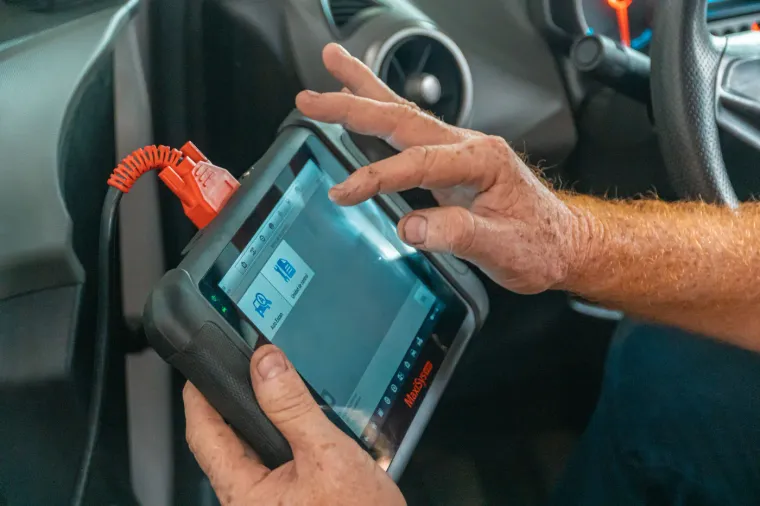
A battery that cranked fine in October can be dead in a parking lot in January — cold cuts its power right when the engine demands the most. We load test before we sell you anything, write the numbers on the invoice, and if your battery is healthy we'll tell you to keep driving it.
Batteries are the most replaced — and the most needlessly replaced — part on a winter vehicle. At 12940 53 Street NW we test first: a load and conductance test that measures what your battery actually delivers against the rating printed on its label, with the numbers written on your invoice. If it's healthy, we say so. If it's marginal, you get to choose between replacing it on your schedule or gambling on the first -35 morning. Eskimo Auto Repair Ltd is AMVIC-licensed, our techs are Red Seal, and the warranty is in writing. Call (780) 482-2424.

Cold Cranking Amps and the -40 Reality
Cold cranking amps — CCA — is the number that matters here. It's the current a battery can deliver for 30 seconds at -18 C without collapsing, and your vehicle's label sets a minimum for it. The catch is that -18 is a mild day by Edmonton standards. At -30 a battery delivers a fraction of its rated power, and at -40 less still — at the exact moment the engine needs more current than ever, because the oil has thickened to syrup and the starter is fighting it. Those two curves cross on the first hard cold snap of the season, which is why January is boost-cable season in every parking lot in the city. A battery here typically lasts four to six years; the cold doesn't so much kill batteries as expose the ones that were already dying.
We Test Before We Replace — Half of 'Dead Batteries' Aren't
Half the 'dead batteries' that come through the door aren't dead batteries. Corroded terminals and cable ends, a loose ground strap, or a charging system that quietly quit will all imitate a failed battery — and a new battery bolted onto any of those problems dies the same way within months. So we test in order: the battery itself under load, then the connections and grounds, then charging output. If your vehicle is dead every time it sits a few days, that's usually a parasitic draw — something staying awake after you walk away — and that's a diagnostic job, not a battery sale. The fall battery test is the cheap habit worth building: five minutes in October tells you whether you'll make it to spring, and replacing a battery on your schedule beats a boost and a tow on the coldest morning of the year.
Group Size, CCA Rating, AGM and Start-Stop Batteries
The right battery is more specific than most people expect. Group size has to match the tray and the terminals. The CCA rating should meet or beat what your vehicle's label calls for — in this climate there's no upside in going lower, ever. Chemistry matters too: start-stop systems and many European vehicles require an AGM battery, which costs more but is built for the deeper cycling those systems demand, and putting a standard flooded battery in an AGM application shortens its life dramatically. Many newer vehicles also need the new battery registered to the vehicle's computer so the charging strategy resets — skip that step and the vehicle slowly cooks the new battery the way it was managing the old, dying one. Diesel trucks run two batteries, and they should be replaced as a pair; a fresh battery yoked to a tired one gets dragged down to its level.
Battery Replacement Cost in Edmonton
There's no flat rate on this, so these are general market ranges, not our quote. Installed and tested, most car and light-truck batteries typically run somewhere between about $250 and $450, depending on group size and whether the vehicle takes AGM — start-stop systems and many European vehicles do, and those cost more. Diesel trucks running two batteries are higher again. Done properly, the job includes cleaning the terminals and cable ends, checking the grounds, verifying charging output afterward, and registering the battery where the vehicle requires it — because a good battery on corroded cables won't last. We test before we sell you one, and the old battery gets recycled.
Signs you need this service
- Slow, laboured cranking on cold mornings, even if it starts eventually
- A rapid clicking and dimming dash lights when you turn the key
- You've boosted it more than once in the last month
- The battery is more than four years old and hasn't been tested lately
- It started fine through fall and died on the first hard cold snap
- Corroded, crusty terminals or a case that looks swollen or bulged
- The vehicle is dead after sitting three or four days — often a draw, not the battery
- The battery light comes on while driving — that's the charging system, not the battery
What's included
- Load and conductance testing with the numbers written down — measured cold cranking amps against the label rating
- Testing before replacement: battery, cables and grounds, then charging system, in that order
- The correct group size and chemistry, including AGM and start-stop batteries
- Battery registration and computer reset on vehicles that require it
- Terminals and cable ends cleaned, grounds checked, charging output verified after installation
- Diesel dual-battery replacement as a matched pair
- Parasitic draw diagnosis when the battery keeps going flat for no obvious reason
- Old battery recycled, warranty in writing
Frequently asked questions
How much does a new car battery cost installed in Edmonton?
There's no flat rate on this, so these are general market ranges, not our quote. Installed and tested, most car and light-truck batteries typically run somewhere between about $250 and $450, depending on group size and whether the vehicle takes AGM — start-stop systems and many European vehicles do, and those cost more. Diesel trucks running two batteries are higher again. That work should include cleaning the terminals and cable ends, checking the grounds, and verifying charging output afterward, because a good battery on corroded cables won't last. We test before we sell you one.
How many cold cranking amps do I need in Edmonton?
Meet or beat the CCA minimum on your vehicle's battery label — never go under it here. The rating is measured at -18 C, and output falls steeply below that, so a battery with no margin at -18 has nothing left at -35. If a higher-CCA battery fits your group size and budget, it buys you margin in the deep cold. What extra CCA won't do is fix a charging problem or survive corroded cables, which is why we test the whole system before recommending anything.
How long do car batteries last in Edmonton?
Typically four to six years, and the winters are what decide it — cold cuts a battery's cranking power drastically right when the engine is hardest to turn. A battery rarely fails overnight; it's marginal for months and the first hard cold snap collects on it. A fall load test tells you which side of the line yours is on, and replacing it on your schedule beats a boost and a tow at -38.
How do I know it's the battery and not the alternator or starter?
Listen to what it does. No crank with dimming dash lights or fast clicking is the battery or its connections most of the time. A strong crank that never catches is fuel, spark, or the immobilizer. A whirr or grind with no engine rotation is the starter drive. A battery light on while driving, then dimming lights and a stall, is the charging system. A corroded ground can imitate all of them, which is why we test instead of swapping parts — our auto electrical page covers the full no-start triage.
Can I just keep boosting it?
A boost gets you home; it doesn't fix anything, and it tells you nothing about why the battery was flat. Repeatedly driving off on a deeply discharged battery is also hard on the alternator — it's a charging device, not a battery charger, and asking it to refill a flat battery at full output over and over is what cooks the diodes. If you're boosting more than once, get the battery load tested and the charging system checked. And never boost a battery that's frozen solid or visibly bulged.
Do you test batteries before replacing them?
Always — it's the whole point. A load test against the label rating tells us whether the battery is actually done, and testing the cables, grounds, and charging system tells us whether something else killed it. The numbers go on your invoice either way, and if the battery is healthy we'll tell you to keep driving it. A shop that tests first sells fewer batteries and keeps more customers.
Known problems we repair
Deep guides on the failures we see most — symptoms, honest costs, and repair options.
Related services
Book your car battery replacement
Call for a straight answer on cost and timing, or book online.