The short answer
GM's 5.3L V8 is one of the most common truck engines on Alberta roads, and its cylinder-deactivation system (AFM, later DFM) is behind its two best-known problems: heavy oil consumption on 2007-2014 Gen IV engines and collapsed lifters on 2014-and-newer Gen V engines. Caught early, a lifter failure is a repairable job; ignored, it wipes the camshaft and turns into an engine replacement. This guide covers the symptoms, the real causes, honest Canadian repair costs, and when a genuine OEM engine is the right call.
Symptoms, from first warning to failure
Oil level dropping between changes
On 2007-2014 Gen IV engines especially, the dipstick reads low well before the next oil change — a litre every 2,000 to 3,000 km is the classic complaint. There is often no visible leak and no blue smoke; the oil is going out the tailpipe a little at a time.
Brief tick or chirp on cold start
A light tapping from the top of the engine for the first few seconds after a cold start, fading as oil pressure comes up. Lots of these engines do this for years, but on an AFM engine it is worth keeping an ear on — a tick that starts lasting longer is how lifter trouble announces itself.
Shudder or surging as the engine switches modes
A slight vibration or hunting feel at steady highway speed as the engine drops into 4-cylinder mode and back. More noticeable on DFM (2019+) engines, which switch patterns constantly. On its own it is a refinement complaint, but a new or worsening shudder deserves a look.
Persistent lifter tick that does not fade when warm
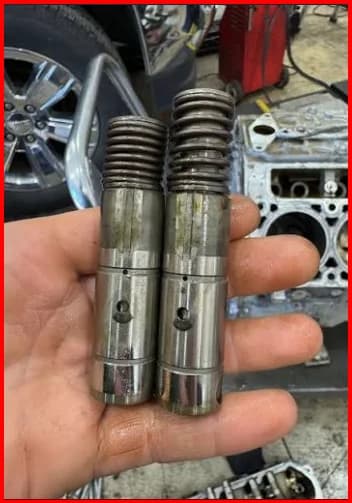
A steady tap-tap-tap that follows engine speed and stays after warm-up usually means a lifter has stopped pumping up or is starting to collapse. At this stage the camshaft may still be fine — this is the window where the repair is cheapest.
Misfire codes and a flashing check-engine light
Codes P0300 through P0308, most often on the deactivation cylinders (1, 4, 6 and 7). A collapsed AFM/DFM lifter stops opening its valve, so the cylinder goes dead. A flashing light means raw fuel is reaching the catalytic converter — get off the throttle and get it looked at.
Oil-fouled spark plugs, especially cylinders 1 and 7
On oil-burning Gen IV engines, the driver-side deactivation cylinders (1 and 7) foul first — they sit closest to the AFM relief-valve oil spray. Repeated fouling on the same cylinder is a strong clue the rings and AFM oil spray are behind the consumption, not a bad plug.
Low oil pressure warning at idle
Gen IV trucks are known for the oil pressure relief valve and pickup screen issues that pair with AFM trouble. A gauge that drops near zero at hot idle, or an oil pressure DTC, needs diagnosis before it starves the lifters and bearings.
Loud knocking or clatter from one side of the engine
A collapsed lifter that has been driven on starts hammering the pushrod and wiping the cam lobe. Once you can hear it across a parking lot, the camshaft is usually damaged and the repair bill roughly doubles.
Dead cylinder with metal debris in the oil
Glitter on the drain plug or in the filter means lifter and cam material has circulated through the bearings and oil pump. At this point patching in new lifters is risky — the engine needs to come apart, or come out.
Bent pushrod or valve not opening at all
Severe rough running, a cylinder with no compression change when unplugged, or a rocker with visible lash. Keep driving and you risk dropping a valve, which destroys the piston and head and ends any repair conversation.
Engine ran low on oil and now knocks from the bottom end
The consumption problem and the lifter problem feed each other: an engine quietly burning oil runs low, oil pressure falls, and lifters and bearings die together. A deep, rhythmic bottom-end knock after running low is almost always a replacement engine.
Affected models
| Model | Years | Notes |
|---|---|---|
| Chevrolet Silverado 1500 / GMC Sierra 1500 | 2007–2013 | Gen IV Vortec 5300 with AFM (LC9, LMG, LY5, LH6). Oil consumption is the headline problem, worst on 2010-2013 engines with the LC9/LMG and VVT; AFM lifter failures happen too. The US class action covered 2011-2014 LC9 vehicles. |
| Chevrolet Silverado 1500 / GMC Sierra 1500 | 2014–2018 (plus 2019 Silverado LD / Sierra Limited carryover) | Gen V EcoTec3 L83 with AFM. Oil consumption largely fixed, but collapsed AFM lifters are the known failure — often one dead cylinder with a P0300-series misfire. |
| Chevrolet Silverado 1500 / GMC Sierra 1500 | 2019–present | Gen V L84 with Dynamic Fuel Management (DFM). Lifter failures are the dominant complaint, with a well-documented cluster in trucks built roughly late 2020 to early 2021, some failing under 20,000 km. No recall as of mid-2026. |
| Chevrolet Tahoe / GMC Yukon | 2007–2014 | Gen IV AFM engines; same oil consumption and lifter pattern as the GMT900 pickups. Named in both the US and (discontinued) Canadian class actions. |
| Chevrolet Suburban / GMC Yukon XL | 2007–2014 | Gen IV AFM; identical story to Tahoe/Yukon. Heavy holiday-trailer duty masks oil use — check the dipstick, not just the oil-life monitor. |
| Chevrolet Tahoe / Suburban / GMC Yukon / Yukon XL | 2015–2020 | Gen V L83 with AFM — collapsed-lifter risk, low oil-burning risk. |
| Chevrolet Tahoe / Suburban / GMC Yukon / Yukon XL | 2021–present | Gen V L84 with DFM; shares the 2021-build lifter failure cluster with the pickups. The related 6.2L L87 in these SUVs and the Escalade has the same lifter design and its own well-known problems. |
| Chevrolet Avalanche | 2007–2013 | Gen IV AFM 5.3L throughout; oil consumption complaints mirror the Silverado. Production ended in 2013. |
What actually goes wrong
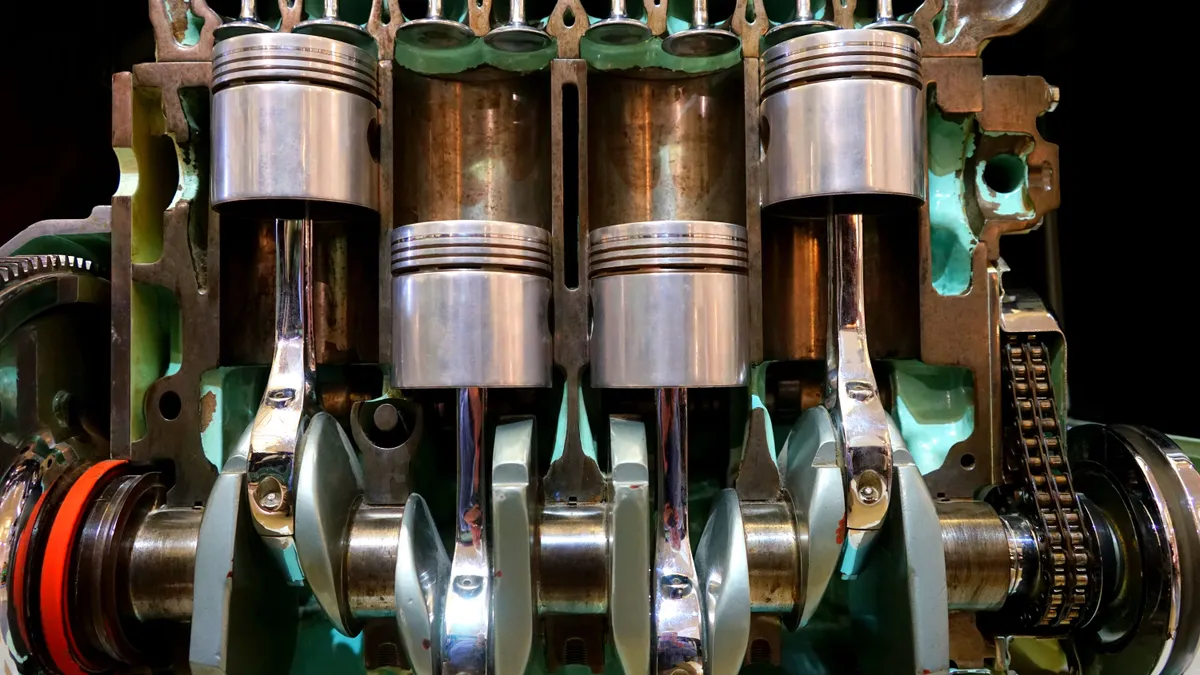
Active Fuel Management (AFM) — GM's name for cylinder deactivation, sometimes called Displacement on Demand — shuts off cylinders 1, 4, 6 and 7 under light load so the truck sips fuel like a V4. It does this with special two-piece lifters that collapse on command: an oil-pressure signal from a valve lifter oil manifold (VLOM) releases a locking pin inside the lifter, the lifter telescopes, and the valves for that cylinder stay shut. In 2019 GM replaced AFM with Dynamic Fuel Management (DFM), which uses electro-hydraulic lifters on all cylinders and can run 17 different deactivation patterns, switching many times a second. Clever engineering, real fuel savings — and a lot of extra moving parts in the one place a pushrod V8 used to be nearly indestructible.
On the Gen IV Vortec 5300 (2007-2014), the main casualty was oil. GM paired AFM with low-tension piston rings, and the AFM system's oil pressure relief valve sprays oil at the underside of the pistons. The rings gum up with carbon, lose their seal, and the engine starts burning oil — commonly a litre every 2,000 to 3,000 km by 120,000 km or so, with no leak to be found. The PCV system pulls still more oil vapour into the intake. Burned oil fouls plugs (cylinders 1 and 7 are the usual suspects), and owners who trusted the oil-life monitor instead of the dipstick sometimes ran the crankcase low enough to take out lifters and bearings. GM added an oil deflector shield to production engines in early 2011, with a service bulletin retrofit (plus piston and ring replacement) for earlier engines; the fully redesigned pistons and rings arrived with the Gen V engine that replaced this design in the 2014 pickups.
On the Gen V EcoTec3 (L83 from 2014, L84 with DFM from 2019), the ring problem was largely engineered out, but the deactivation lifters themselves became the weak point. The internal locking pins wear or stick, the lifter collapses and stays collapsed, and that cylinder's valve stops opening — instant dead cylinder and a P0300-series misfire. Because a collapsed lifter no longer follows the cam properly, its roller can skid and wipe the cam lobe within a surprisingly short time. DFM made the odds worse simply by cycling the mechanism far more often. The most concentrated run of failures hit L84 5.3L and L87 6.2L engines built from roughly September 2020 to March 2021 — some failed with under 20,000 km on the odometer — but complaints span the whole 2019-and-later range, and the earlier L83 is far from immune.
The failure snowballs, which is why early action matters. A ticking lifter caught in the first weeks is a lifters-and-gaskets job. Driven on, it bends pushrods, wipes the cam lobe, and sheds hardened steel into the oil, which then circulates through the bearings and oil pump. At that point the honest options narrow to a full teardown or a replacement engine. GM's own service bulletins (the long-running misfire/tick bulletin 15-06-01-002F and its successors) have dealers replace failed AFM lifters — typically the whole bank, often the full set — and inspect the cam. There has never been a recall for either the oil consumption or the lifters, on either side of the border.
The legal history tells you where you stand as a Canadian owner: on your own. In the US, the Siqueiros class action over the Gen IV LC9's oil consumption went to trial in 2022, the jury awarded class members US$2,700 each, and a settlement in the range of US$150 million received final approval in October 2025 — but it covered owners in only three US states. A parallel Canadian class action (filed in Ontario against GM Canada, naming 2010-2013 Silverado/Sierra and 2010-2014 Tahoe, Suburban, Yukon and Yukon XL among others) was discontinued, and GM is not providing any benefit to Canadian 5.3L owners. GM has offered goodwill and extended component coverage to some newer-truck owners after repeat lifter repairs, but it is case-by-case, not a program you can count on.
That leaves the disable-or-delete question every 5.3 owner eventually asks. Three honest options. A plug-in AFM/DFM disabler (Range, Pulsar and similar, roughly $300-500) keeps the engine in V8 mode using the truck's own logic — no permanent change, unplug it before a dealer visit, and it stops the constant lifter cycling, though it cannot un-wear parts that are already failing. A tune that switches off deactivation does the same thing in software. A full mechanical AFM delete — non-AFM cam and standard lifters, VLOM blocked off, custom tune — only makes economic sense when the engine is already apart for a lifter job, and you should know it modifies factory emissions equipment: Alberta has no emissions testing, but a delete is technically not emissions-compliant and will void related warranty coverage. Plenty of high-km Alberta trucks run deleted and happy; just make the choice with your eyes open.
How the failure happens
Hover the diagram — or tap a part below — to see what it does and how it fails.
What it costs to fix
Typical ranges in Canadian dollars — every vehicle is quoted individually.
Monitor and manage
$100–$400 per year
For a Gen IV engine that burns oil but runs well: check the dipstick every couple of fill-ups, top up with the correct dexos-approved oil, and shorten oil-change intervals to 5,000-8,000 km. Not a fix, but many of these engines cover another 100,000 km this way for the cost of top-up oil.
AFM/DFM disabler or disable tune
typically $300–$700
A plug-in disabler ($300-500) or a tune that locks the engine in V8 mode. Reduces lifter cycling and the mode-switch shudder, and on Gen IV engines cuts the AFM oil spray events. Cheap insurance on a healthy engine; it will not save lifters that are already failing.
Single-bank lifter replacement
typically $2,500–$4,500
Caught early, with a healthy camshaft: replace the lifters (and usually the VLOM gaskets and head gasket on that side) on the affected bank. Dealers often quote toward the top of this range or above. Many owners do both banks while the engine is open — the labour overlap makes it far cheaper than a second visit.
Full lifter set, camshaft, and optional AFM delete
typically $4,500–$8,000
When the cam lobe is wiped or you want the problem gone for good: all 16 lifters, new camshaft, gaskets, and — if you choose — a delete kit and tune so the failure mode is removed entirely. The delete parts add relatively little once everything is already apart.
Genuine OEM replacement engine, installed (through Eskimo Auto & Truck Parts)
typically $4,000–$8,500 installed; the engine itself often $1,000–$4,500
A tested low-km takeout engine is usually the right call once metal has circulated or the engine is worn out. Gen IV 5.3s are plentiful; Gen V L83/L84 engines are less common but readily sourced. Eskimo Auto & Truck Parts in Edmonton stocks genuine OEM 5.3L engines and ships across Canada and the USA.
Remanufactured or new crate engine (installed)
typically $9,000–$14,000+
A reman long block with a multi-year warranty, or a GM crate engine, plus installation. The right call for a newer truck you plan to keep a long time, or where the buyer wants zero-km internals — but on a 250,000 km work truck the math rarely beats a good genuine OEM engine.
Repair it, or replace it?
Under about 150,000 km with a tick caught early and no metal in the oil: repair. A lifter job (ideally both banks) on an otherwise healthy engine is money well spent, and it is the right moment to decide on an AFM delete or a disabler so you are not back in two years.
150,000-250,000 km with a wiped cam lobe: get quotes both ways before committing. A cam-and-lifters job at $5,000-8,000 is buying you a repaired 200,000 km engine; a tested lower-km genuine OEM engine installed can land in the same range and resets the whole clock — rings, bearings, timing components and all.
Any engine where debris has circulated — glitter in the filter, knock from the bottom end, or a lifter that ran collapsed for months: replace, don't patch. New lifters fed by a contaminated oil pump and scored bearings is how people pay for the same job twice.
A Gen IV (2007-2014) burning oil heavily: almost never worth opening up for rings. The proper fix is pistons-out machine work that costs more than the truck's engine bay deserves. Either manage it with top-ups and a disabler, or drop in a genuine OEM engine when it gets tiresome.
Past 250,000 km — which is a normal Alberta truck, not a worn-out one — put money into a replacement engine rather than open-heart surgery on tired internals. These trucks hold their value here, so a $5,000-7,000 genuine OEM engine swap on a truck worth $15,000-25,000 usually pencils out easily against payments on a new one.
Whatever route you choose, deal with it promptly. The gap between 'ticking lifter' and 'needs an engine' is often a few thousand kilometres of highway driving, and the price difference is several thousand dollars.
How we fix this in Edmonton
Engine Repair & Replacement in Edmonton
A bad engine doesn't automatically mean a new vehicle. We diagnose before we condemn — and then we can fix it every way there is: rebuild it in-house, install a remanufactured ATK engine, or fit a genuine OEM engine sourced through our sister company, Eskimo Auto & Truck Parts.
See the service →Engine Rebuild in Edmonton
A rebuild is your own engine taken apart, measured, machined back to specification and put together with its weak points corrected. We tear it down first, then give you a firm quote that itemises the work, and an honest answer on whether your vehicle is worth it.
See the service →Vehicle Diagnostics & Check Engine Light in Edmonton
A trouble code tells you what the computer noticed, not what is broken. We read the codes, look at live data, and test the actual circuit before anything gets replaced. Diagnostic time is $120 an hour, quoted before we start, because the most expensive repair is the one that didn't fix the problem.
See the service →The genuine OEM parts option
If the math points to a replacement engine, this is exactly what our sister company is for. Eskimo Auto & Truck Parts is one of Edmonton's largest parts operations with a steady supply of GM trucks and SUVs coming through — which means genuine OEM 5.3L engines across the Vortec and EcoTec3 generations, sourced from western Canadian vehicles and sold with the kilometres documented. A genuine OEM takeout engine is the same factory engine your truck left the line with, so there are no fitment surprises. They ship across Canada and the USA, and they carry the rest of the driveline too — transmissions, transfer cases, cylinder heads and more — so a shop anywhere in the country can source the whole job from one supplier. Tell them the year, model and engine RPO code, and they can match you up.
Browse inventory at Eskimo Auto & Truck Parts →How to make yours last longer
- Check the dipstick every second fuel fill, and always before a highway trip or towing. Most catastrophic 5.3 failures started as unnoticed low oil, not as a sudden break.
- Ignore the oil-life monitor's optimism and change oil every 5,000-8,000 km with the correct dexos-approved grade (0W-20 on most Gen V, 5W-30 on Gen IV) and a quality filter. Clean oil at full level is the single best defence AFM lifters have.
- Consider an AFM/DFM disabler on a healthy engine. Keeping the engine in V8 mode stops the constant collapse-and-lock cycling that wears the lifter pins, and on Gen IV engines reduces the oil-spray events behind ring fouling.
- Investigate any new tick, shudder or misfire within days, not months. A one-bank lifter job and a cam-and-engine-out job are separated mostly by how long the noise was ignored.
- On Gen IV engines, keep the PCV system clean and fix fouling plugs on cylinders 1 and 7 promptly — both slow down the carbon build-up that accelerates oil burning.
- Avoid long idling where practical. Deactivation systems spend more time cycling at light load, and idle hours are hard on marginal oil pressure in these engines.
Frequently asked questions
Which years of the GM 5.3 have lifter and oil consumption problems?
Two distinct problems. The 2007-2014 Gen IV Vortec 5300 (Silverado, Sierra, Tahoe, Yukon, Suburban, Avalanche) is the oil burner — worst in the 2010-2013 trucks and 2010-2014 SUVs. The 2014-and-newer Gen V EcoTec3 (L83 with AFM to 2018-2020 depending on model, L84 with DFM after) mostly fixed the oil burning but is known for collapsed lifters, with the heaviest cluster in 2019-2021 trucks and 2021 SUVs — notably engines built from late 2020 to early 2021. No year of AFM/DFM 5.3 is completely exempt.
Is there a recall for GM 5.3 lifter failure or oil consumption?
No. GM has never recalled the 5.3L for either issue, in Canada or the US. There are long-running service bulletins telling dealers how to replace failed AFM lifters, and GM has extended component coverage for some individual owners after repeat lifter repairs, but that is goodwill, not a recall. If your truck is within its base or powertrain warranty, the repair is covered — push for the full set of lifters, not just the failed one.
Was there a class action, and does it help Canadian owners?
In the US, the Siqueiros class action over Gen IV 5.3L oil consumption went to a jury in 2022, which awarded US$2,700 per class member; a settlement in the range of US$150 million got final approval in October 2025 — but only for owners in California, Idaho and North Carolina. A similar Canadian class action against GM Canada, covering 2010-2013 Silverado/Sierra and 2010-2014 Tahoe/Suburban/Yukon among others, was discontinued. Canadian owners received nothing and pay for their own repairs.
How much does it cost to fix AFM lifters in Canada?
At an independent shop, replacing the lifters on one bank with a healthy camshaft typically runs $2,500-4,500 depending on the vehicle and what is found inside; dealers usually quote more. If the cam is damaged or you do all 16 lifters plus a cam, expect roughly $4,500-8,000. It is heavy labour — the intake, heads-adjacent hardware and front of the engine all come apart — which is why doing it once, thoroughly, beats doing it twice.
Can I keep driving with a collapsed lifter?
Short answer: no. The engine will run on seven cylinders, but the collapsed lifter is skidding on its cam lobe and hammering the valvetrain, and raw fuel from the dead cylinder is cooking the catalytic converter. Every week of driving raises the odds that a $3,000 lifter job becomes a $6,000-8,000 cam job or a replacement engine. If the check-engine light is flashing, treat it as a tow-or-limp-home situation, not a drive-it-till-payday one.
Does an AFM disabler actually prevent lifter failure?
It removes the biggest aggravating factor. A disabler keeps the engine in V8 mode, so the deactivation lifters stop collapsing and re-locking thousands of times per tank of fuel — and on Gen IV engines it also reduces the oil-spray events that foul rings. It cannot repair wear that already exists, and lifters can still fail for other reasons. Think of it as cheap prevention on a healthy engine ($300-500, plugs into the OBD port, fully reversible), not a cure for one that is already ticking.
Should I delete the AFM system entirely?
Only when the engine is already open for a lifter or cam job — then the extra parts (standard lifters, non-AFM cam, VLOM block-off, tune) add relatively little and remove the failure mode permanently. Be aware of the trade-offs: a mechanical delete alters factory emissions-related equipment, which is technically non-compliant even though Alberta has no emissions testing, and it will end any warranty argument on the engine. On an out-of-warranty work truck being repaired anyway, it is a defensible, popular choice. On a warrantied truck, use a disabler instead.
How much oil consumption is normal on a 5.3?
GM's own guideline over the years has treated roughly a litre per 3,000 km as within limits, which many owners consider generous. A healthy Gen V 5.3 should use noticeably less than that between changes. If your Gen IV is using a litre every 2,000-3,000 km with no visible leak, you have the classic ring/AFM consumption pattern — it can be managed with diligent top-ups, but it will not improve on its own.
Is the 5.3 worth keeping, or should I get rid of the truck?
The 5.3 is fundamentally a good, simple pushrod V8 — millions have passed 300,000 km, and the ones that die young usually die of AFM-related causes that are preventable or fixable. If the truck is otherwise solid, fixing the engine (or dropping in a genuine OEM one) is nearly always the sounder move than replacing the truck in today's market. The exception is a rusty or tired truck needing an engine plus other major work — that is when the genuine OEM engine quote helps you decide honestly.
Genuine OEM engine or remanufactured — which makes more sense?
For most higher-km Alberta trucks, a tested genuine OEM takeout engine is the sensible choice: typically $1,000-4,500 for the engine depending on generation and kilometres, and it is the exact factory engine your truck came with. A reman ($9,000-14,000+ installed) makes sense on a newer truck you intend to keep for many years, since you get zero-km internals and a longer warranty. Ask what the genuine OEM engine's kilometres are and whether it came from a rust-free western vehicle — provenance matters.
Dealing with this problem right now?
Edmonton and area: bring it in and we'll confirm the diagnosis before any work. Anywhere else in Canada or the USA: our sister company ships the genuine OEM parts to your shop.