
The short answer
If your 2004-2010 Ford F-150, Expedition or Navigator with the 5.4L Triton clatters like a diesel for a few seconds on a cold morning, you are almost certainly hearing worn cam phasers — the single most common failure on the 3-valve version of this engine. Caught early, it can sometimes be managed cheaply. Ignored, it hammers away at the timing chains, guides and camshafts until the bill roughly doubles. This guide explains what actually fails, what the fix typically costs in Canada, and when a genuine OEM engine makes more sense than a timing job.
Symptoms, from first warning to failure
Loud rattle or knock on cold start that fades after a few seconds
This is the famous Triton "death rattle": a harsh, diesel-like clatter from the front of the engine for roughly two to ten seconds after a cold start, which quiets down once oil pressure builds. It happens because the worn phaser can't hold the camshaft steady until pressurized oil arrives. Many trucks make this noise for months or years before it gets worse, which is exactly why owners learn to ignore it — and exactly why they shouldn't.
Ticking or light knock at hot idle
Hot oil is thin oil, and oil pressure on these engines drops noticeably at idle when fully warmed up. A tick or knock that shows up idling at a red light on a summer day, then disappears the moment you touch the throttle, points at the phasers not getting enough pressure to stay pinned. It often shows up alongside the cold-start rattle.
Check engine light with cam timing codes
Codes P0011, P0012, P0021 or P0022 (camshaft position over-advanced or over-retarded, bank 1 or bank 2) are the classic phaser codes, sometimes joined by P0016 or P0018 cam/crank correlation codes as the chains wear. The computer is telling you it commanded a cam position and the phaser didn't deliver it. A scan tool showing actual cam timing wandering away from desired timing is one of the more reliable ways to confirm the diagnosis.
Rough idle, hesitation and lost power
When the computer sees cam timing it can't control, it stops trying and defaults the timing. The truck still drives, but it idles rough, hesitates on throttle tip-in, pulls weaker under load and burns more fuel. If your 5.4 feels lazy and rattles, those two things are usually the same problem.
Rattle that no longer goes away
A knock that follows engine speed and continues after warm-up means the phaser is loose enough to hammer constantly, not just at low oil pressure. At this stage every kilometre is grinding the phaser, chains and guides against each other. The repair is the same as it was six months earlier — it just needs more parts now. Get it in a shop soon.
Metal flake in the oil or on the drain plug
Fine glitter in the drain oil or fuzz on a magnetic drain plug means the phasers, chains, guides or cam followers are shedding metal, and that metal is circulating through the bearings and clogging the small oil screens that feed the VCT system. Once an engine is eating itself, the conversation shifts from a timing job toward a replacement engine, so this finding changes the math.
Stalling, misfires or limp mode
In the end stage, cam timing gets erratic enough that the engine misfires, stalls at idle or drops into reduced-power mode. Badly stretched chains and worn guides can eventually let the engine jump time. A 5.4 that has reached this point should be towed, not driven, and needs a compression check before anyone quotes a timing job.
Affected models
| Model | Years | Notes |
|---|---|---|
| Ford F-150 | 2004-2010 | The highest-volume victim. The 3-valve 5.4L arrived with the redesigned 2004 F-150 and was the mainstream engine through 2010. The 2004-2008 trucks fail most often; 2009-2010 got revised heads and updated phaser hardware and hold up better, but they are not immune. |
| Ford F-250 / F-350 Super Duty (gas) | 2005-2010 | Same 3-valve 5.4L as the F-150, working harder. Plow trucks and trailer haulers that idle a lot are well represented in the failure pool. |
| Ford Expedition | 2005-2014 | The Expedition kept the 3-valve 5.4L for years after the F-150 moved on, so even the last 2014s carry the same phaser design and the same risk. |
| Lincoln Navigator | 2005-2014 | Mechanically the same engine as the Expedition. A luxury badge does not change the timing hardware or the repair bill. |
| Lincoln Mark LT | 2006-2008 | An F-150 in a suit — identical 5.4L 3V engine, identical failure pattern. |
| 4.6L 3V models: Mustang GT, Explorer, Mountaineer, F-150 | 2005-2010 | The 4.6L 3-valve (Mustang GT 2005-2010, Explorer/Mountaineer 2006-2010, F-150 2009-2010) uses the same variable cam timing design and can develop the same phaser rattle, though it fails less often than the 5.4L. |
| F-150, Expedition, Navigator 3.5L EcoBoost | 2017-2020 | Newer trucks too: the 3.5L EcoBoost has its own well-documented cold-start cam phaser rattle. Ford issued TSBs and Customer Satisfaction Program 21N03 covering phaser replacement on 2017-2020 F-150s and 2018-2020 Expedition/Navigator. Different engine, different parts, similar noise — worth knowing if you traded a Triton for an EcoBoost. |
What actually goes wrong
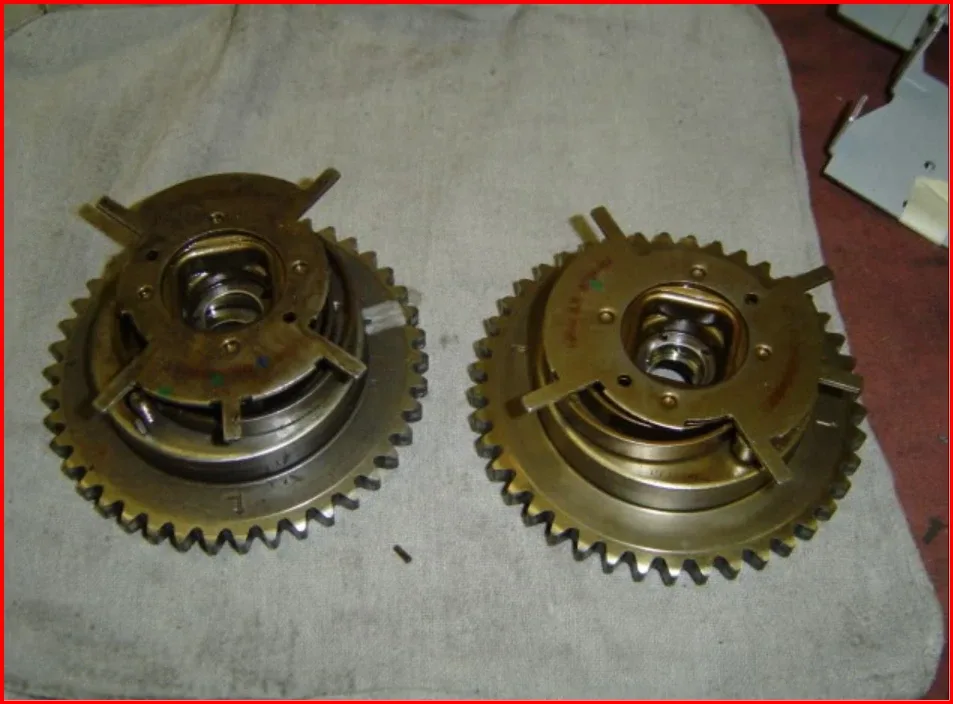
Start with what a cam phaser is. When Ford redesigned the 5.4L for 2004, it added variable camshaft timing to the new 3-valve heads. On the end of each camshaft sits a phaser — a sprocket with an internal set of oil-driven vanes that lets the computer rotate the camshaft slightly relative to the timing chain while the engine runs. Advance the cams for low-end torque, retard them for cleaner emissions and better economy. It is a good idea, and nearly every modern engine uses some version of it. Ford's problem was execution: the 3V phaser design depends completely on a steady supply of clean, pressurized oil, and it is not forgiving when it doesn't get it.
At idle and at start-up, oil pressure is at its lowest, so a spring-loaded locking pin is supposed to hold the phaser in a fixed position until there is enough pressure to control it properly. Over time the vanes and the lock pin bore wear, the pin no longer seats or holds, and the camshaft is left free to flop back and forth inside the phaser with every valve-spring pulse. That hammering is the rattle you hear. It shows up first on cold starts and at hot idle for the same underlying reason: not enough oil pressure at the phaser to take up the slack that wear has created.
Oil is where most of these failures start. The 5.4L 3V calls for 5W-20, runs tight clearances, and feeds the phasers through small passages and fine screens on the variable-timing solenoids. Stretch the oil change interval, run the level a litre low, or let sludge build up, and those screens clog while the pressure the phasers see drops. Worn oil pumps and hot idle make it worse. This is why two identical trucks can have completely different lives: the one that got fresh oil every 5,000-8,000 kilometres often reaches high mileage quietly, while the one that got gas-station oil changes twice a decade rattles at 150,000 km.
The failure doesn't stay contained. A loose phaser hammers the timing chains; the chains stretch and beat on their plastic guides; the tensioners run out of travel trying to compensate. The cam followers and lobes wear as the valvetrain slops around. Left long enough, the debris circulates through the engine and the chains get loose enough to jump timing. This cascade is why the honest fix is never "replace the phasers" alone — by the time a phaser is noisy, the chains, guides, tensioners and usually the VCT solenoids are due, and any competent quote reflects that.
Ford knew. It revised the phaser and tensioner design several times through the production run and released multiple service bulletins about cold-start and idle noise on the 3-valve engines, but it never issued a recall or an extended-coverage program for the 5.4L phasers — every repair outside the basic warranty landed on the owner. The 2009-2010 updates genuinely helped, which is why the late trucks have a better reputation, but the fundamental sensitivity to oil pressure and maintenance never went away. As a side note, when Ford's newer 3.5L EcoBoost developed its own phaser rattle, the company did offer a program (21N03) — small comfort to Triton owners.
One more thing a shop should look at while diagnosing a rattling 3V: the spark plugs. The 2004-2007 5.4L 3V used a two-piece Motorcraft plug that carbons up below the seat and is notorious for snapping off in the head during removal — Ford wrote an entire bulletin (TSB 08-7-6) on how to extract the broken halves. That is a different problem from the older 2-valve 5.4L (1997-2003), which was known for spitting plugs out of stripped threads. If your 3V still has its original plugs, budget for careful removal, and have it done before they seize further. It has nothing to do with the phasers mechanically, but it is the other big-ticket surprise these engines spring on owners, and it is worth pricing into any keep-or-sell decision.
How the failure happens
Hover the diagram — or tap a part below — to see what it does and how it fails.
What it costs to fix
Typical ranges in Canadian dollars — every vehicle is quoted individually.
Proper diagnosis and oil service
$150 - $450 CAD
A shop confirms the noise is phasers and not an exhaust leak, loose flexplate or worn follower: listening with a stethoscope, watching commanded-versus-actual cam timing on a scan tool, and checking mechanical oil pressure. Fresh oil in the correct 5W-20 weight sometimes quiets a very early rattle. This step doesn't fix worn phasers, but it stops you from paying for the wrong repair.
VCT solenoid replacement
$400 - $900 CAD
The two variable-timing solenoids have fine screens that clog with sludge. If the phasers themselves are still healthy, new solenoids and clean oil can genuinely resolve timing codes and light noise. An honest shop presents this as a worthwhile gamble on a lightly rattling engine, not a guaranteed fix — if the phasers are worn, the noise comes back.
Full cam phaser and timing job
$2,800 - $4,800 CAD
The real fix: both phasers, both chains, guides, tensioners and VCT solenoids, typically 10 to 12 hours of labour because the front of the engine comes apart. Many shops recommend an oil pump while they're in there. Dealer quotes with all-Motorcraft parts can run higher, sometimes past $5,500. Done properly with quality parts, this resets the whole timing system for another long run.
Phaser lockout kit
$2,000 - $3,400 CAD
Lockout kits replace the phasers with fixed sprocket hardware, deleting variable cam timing entirely. The teardown and most of the labour are the same; the parts are cheaper. The trade-offs are real: a permanent check-engine light unless the computer is tuned, rougher cold running, and reduced low-end torque and economy. Reasonable for a farm or yard beater you intend to run into the ground, hard to recommend for a truck you plan to keep or resell.
Genuine OEM replacement engine, installed (through Eskimo Auto & Truck Parts)
$4,500 - $7,500 CAD
A complete genuine OEM 5.4L 3V typically runs $1,200 to $2,800 depending on mileage and year, plus 12 to 16 hours of swap labour, fluids and gaskets. Through our sister company, Eskimo Auto & Truck Parts in Edmonton, we source compression-tested engines from insurance write-offs — often lower-kilometre engines than the one you're replacing. When the original engine has metal in the oil or weak compression, this is usually the more reliable choice than a timing job on a worn engine.
Remanufactured engine, installed
$8,500 - $13,000 CAD
A reman long block with updated phasers, new chains and a multi-year warranty is the closest thing to a new engine. On a work truck earning its keep it can pencil out; on a 300,000 km personal truck it usually costs more than the vehicle is worth, which is why most owners land on the genuine OEM engine option instead.
Repair it, or replace it?
The first question isn't the phasers — it's the rest of the engine. Before anyone spends $3,000-plus on a timing job, the engine should pass a compression test, show clean oil with no metal, and not be burning oil at a serious rate. On a 5.4 that checks out, the full phaser-and-timing repair is genuinely worth doing: it replaces every wear item in the timing system at once, and a well-maintained 3V with fresh timing components can run a long time afterward. The trap to avoid is the cheap version of the job — new phasers bolted to a stretched chain and worn guides. That repair rattles again within a year or two, and you pay the 11 hours of labour twice.
The math changes on a tired engine. If the truck has 300,000 km, drinks a litre of oil between changes, shows glitter on the drain plug or posts weak compression on a cylinder or two, a timing job is expensive life support for a bottom end that's already on its way out. At that point a good genuine OEM engine costs roughly the same as — or modestly more than — the timing repair, and it resets everything: phasers, chains, gaskets, compression. This is where having one of Edmonton's largest parts operations in the family matters: we can often source a tested genuine OEM 5.4L 3V with fewer kilometres than the engine coming out, which turns a borderline repair decision into a straightforward one.
Then weigh the truck, not just the engine. Clean 2004-2010 F-150s and Expeditions in Alberta still sell for real money, and a paid-off work truck you know the history of is cheap transportation even after a $4,000 to $6,000 engine decision — compare that against payments on a $30,000-plus replacement used truck with its own unknown problems. On the other hand, if the truck also needs a transmission, brake lines and a box floor, putting the price of the truck into the engine rarely ends well. An honest shop will tell you which side of that line you're on before starting work.
Whichever way you go, deal with the noise early. The single most expensive version of this failure is the ignored one: a rattle that ran for two years, wore the chains into the guides, filled the oil with debris and took the cam followers with it. That owner pays for a genuine OEM engine when six months sooner they'd have paid for phasers. If your 5.4 has started making the cold-start clatter, the cheapest time to fix it is now.
How we fix this in Edmonton
Engine Repair & Replacement in Edmonton
A bad engine doesn't automatically mean a new vehicle. We diagnose before we condemn — and then we can fix it every way there is: rebuild it in-house, install a remanufactured ATK engine, or fit a genuine OEM engine sourced through our sister company, Eskimo Auto & Truck Parts.
See the service →Vehicle Diagnostics & Check Engine Light in Edmonton
A trouble code tells you what the computer noticed, not what is broken. We read the codes, look at live data, and test the actual circuit before anything gets replaced. Diagnostic time is $120 an hour, quoted before we start, because the most expensive repair is the one that didn't fix the problem.
See the service →Remanufactured Engines in Edmonton
The engine is condemned and now you have to decide what goes back in. On a vehicle worth keeping, a remanufactured unit is often the answer: we supply and install ATK engines, and the 4-year no-fault warranty is included in the price rather than sold on top of it. Full terms on this page.
See the service →The genuine OEM parts option
One reason we can quote 5.4L Triton work more confidently than most: our sister company, Eskimo Auto & Truck Parts, is one of Edmonton's largest parts operations and ships across Canada and the USA. When a timing job doesn't make sense, we can source a complete genuine OEM 5.4L 3V — compression-tested, often with fewer kilometres than the engine coming out — and the same goes for transmissions, transfer cases and body parts these trucks eventually need. The parts side and the shop work off the same inventory, so you get the right part fast and one team standing behind the whole job. If you're outside Edmonton, Eskimo Auto & Truck Parts ships genuine OEM engines and parts to shops and owners anywhere in the country.
Browse inventory at Eskimo Auto & Truck Parts →How to make yours last longer
- Change the oil every 5,000 to 8,000 km with a quality 5W-20 synthetic and a good filter. Nothing protects the phasers more than clean oil at full pressure, and nothing kills them faster than stretched intervals and sludge. There is no such thing as lifetime oil.
- Check the oil level monthly. Many higher-mileage 5.4s quietly burn or seep oil, and a level that's a litre or two low drops the pressure the phasers depend on. A $30 top-up habit prevents a $4,000 repair.
- Take the first cold-start rattle seriously. Phaser wear is progressive — a truck diagnosed at the two-second-rattle stage needs far fewer parts than one that hammered for two years.
- Avoid long idling where you can. Hot idle is the lowest-oil-pressure condition the engine sees, and trucks that idle for hours — plow trucks, job-site trucks — wear phasers noticeably faster.
- If your 2004-2007 3V still has its original two-piece spark plugs, have them changed by a shop that knows the TSB 08-7-6 procedure, on a cold engine, before they seize any tighter. Waiting makes extraction more likely, not less.
- Buying used? Show up before the seller has warmed the truck and listen to a stone-cold start. Ten seconds of clatter is a $3,000 to $5,000 negotiating point — or your cue to walk away.
Frequently asked questions
What does 5.4 Triton cam phaser failure sound like?
A harsh metallic clatter or knock from the top front of the engine — most owners say it sounds like a diesel. Early on it lasts a few seconds after a cold start and disappears once oil pressure builds; later it shows up at hot idle too, and eventually it never goes away. A rattle that changes with engine speed and fades above idle is the classic signature.
Can I keep driving with bad cam phasers?
For a while, yes — plenty of people do — but every start and every idle hammers the chains, guides and camshafts a little more. What starts as a phaser-and-chain job can grow into worn cam followers, metal in the oil and, in the worst cases, an engine that jumps time. If the noise is constant, the truck stalls, or you see metal in the oil, stop driving it.
Will thicker oil fix the cam phaser knock?
Sometimes running a heavier oil quiets the noise for a while, because thicker oil holds a bit more pressure at hot idle. But it's masking wear, not repairing it, and the engine was designed around 5W-20 flow — very heavy oil can actually slow delivery to the phasers on cold starts. Treat a rattle that quiets with thicker oil as confirmation of the diagnosis, not a fix.
How much does cam phaser replacement cost in Canada?
A proper job — both phasers plus chains, guides, tensioners and VCT solenoids — typically runs $2,800 to $4,800 CAD at an independent shop, driven mostly by 10 to 12 hours of labour. Dealer quotes often land higher. Quotes far below that range usually mean the chains and guides are being reused, which is how you pay for the same job twice.
Are cam phaser lockout kits a good idea?
They're the budget endgame: fixed sprockets replace the phasers, eliminating the failure point but also deleting variable cam timing. Expect a permanent check-engine light unless the computer is tuned, rougher cold running and some lost low-end torque and fuel economy. On a work beater you'll never sell, it's defensible. On a truck you care about, spend the extra on proper phasers.
Which years of the 5.4 Triton are worst for cam phasers?
The 2004-2008 3-valve engines fail most often, with the earliest years generally worst. Ford's 2009-2010 updates to the heads and phaser hardware helped, and the later Expeditions and Navigators (which kept the 5.4L 3V through 2014) benefit from the revisions — but no 3-valve Triton is immune, especially with stretched oil changes.
Was there ever a recall for 5.4 cam phasers?
No. Ford issued service bulletins about the noise but never a recall or extended coverage for the 5.4L 3V phasers, so repairs outside basic warranty have always been owner-paid. Confusingly, Ford did run a program — Customer Satisfaction Program 21N03 — for cam phaser rattle on 2017-2020 F-150s and 2018-2020 Expedition/Navigator with the 3.5L EcoBoost. That's a different engine, and that coverage window has since closed for most owners.
Does the 4.6L 3-valve have the same cam phaser problem?
It can. The 4.6L 3V used in the 2005-2010 Mustang GT, 2006-2010 Explorer and 2009-2010 F-150 shares the same variable-cam-timing design and shows the same cold-start rattle, though at a lower rate than the 5.4L. The diagnosis, repair and costs are similar. The same oil-change advice applies.
Is a genuine OEM engine a better choice than fixing the phasers?
If the engine is otherwise healthy, no — the timing job is usually the right call. But on a high-kilometre engine that's burning oil, showing metal in the pan or losing compression, a tested genuine OEM 5.4L 3V installed for roughly $4,500 to $7,500 CAD often makes more sense than spending $4,000 on the timing system of a worn-out engine. A compression test and an oil inspection are what settle the question.
Why do spark plugs break in the 5.4 Triton, and is that related?
The 2004-2007 3-valve engines used a two-piece Motorcraft plug whose lower shell carbons into the head and can snap off during removal — Ford's TSB 08-7-6 describes the extraction procedures. It's a separate problem from the phasers, but it's the other expensive surprise on these engines, so a shop quoting timing work should ask when the plugs were last out. The older 2-valve 5.4L (1997-2003) had the opposite plug problem: ejecting them from stripped threads.
Dealing with this problem right now?
Edmonton and area: bring it in and we'll confirm the diagnosis before any work. Anywhere else in Canada or the USA: our sister company ships the genuine OEM parts to your shop.