
October 3, 2026 · 7 min read · Eskimo Auto Repair, Edmonton
Rebuilding a Kubota V2403 out of a Bobcat T180 — what the job actually involves
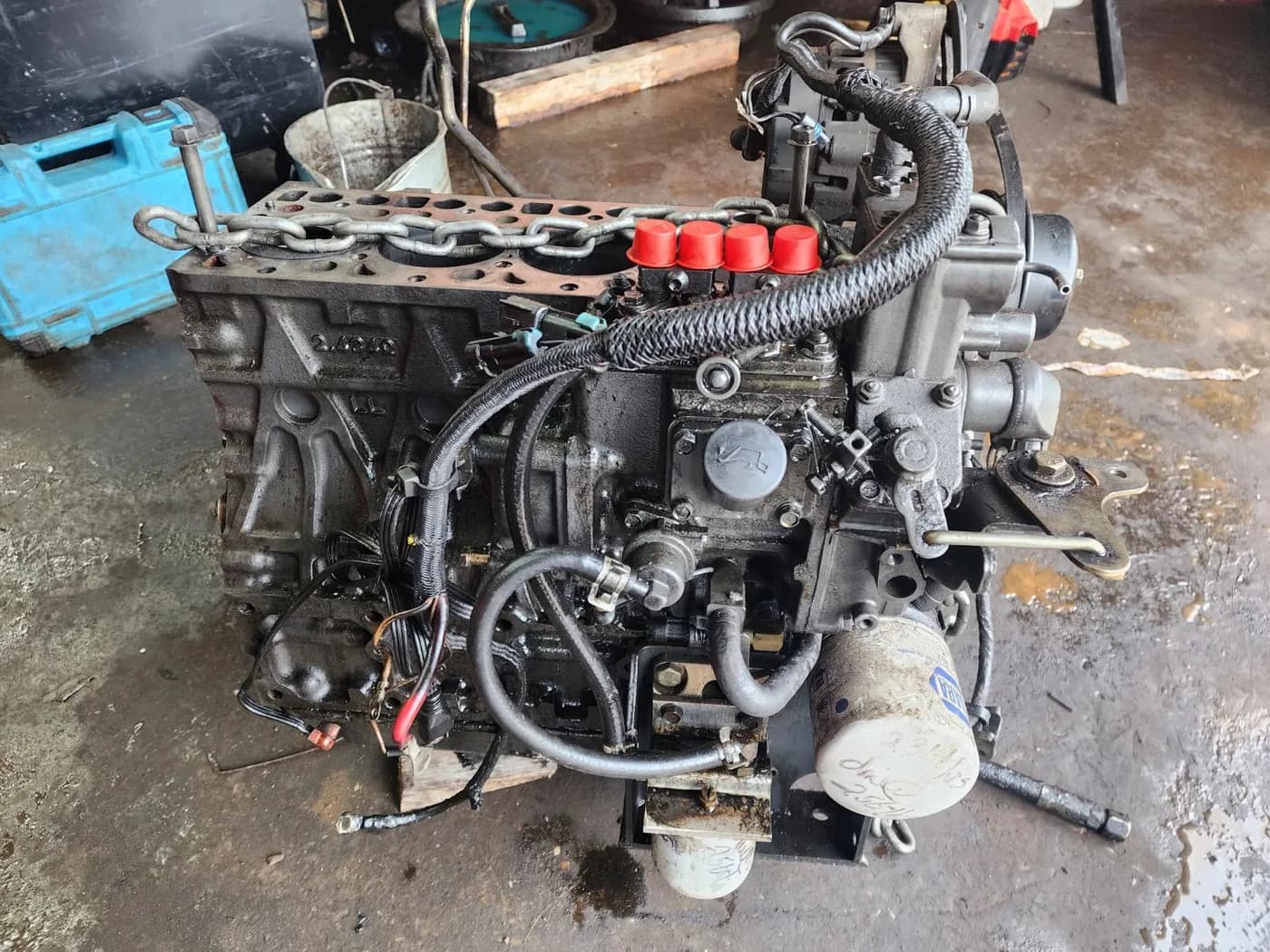
This one came in as a Kubota V2403 out of a Bobcat T180 compact track loader — 2.4 litres, four cylinders, the engine that sits in a large slice of the compact equipment working around Edmonton. Rebuilding an industrial diesel is a different job from rebuilding a car engine, and most of the difference is in the decisions rather than the wrenching. Here is what it actually involved, with photos from our own bench.
What a V2403 is, and why you see so many of them
The V2403 is Kubota's 2.4-litre four-cylinder industrial diesel, and it turns up far beyond Bobcat loaders — in telehandlers, generators, compactors, pumps, chippers and light utility machines. That ubiquity is the reason parts are available and the reason a rebuild is usually worth doing: this is not an orphan engine where a single hard part ends the conversation.
It is also an engine built to be worked on. The timing is gear-driven rather than belt or chain, the block is plain cast iron, and the whole thing is designed around long service life in machines that run thousands of hours at a near-constant load. None of that makes it immortal — it makes it rebuildable, which is a different and more useful property.
Worth knowing if you own one: machine hours are a far better guide to engine condition than the machine's age. A loader that has sat on a yard for eight years with 1,200 hours on it is a different proposition from one that did 6,000 hours in three seasons on a site.
What puts one of these on the bench
Compact equipment is harder on an engine than a highway vehicle, and the reasons are unglamorous. Dust is the big one: a loader works in exactly the conditions that fill an air filter, and anything that gets past a tired element or a loose clamp downstream of it goes straight down the cylinders. That is abrasive wear on the bores and rings, and it accumulates at hours that would look modest on a truck.
Long idling is the second. A machine that spends its day at low load never gets the cylinder temperatures it was designed around, which leaves fuel and soot in the oil. The third is heat going the other way — a plugged radiator core packed with chaff and dust on a hot day, which is a five-minute cleaning job that nobody does until something expensive happens.
The symptoms owners actually notice are blow-by at the breather, oil consumption that was not there last season, and a machine that no longer holds full power under load. Any one of those is worth measuring rather than waiting out.
Stripping it down: the castings matter
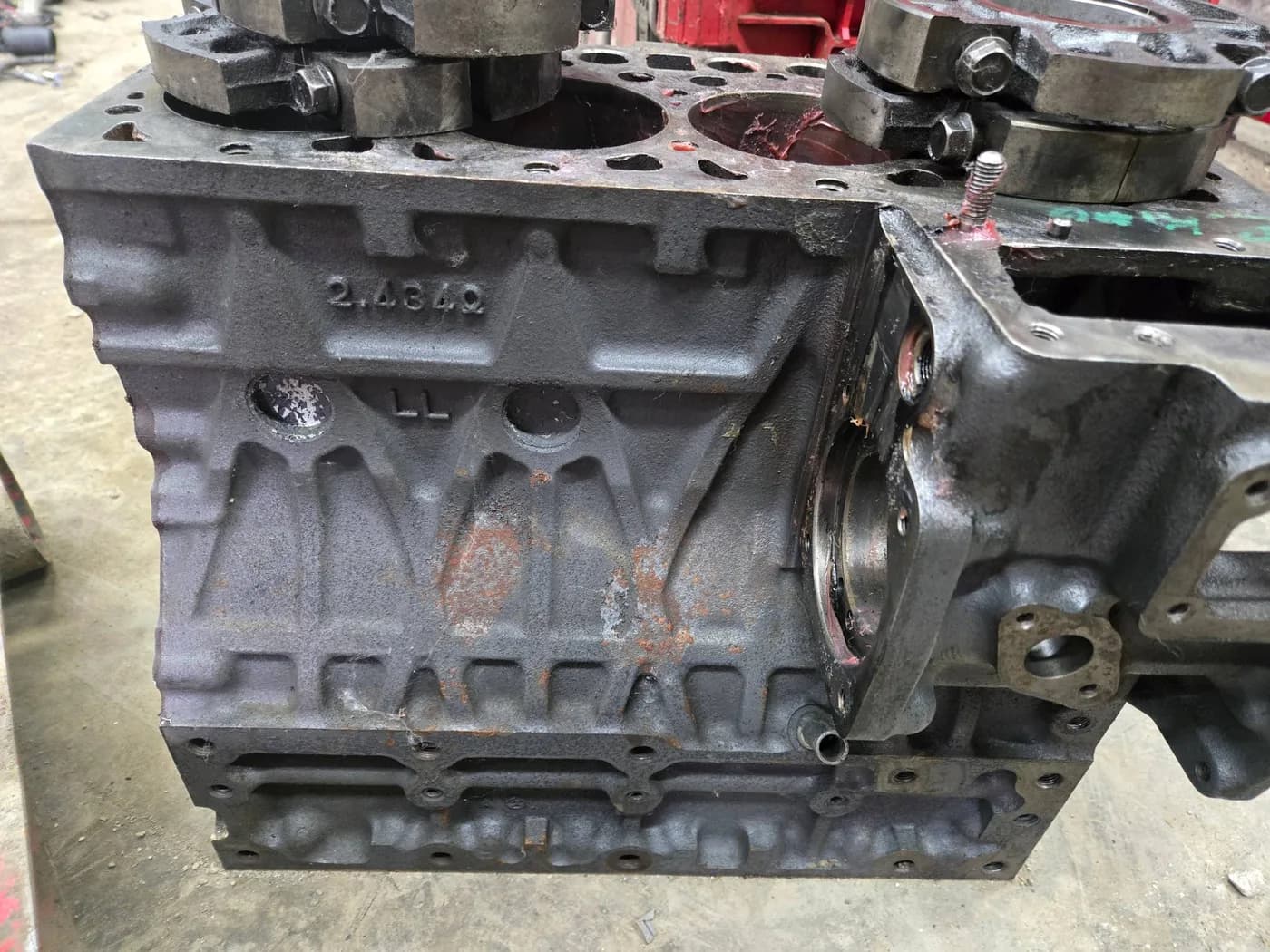
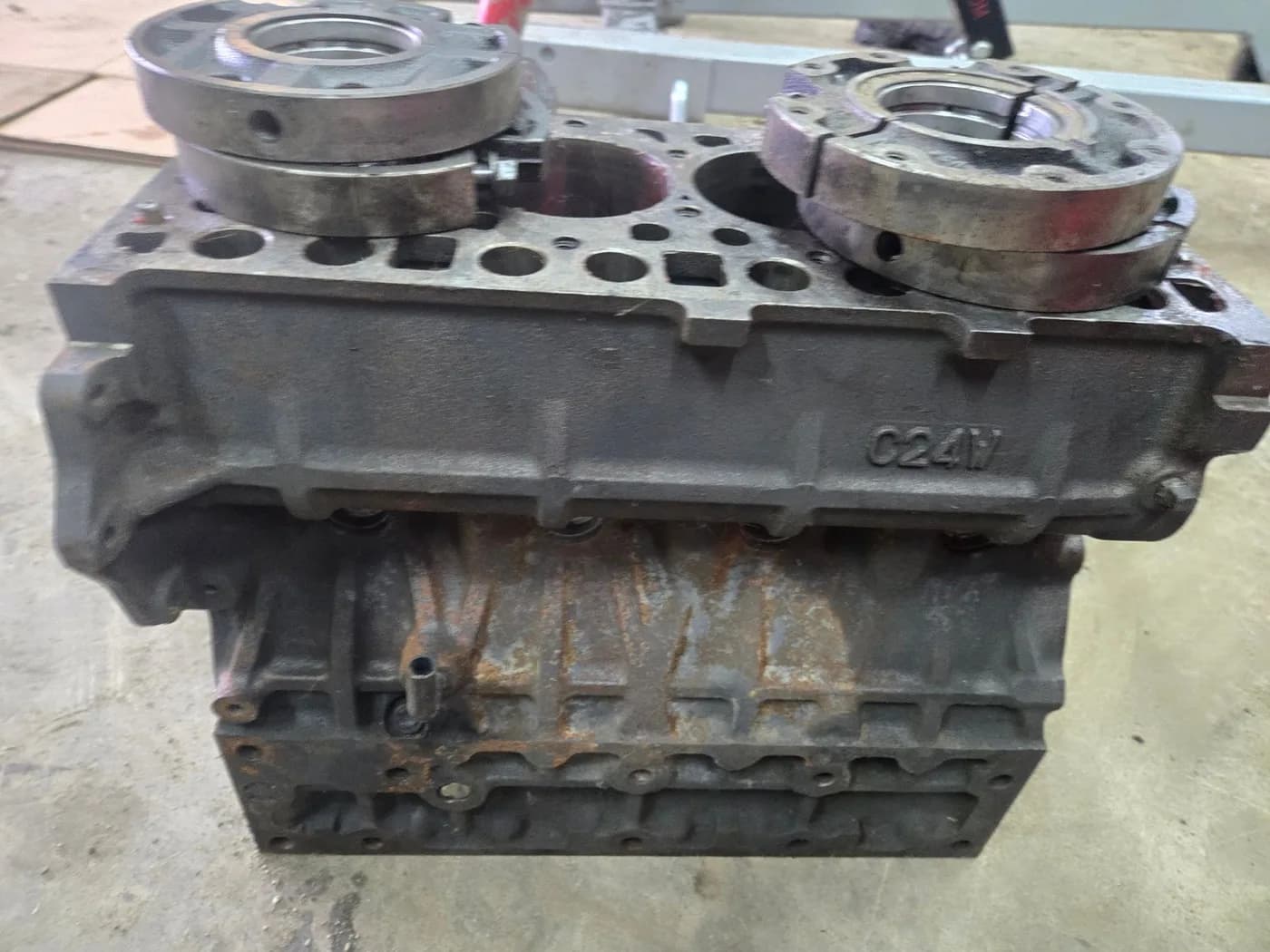
The first real job is recording what you have. Industrial engines go through long production runs with running changes, and the casting numbers on the block are how you make sure the parts you order are the parts that fit. On this one that meant noting the block casting and the identifiers on the pan rail before anything came apart, alongside the V2403 number cast into the side of the block.
This matters more than it sounds. Order a gasket set or a piston set against the wrong variant and you find out at assembly, with the machine down and the customer waiting. Five minutes with a camera at teardown is the cheapest insurance in the job.
Everything else came off at this stage: head, pan, oil pump, main caps, crank, pistons and rods. Each main cap is marked for its position and goes back where it came from — they are line-bored as a set with the block and are not interchangeable.
Cleaned, then measured — before anyone decides anything
A bare block tells you almost nothing until it is clean. Once it is, the measuring decides the job: bore diameter at several heights and across two axes to find taper and out-of-round, deck flatness, and the main bores. On a diesel, roundness matters more than it does on a petrol engine, because cylinder pressure is far higher and the rings have less tolerance for a bore that is not true.
Here is the part specific to this engine. The V2403 is a parent-bore block — the cylinders are machined straight into the iron, with no replaceable liners. That narrows the fork compared with a lined engine: either the bores clean up within reach of an oversize piston that is actually manufactured, or the block is finished as a candidate. There is no quiet third option that resets the bore back to standard.
Some things end a block outright no matter how good the rest looks: a crack, a deck moved by a serious overheat, or erosion around the coolant passages. None of that showed here, which is what made the next step possible.
Bored 0.25 mm oversize, and what that marking means
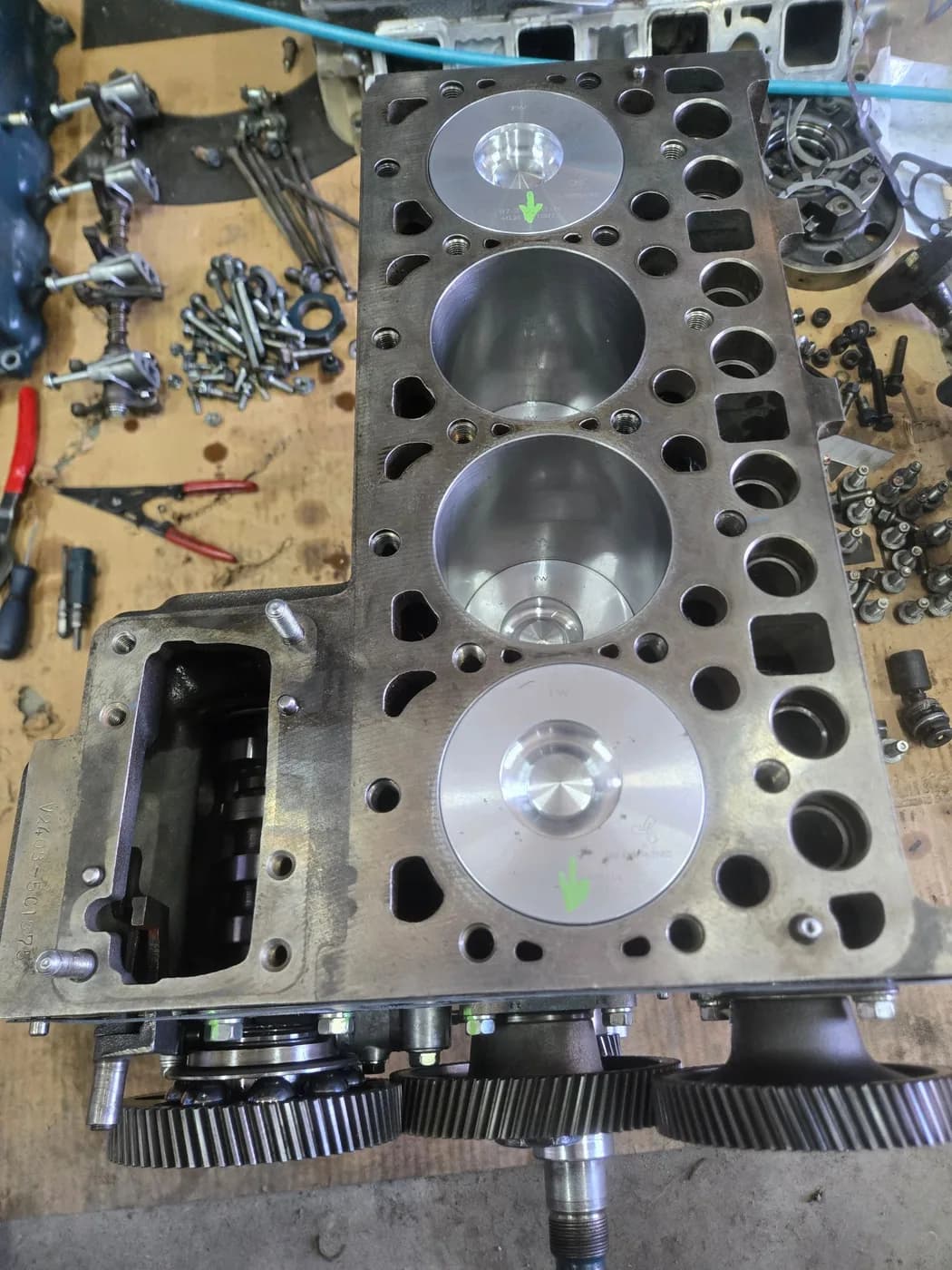
The bores went 0.25 mm oversize, and the pistons that went back in are marked to match — you can read the size and the +0.25 stamped right on the crown in the photo below. That marking is not decoration. It is the record for whoever opens this engine next, and it is the reason the size gets photographed and written down rather than remembered.
The order of operations is the opposite of what people assume. You do not bore a cylinder to a round number and then go looking for a piston. The piston set is chosen first and the block is machined to suit it, because the clearance between the two is what the engine actually runs on. The honed finish is specified for the rings being fitted as well — rings bed against the surface texture, not against the diameter, and the cross-hatch you can see in the bores is what lets them seat instead of glaze.
The green arrows on the crowns are the other thing worth pointing out. They mark which way the piston faces. The combustion bowl in a diesel piston is usually offset, so a piston installed backwards will run — badly, briefly — and that is a mistake you only get to make once.
One oversize buys a second life. Past the largest size made for the casting there is no third, which is the honest limit of this route and the thing to weigh against a replacement engine before committing.
Gear-driven timing: no belt, no chain, no interval
Look at the front of the engine in that last photo and you will see the timing gear train — helical-cut gears running crank to cam to injection pump, with an idler between them. There is no belt to replace on a schedule and no chain to stretch, which is one of the quiet reasons these engines last.
It does change the assembly, though. The gears have timing marks that have to line up exactly, and the backlash between them is a measurement rather than a feel — too tight and they load the bearings, too loose and the injection timing wanders. On an engine where the pump is driven off the same train, that is fuel delivery as well as valve timing, so it is checked rather than assumed.
The upside for an owner is real: a gear train is one fewer maintenance item and one fewer way to destroy an engine by neglecting a service interval. Diesel pickups with timing chains do not get that luxury.
If you run compact equipment around Edmonton
A few things genuinely extend the life of these engines, and none of them are expensive. Service the air filter on hours and conditions rather than on the calendar, and check every clamp downstream of it — a loose boot lets dust bypass a brand-new filter entirely. Blow out the radiator and oil cooler regularly, because overheating on a machine is almost always a plugged core rather than a failed part. And change the oil on hours, not seasons.
If a machine is already showing blow-by or burning oil, the useful thing is a measurement, not a guess. Whether a parent-bore block can be saved is a question with a numeric answer, and getting it measured before committing to either a rebuild or a replacement engine is how you avoid paying for the wrong one.
We rebuild engines like this in-house in our own bays, and we do mobile service for loaders, telehandlers, skid steers, backhoes, manlifts and forklifts at your yard or job site. If you have a machine down, call us with the make, model and hours and we will tell you straight what we think it needs.
Related on this site
Want it checked before winter?
One visit covers battery, block heater, coolant, tires and belts. Call (780) 482-2424 or request a time online.