The short answer
The Bosch CP4.2 high-pressure pump in 2011-2016 6.6L Duramax LML trucks has a well-documented habit of grinding itself apart and pumping metal through the entire fuel system — often with no warning at all. When that happens, the repair typically runs $8,000 to $15,000-plus CAD because the pump, rails, lines and all eight injectors are contaminated. The good news: the failure is largely preventable, a permanent fix exists, and genuine OEM parts from a donor truck can restore the system properly.
Symptoms, from first warning to failure
Longer cranking before start-up
A healthy LML lights off almost immediately. If the engine is cranking noticeably longer than it used to — especially on the first cold start of the day — the pump may be struggling to build rail pressure. Plenty of things can cause a long crank, but on a CP4 truck it is never a symptom to ignore.
Fine metal glitter in the fuel filter
This is the single most useful early warning. When the old fuel filter comes off, cut it open and look for fine silver sparkle in the pleats or the bowl. A failing CP4 sheds microscopic metal long before it lets go completely. Clean filter, cheap peace of mind; glitter means stop driving and get it diagnosed.
Rail pressure lagging behind demand
On a scan tool, actual fuel rail pressure that sags below desired pressure under load — towing, hills, hard acceleration — points to a pump that can no longer keep up. Most owners never see this one themselves, but it is one of the first things a diesel shop will check, and it is worth asking for at any routine service.
Check engine light with codes P0087, P0088 or P0191
These are fuel rail pressure codes — pressure too low, too high, or sensor performance. On a 2011-2016 LML they are treated as a CP4 red flag until proven otherwise. Before anyone replaces a sensor or a regulator, the regulator inlet screen and fuel filter should be inspected for metal.
Power loss, limp mode or stumbling under load
When the pump can no longer hold commanded pressure, the engine computer pulls power to protect itself. A truck that falls on its face while towing, surges, or drops into reduced-power mode is telling you the high-pressure side of the fuel system is in trouble. Continuing to drive it risks turning a bad pump into a contaminated system.
Stalling, or stall-and-restart episodes
An engine that dies at idle or under way and then restarts is often running on the ragged edge of minimum rail pressure. Every additional run cycle on a disintegrating pump pushes more debris into the rails and injectors, and directly grows the final repair bill. This is a tow-it-in situation, not a drive-it-in one.
Sudden death: cranks but will not start
The classic CP4 failure is no warning at all — the truck dies on the highway or simply will not start one morning because the pump has come apart internally and cannot build the pressure needed to fire. If a 2011-2016 LML cranks strongly but will not light, assume CP4 failure and do not keep cranking; you are pumping metal deeper into the system.
Metal found in the rails, lines or regulator screen
Once anyone finds visible debris past the pump — in the fuel pressure regulator screen, the rails or the injector return — the contamination event has already happened. At this point the honest repair is a full fuel system, not a pump swap, and the job should be priced accordingly.
Affected models
| Model | Years | Notes |
|---|---|---|
| Chevrolet Silverado 2500HD / 3500HD | 2011-2016 | 6.6L Duramax LML with the Bosch CP4.2 pump — the core affected population, and the trucks named in the US class action. |
| GMC Sierra 2500HD / 3500HD | 2011-2016 | Mechanically identical to the Silverado HD; same LML engine, same CP4.2 pump, same failure mode. |
| Chevrolet Express / GMC Savana 2500/3500 | 2010 (interim)-2016 | Cutaways and cargo/passenger vans with the 6.6L Duramax use the derated LGH version of this engine — different tune, same CP4.2 pump and same risk. The LGH arrived in the vans as an interim 2010 model-year engine, so late-2010 vans carry it too. |
| Silverado/Sierra HD chassis cab | 2011-2016 | Chassis cabs ran the LGH in 2011-2012 and the full-output LML from 2013 on. Either way, it is a CP4.2 truck. |
| 2017+ Silverado/Sierra HD (L5P) | 2017 onward | Not affected. GM replaced the Bosch CP4 with a more robust Denso HP4 and added a factory in-tank lift pump for the L5P. |
| 2001-2010 Duramax (LB7, LLY, LBZ, LMM) | 2001-2010 | Not affected. These engines use the earlier Bosch CP3 pump, which has an excellent reliability record — it is the very pump the aftermarket converts LML trucks back to. |
What actually goes wrong
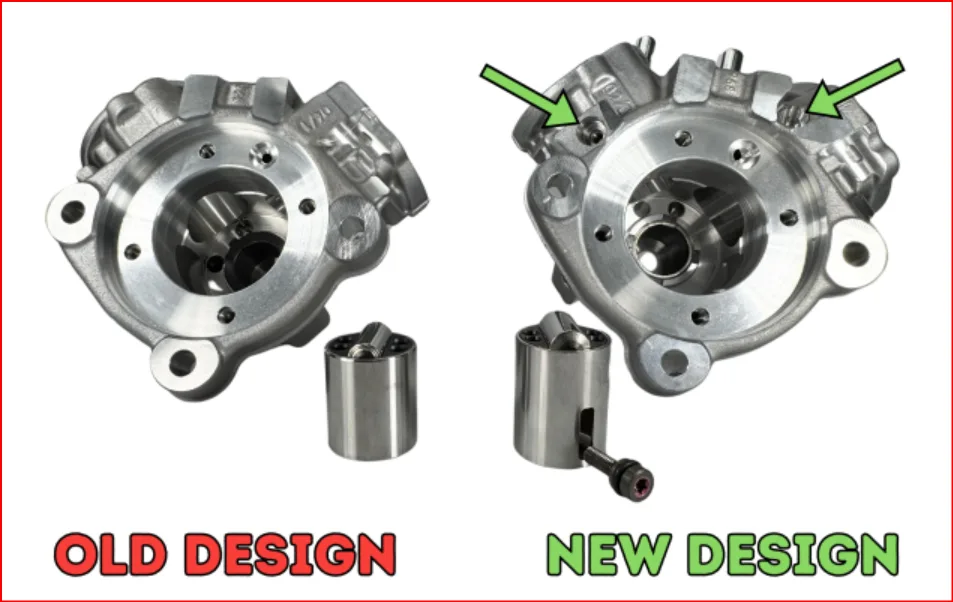
Every 2011-2016 6.6L Duramax depends on one component to run at all: the Bosch CP4.2 high-pressure injection pump, bolted in the engine valley. Its job is to take low-pressure diesel from the tank and squeeze it to roughly 2,000 bar — in the neighbourhood of 29,000 psi — to feed the common rails and injectors. Inside the pump, two plungers are driven off a camshaft through small roller lifters. Those rollers have to stay perfectly square to the cam lobe, riding on a film of diesel fuel. There is no oil in there; the fuel itself is the only lubricant the pump ever sees.
That is the root of the problem. The CP4 was engineered in Europe around European diesel, which tends to carry more natural lubricity than the ultra-low-sulphur diesel sold in North America. Run the pump on drier fuel — or fuel with a trace of water, air or dirt in it — and the lubricating film between roller and cam breaks down. The roller can twist slightly in its bore and skate sideways across the lobe instead of rolling. From that moment the pump is machining itself: hardened steel grinding on hardened steel, shedding fine metal debris into the very fuel it is pressurizing.
What makes a CP4 failure so expensive is not the pump — it is where the metal goes. The debris gets driven downstream at extreme pressure into the fuel rails, the injection lines and all eight injectors, and the return fuel carries it back to the tank, where there is no filter to catch it before it gets picked up and sent through again. By the time the truck stalls or refuses to start, the entire fuel system is seeded with abrasive metal. Installing a new pump into that system just kills the new pump. The honest repair is pump, rails, lines, all eight injectors, tank cleaning and every filter — which is how a single failed part turns into a five-figure invoice.
GM also gave the LML no factory lift pump. The CP4 has to pull its own fuel from the tank, several feet away, under vacuum. Any restriction — a tired filter, gelled winter fuel, a low tank sloshing on a hill — encourages air bubbles in the supply, and every air bubble is a momentary gap in lubrication at the worst possible place. It is part of why these failures so often come without warning: the pump can go from apparently fine to fully self-destructed in one tank of bad luck.
The problem is well documented in the courts. A class action, Chapman v. General Motors, was filed in the US in 2019 alleging the CP4 was not suited to North American diesel; it was certified in seven states in 2023, and a settlement with a US$35-million fund (reported total value around US$50 million) received final approval in May 2025. It compensated eligible owners in those seven US states only; the main claim deadline (November 6, 2025) has passed, and the last window — reimbursement for repairs done before May 6, 2026 — closes July 5, 2026. There has never been a recall in either country, and GM has never admitted the pump is defective. In Canada, proposed class actions have been filed against GM and GM Canada by firms including Siskinds LLP and Merchant Law Group, but as of mid-2026 they have not been certified or settled — so no Canadian owner should count on a cheque to fund this repair. Worth noting: when GM redesigned the truck for 2017, the new L5P engine got a Denso HP4 pump and a factory lift pump, and this failure mode essentially disappeared.
For Alberta owners the math is a little worse than average. These trucks are now ten to fifteen years old, most with 200,000 to 400,000 km on them, and the risk does not go down with age. Cold starts are hard on marginal lubrication, winter diesel is blended for cold-flow with lighter components that typically carry less natural lubricity, and condensation in half-empty tanks puts water exactly where the pump cannot tolerate it. A CP4 that has survived this long is not proof it will keep surviving — it is a reason to protect it now, while protecting it is still cheap.
How the failure happens
Hover the diagram — or tap a part below — to see what it does and how it fails.
What it costs to fix
Typical ranges in Canadian dollars — every vehicle is quoted individually.
Prevention: lift pump and real filtration
$1,500-$2,500 CAD installed
An aftermarket lift pump system (FASS, AirDog and similar) feeds the CP4 positive fuel pressure instead of making it suck fuel from the tank, and adds far better filtration, water separation and air removal than stock. Kits typically run $1,000-$1,400 in parts plus a few hours of labour. It does not change the CP4's internal design, but it removes most of the conditions that kill it. Cheap insurance on any CP4 truck you plan to keep.
Early-catch CP4 replacement (no contamination found)
$3,000-$5,000 CAD
If a failing pump is caught genuinely early — glitter in the filter but a verified-clean regulator screen and rails — replacing just the pump is sometimes defensible. A new or Bosch reman CP4 typically runs $2,000-$2,800 in parts plus labour. Be honest with yourself here: this only makes sense when inspection confirms the debris never left the pump, and at this price point most owners are better off putting the money toward a CP3 conversion instead.
Preventive CP3 conversion — the permanent fix
$4,500-$7,000 CAD installed
Conversion kits from S&S Diesel Motorsport, Fleece and others replace the CP4 with the older, proven Bosch CP3 while keeping all factory emissions equipment intact; the S&S version even carries a CARB executive order (D-756-4) and needs no tuning. Kits run roughly $2,500-$3,700 in Canadian dollars depending on version, plus typically 10-14 hours of labour. Done before a failure, it permanently removes the failure mode on your schedule instead of during a roadside breakdown.
Post-failure rebuild with genuine OEM parts (through Eskimo Auto & Truck Parts)
$5,500-$9,000 CAD installed
After a contamination event, the biggest cost is parts — and a complete, tested genuine OEM fuel system (rails, lines, injectors) from a running donor truck restores the system with the exact factory components. Pair genuine OEM components with a new CP3 conversion pump and a cleaned tank, and you get a fuel system built from the right parts. This is where a good donor makes the difference between fixing the truck and writing it off.
Full new-parts fuel system replacement
$10,000-$18,000+ CAD
The by-the-book repair after catastrophic failure: new pump, both rails, all lines, all eight injectors, filters, and tank removal and cleaning. Parts alone commonly run $8,000-$12,000, and the labour is substantial. Independent shops with careful sourcing usually land in the $10,000-$15,000 range; dealer quotes can exceed $18,000-$20,000. Whatever the quote, insist the replacement pump is a CP3 conversion — paying five figures to install another CP4 is repeating the experiment.
Repair it, or replace it?
A CP4 failure almost never damages the engine itself. The bottom end, heads and turbo are untouched — the destruction is confined to the fuel system. So the question is not whether the truck is mechanically finished; it is whether a five-figure fuel system repair makes sense against what the truck is worth and what replacing it would cost.
For most Alberta trucks, the repair pencils out. A sound 2011-2016 Duramax HD with 200,000-300,000 km is still a $25,000-$45,000 truck on the used market, and a newer replacement HD diesel costs far more than that. A $9,000-$14,000 repair that includes a CP3 conversion buys back a truck with a fuel system arguably better than it left the factory with.
Use genuine OEM components. Rails, lines and injectors from a low-kilometre running donor are the exact factory parts, and on a ten-plus-year-old truck they are entirely appropriate. The one place not to reuse contaminated-system parts is the pump itself — go CP3 there, new.
Be honest about the whole truck before committing. At 350,000-plus km, if the truck also needs a transmission, has heavy frame or cab corrosion, or the injectors were already tired, the fuel system bill may be the push toward a genuine OEM engine swap — a complete donor Duramax with its fuel system intact — or toward moving the truck along as-is with full disclosure.
Do not pay for a pump-only repair after a contamination event. It is the cheapest quote you will get and the most expensive mistake you can make: the residual metal in the rails, lines and tank will take out the new pump, and you will pay for the full job anyway — twice.
If the truck still runs fine today, the repair-vs-replace question is really prevent-vs-gamble. A $5,000-$7,000 preventive CP3 conversion, or even a $2,000 lift pump, is dramatically cheaper than the $10,000-$18,000 failure it prevents. On a truck you intend to keep, prevention is the highest-return money you can spend on it.
How we fix this in Edmonton
Engine Repair & Replacement in Edmonton
A bad engine doesn't automatically mean a new vehicle. We diagnose before we condemn — and then we can fix it every way there is: rebuild it in-house, install a remanufactured ATK engine, or fit a genuine OEM engine sourced through our sister company, Eskimo Auto & Truck Parts.
See the service →Diesel Truck Repair in Edmonton
We fix light-duty diesel pickups — Power Stroke, Duramax and Cummins — and we diagnose them before anyone starts condemning $4,000 parts. Heavy highway trucks belong in a heavy-duty shop and we will tell you so, and we do not hold a CVIP facility licence. Everything else gets tested, quoted in writing, and explained in plain language before we start.
See the service →Vehicle Diagnostics & Check Engine Light in Edmonton
A trouble code tells you what the computer noticed, not what is broken. We read the codes, look at live data, and test the actual circuit before anything gets replaced. Diagnostic time is $120 an hour, quoted before we start, because the most expensive repair is the one that didn't fix the problem.
See the service →The genuine OEM parts option
A CP4 failure is exactly the kind of repair where a good donor truck matters. Our sister company, Eskimo Auto & Truck Parts in Edmonton, is one of Edmonton's largest parts operations and regularly dismantles 2011-2016 Duramax pickups and vans — including clean, running trucks taken out of service by collisions rather than mechanical failure. That means complete genuine OEM fuel systems (rails, lines, injectors and related hardware) with known donor history, as well as complete Duramax engines with the fuel system intact for trucks where a swap makes more sense than a rebuild. Every donor's story is on record, parts are pulled and inspected in-house, and everything ships across Canada and the USA. If you are staring at a five-figure fuel system quote, it costs nothing to check what a genuine OEM donor system would cost delivered — and if we are doing the repair at the shop, we source those parts directly from Eskimo Auto & Truck Parts.
Browse inventory at Eskimo Auto & Truck Parts →How to make yours last longer
- Do the CP3 conversion before the CP4 fails. It is the only step that fully removes the failure mode, emissions-intact kits exist, and doing it on your schedule costs a third of what the failure costs on the truck's schedule.
- Add a lift pump with proper filtration and water separation. The LML has no factory lift pump; giving the CP4 clean, pressurized, de-aerated fuel addresses most of what kills it.
- Buy fuel at busy, reputable stations. High turnover means fresher fuel and less water and sediment in the station's tanks. Be cautious with dusty on-site slip tanks and jerry cans unless the transfer setup is filtered.
- Use a quality diesel lubricity additive with every fill, especially in winter. North American diesel is drier than what this pump was designed around, and winter blends typically carry even less natural lubricity. A few cents per litre is cheap protection.
- Never run the tank low. Below a quarter tank, the pickup is more likely to grab aerated fuel and any water or sediment sitting at the bottom — all of it headed straight for the pump. Keeping the tank fuller also reduces condensation.
- Change the fuel filter on time and cut the old one open. Every 20,000-25,000 km with a quality OEM-spec filter is a reasonable habit, and thirty seconds with a filter cutter looking for metal glitter is the best early-warning system a CP4 truck has.
- Drain the water separator regularly and never ignore a water-in-fuel light. Water displaces the lubricating fuel film inside the pump; even a small slug can start the damage.
- Treat fuel for winter before the cold snap, not after. Gelled or waxed fuel starves the pump of both flow and lubrication on exactly the mornings it is working hardest. Use anti-gel in season and make sure any additive you choose also supports lubricity.
Frequently asked questions
Which Duramax years have the CP4 pump problem?
Model years 2011 through 2016 with the 6.6L Duramax — the LML in Silverado and Sierra 2500HD/3500HD pickups, and the derated LGH in Express and Savana vans and some chassis cabs. The LGH actually reached the vans as an interim 2010 model-year engine, so late-2010 Express and Savana Duramax vans carry the CP4.2 as well. Every one of those engines left the factory with the Bosch CP4.2 pump. Older Duramaxes (2001-2010 LB7 through LMM) use the earlier CP3 pump and are not affected, and the 2017-and-newer L5P switched to a Denso HP4 with a factory lift pump, which ended the problem.
How common is CP4 failure, really?
There is no official failure rate — GM has never published one and has never admitted a defect. What can be said honestly: failures were widespread enough to support a certified US class action and a US$35-million settlement, a whole aftermarket industry exists solely to prevent or fix this failure, and every diesel shop in the country has seen them. Plenty of CP4 trucks live long lives, especially on clean fuel. But the failure is random enough, and expensive enough, that treating it as "probably won't happen to me" is a poor bet on a truck you rely on.
What does CP4 failure feel like? What are the first signs?
Often, nothing — the classic presentation is a truck that dies on the highway or cranks and will not start one morning, with no warning at all. When there are warnings, they look like: longer cranking than usual, fine metal glitter in the fuel filter, rail pressure codes (P0087, P0088, P0191), power loss or limp mode under load, and stalling. If a 2011-2016 LML cranks but will not start, stop cranking — every revolution pumps more debris through the system — and have it towed in for diagnosis.
Was there ever a recall for the CP4 pump?
No. Neither GM nor Transport Canada nor the US regulator ever issued a recall for the CP4 in these trucks. What did happen is litigation: a US class action (Chapman v. General Motors) settled with final court approval in May 2025, providing payments to eligible owners in seven US states. Canadian trucks were not part of that settlement. GM has consistently denied the pump is defective — while, notably, replacing it with a different manufacturer's pump in the 2017 redesign.
Is there a CP4 class action in Canada?
Proposed class actions have been filed in Canada against General Motors and GM of Canada over the CP4 — Siskinds LLP and Merchant Law Group are among the firms involved — covering 2011-2016 Duramax trucks and vans. As of mid-2026 those cases have not been certified or settled, so there is no compensation available to Canadian owners today and no guarantee there ever will be. Our honest advice: if you own one of these trucks, make decisions assuming the repair or prevention bill is yours, and treat any future settlement as a bonus.
How much does a CP4 failure cost to fix in Canada?
For a true contamination event — metal through the system — expect roughly $10,000 to $18,000-plus CAD for the by-the-book repair with all new parts, depending on shop rates and how much is replaced; dealer quotes often sit at the top of that range or above it. The bill often lands in the $5,500-$9,000 range by using a complete tested genuine OEM fuel system from a donor truck for the rails, lines and injectors, paired with a new CP3 conversion pump and a professionally cleaned tank.
What is a CP3 conversion, and is it emissions-legal?
It replaces the fragile CP4 with the older Bosch CP3 — the pump that earned its reputation on 2001-2010 Duramaxes — using an adapter kit for the LML. Done right, it is a permanent fix. Emissions-intact kits keep all factory equipment (DPF, SCR, EGR) in place, and the S&S Diesel Motorsport version carries a CARB executive order (EO D-756-4) and requires no tuning, which is as clean as aftermarket compliance gets. Expect roughly $2,500-$3,700 CAD in parts and 10-14 hours of labour. Avoid "off-road only" kit versions on a street truck.
Should I add a lift pump to my LML?
If you are keeping the truck and not ready for a CP3 conversion yet, yes — it is the strongest protection available short of the conversion. The LML has no factory lift pump, so the CP4 pulls its own fuel under vacuum, which invites air, and air means lubrication gaps inside the pump. An aftermarket lift pump system supplies positive pressure and adds serious filtration, water separation and air removal. Typical installed cost is $1,500-$2,500 CAD. It lowers the risk considerably; the CP3 conversion removes it.
Do additives actually help prevent CP4 failure?
They help, with realistic expectations. The CP4's core weakness is that it is lubricated only by fuel, and North American diesel is on the dry side — winter blends more so. A quality lubricity additive at every fill measurably improves the fuel's lubricating ability for a few cents per litre, and in winter an anti-gel keeps fuel flowing to a pump that cannot tolerate starvation. What additives cannot do is fix the pump's design or stop a failure already in progress. Think of them as one layer: additives plus clean fuel plus on-time filters, with a lift pump or CP3 conversion as the real protection.
Can I use genuine OEM parts from a donor truck to fix a CP4 failure?
Yes, and on a ten-plus-year-old truck it is often the smartest move. Fuel rails, injection lines and injectors from a running, tested donor truck — one that died from a collision, not a fuel system failure — are proven genuine OEM parts. The two rules: know the donor's history (a reputable supplier can tell you), and do not reuse a pump out of a CP4 truck as your long-term fix — put the money toward a new CP3 conversion, new filters and a cleaned tank, and the repair is better than factory.
Dealing with this problem right now?
Edmonton and area: bring it in and we'll confirm the diagnosis before any work. Anywhere else in Canada or the USA: our sister company ships the genuine OEM parts to your shop.