
We fix light-duty diesel pickups — Power Stroke, Duramax and Cummins — and we diagnose them before anyone starts condemning $4,000 parts. Heavy highway trucks belong in a heavy-duty shop and we will tell you so, and we do not hold a CVIP facility licence. Everything else gets tested, quoted in writing, and explained in plain language before we start.
Diesel work here means light-duty diesel pickups: Ford Power Stroke, GM Duramax and Ram Cummins in three-quarter-ton and one-ton trucks, plus the light commercial units built on those chassis. We are not a heavy highway truck shop. If you run a Class 8 tractor with an ISX, DD15 or Paccar MX, you want a specialist with the tooling and parts network for it, and we will tell you that rather than tie up your truck. We also do not hold a CVIP facility licence, so we cannot do commercial vehicle inspections. What we do is diagnose diesels properly before anyone condemns an expensive part, because on these trucks a guess costs thousands. AMVIC-licensed shop, Red Seal techs, written warranty, and the quote comes before the wrench.
Ford Power Stroke Repair in Edmonton — 6.0L Oil Coolers, EGR Coolers and Head Gaskets
The 6.0L Power Stroke (2003-2007) fails in a pattern, and the order matters. The engine oil cooler plugs with casting sand and scale, that starves the EGR cooler of coolant flow, the EGR cooler cracks and pushes coolant into the intake, and you start losing coolant with bubbles in the degas bottle. Underneath it all, the torque-to-yield head bolts stretch under boost, the heads lift and the gaskets go. We compare engine oil temperature against coolant temperature under load before opening anything: more than roughly 15°F (8°C) of spread and the oil cooler is plugged. Our deep guide on 6.0L Power Stroke problems walks the whole chain. When the heads come off — a cab-off job, and mostly labour — we fit studs; doing it twice is not a plan. On the 6.7L it is turbos, EGT and NOx sensors, EGR coolers, injectors, and on early trucks the same Bosch CP4.2 pump family the Duramax made famous.
Duramax Repair and LML CP4 Fuel Pump Failure
The LML Duramax (2011-2016) has one failure that defines it: the Bosch CP4.2 high-pressure fuel pump. When the roller follower scuffs, the pump eats itself and sends metal downstream through the rails, lines and injectors, into the filter housing, and back through the return line into the tank. That is why a CP4 failure is never just a pump job. Done properly it is the whole fuel system — pump, injectors, rails, lines, tank and cooler cleaned or replaced — because leftover debris takes the new parts with it. Our guide on LML Duramax CP4 fuel pump failure lays out the real bill. Earlier LB7 trucks (2001-2004) are known instead for injectors buried under the valve covers, and the L5P from 2017 moved to a Denso pump that has behaved far better. The Allison behind these trucks is one of the good ones.
Cummins 6.7 Repair, Grid Heaters, Turbos and the 68RFE Transmission
On the 6.7L Cummins the intake grid heater does the cold-start work instead of glow plugs, and on a long stretch of 2007.5-and-up trucks the grid heater element bolt is known to drop into the intake, which turns a cheap inspection into an engine. Soot-packed variable-geometry turbo vanes and EGR passages are the other Cummins staple, and short-trip trucks get there fastest. Behind many of them sits the 68RFE, home of converter shudder, harsh shifts and overdrive clutch failure; we have a full guide on 68RFE transmission problems. Injectors and turbos get condemned far too often on all three brands, so we run return-flow and contribution testing first. For hard parts like turbos, cylinder heads, transfer cases and front differentials we have recycled genuine OEM through our sister company Eskimo Auto and Truck Parts, one of Edmonton's largest parts operations, plus new OEM and quality aftermarket through our suppliers.
DPF Regeneration, DEF Freezing and -40 Cold Starts in Alberta
A diesel particulate filter is cleaned by heat. Passive regeneration happens at highway temperature; when that is not enough, the truck injects extra fuel to burn the soot out, and that cycle wants 20 to 30 minutes of steady driving to finish. Short-trip and idle-heavy trucks interrupt regens over and over, which plugs the filter and washes fuel past the rings — a rising oil level that smells like diesel is the tell. DEF freezes around -11°C, which is most of our winter, but the tank, lines and dosing injector are heated and the truck is built to run while it thaws. Add a block heater on a timer, healthy batteries, winter-blend fuel and a drained water separator and a -40 morning is a non-event. Skip them and it is a tow.
Signs you need this service
- Hard starting at -30 or -40 with white smoke and a rough idle until it warms — glow plugs, an intake grid heater, or batteries too weak to crank it fast enough
- Coolant disappearing with bubbles in the degas bottle on a 6.0L Power Stroke — oil cooler, EGR cooler or head gaskets
- Sudden power loss or a stall that will not restart, with metallic glitter in the fuel filter — a CP4 pump coming apart
- An exhaust filter or DPF message that keeps coming back, or a regen that never finishes
- Oil level rising on the dipstick and the oil smelling like diesel — fuel dilution from interrupted regens or a leaking injector
- An SCR or DEF warning counting down to a speed derate — heater, dosing injector, NOx sensor or fluid quality fault
- Lost boost, black smoke, a rattle or whistle from the turbo, or variable-geometry actuator codes
- The truck dies after a cold night or the filter ices up — gelled fuel, water in the separator, or summer fuel still in the tank
What's included
- Diesel diagnosis before parts — injector return-flow and contribution testing, rail pressure and fuel supply checks, and oil-versus-coolant temperature testing on the 6.0L
- 6.0L Power Stroke work: oil coolers, EGR coolers, head gaskets with studs, FICM, standpipes and high-pressure oil leaks
- High-pressure fuel system repair on CP4 and CP3 pumps, injectors, rails and lines, including the full clean-out a failed pump makes necessary
- Turbo repair and replacement, including soot-packed variable-geometry vanes and failed actuators
- DPF, EGR and DEF/SCR service — forced regens, filter cleaning or replacement, dosing injectors, heaters and NOx sensors. We do not delete emissions equipment, and anything needing factory-only module programming goes to the dealer
- Cold-weather service: glow plugs, intake grid heaters, block heater elements and cords, batteries, fuel filters, water separators and gelled-fuel recovery
- Automatic transmission service and repair behind these engines, including the 68RFE, 6R140 and Allison 1000
- Fleet accounts, priority scheduling and scheduled diesel preventive maintenance through our fleet maintenance program, with written warranty and financing available
The Liqui Moly we use for diesel truck repair
Diesel-specific oil and the fuel treatment that keeps injectors alive through an Edmonton winter.
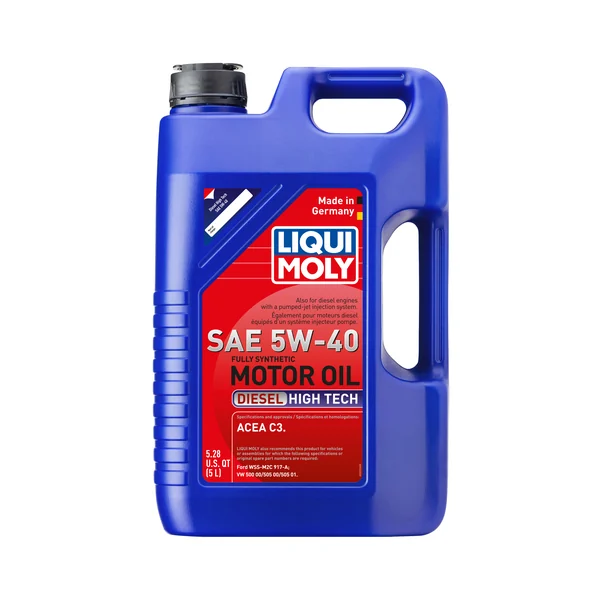
Motor Oil
Diesel High Tech SAE 5W-40
5 L · $92.60
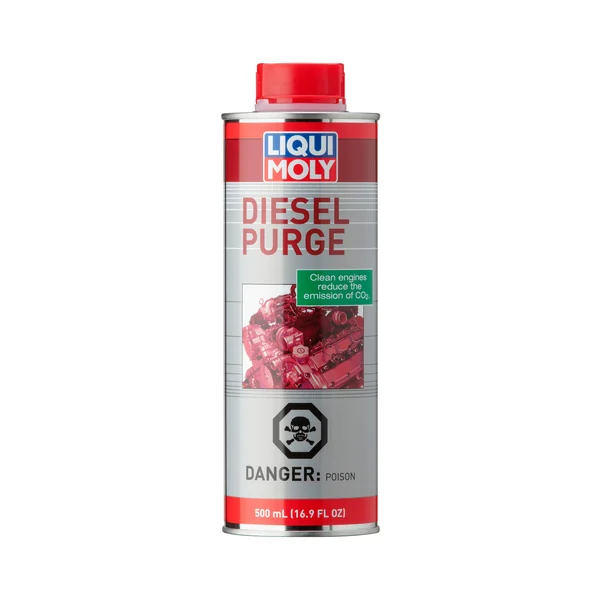
Fuel System Cleaner
Diesel Purge
$23.55
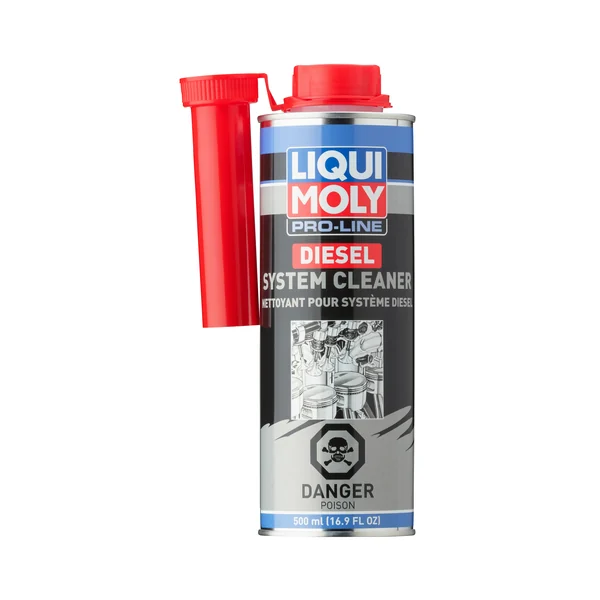
Fuel System Cleaner
Pro-Line Diesel System Cleaner
$29.80
Not sure which one your engine needs? Use the oil finder or browse the whole Liqui Moly range. Free pickup in Edmonton, or we ship it.
Frequently asked questions
How much does diesel repair cost in Edmonton?
There is no honest flat rate on a diesel, so here are general market ranges rather than our quote. Diagnostic time typically runs somewhere between about $150 and $400, depending on how deep the fault is buried. A 6.0L oil cooler and EGR cooler job typically lands somewhere between about $2,500 and $4,500; head gaskets with studs, cab off, somewhere between about $7,000 and $12,000. A full injector set typically runs somewhere between about $3,500 and $7,000 installed, and a turbo somewhere between about $2,500 and $5,500, depending on the engine and what else has to come apart. We inspect, then quote in writing.
Do you work on semis or heavy highway trucks, and can you do a CVIP?
No. We are set up for light-duty diesel pickups: F-250 through F-450, Silverado and Sierra 2500HD and 3500HD, Ram 2500 and 3500, and light commercial units on those chassis. Class 8 highway tractors and big-bore engines belong in a heavy-duty shop with the hoists, tooling and parts network for them, and sending your truck to the wrong shop only costs you downtime. We also do not hold a CVIP facility licence, so we cannot perform commercial vehicle inspections. Book those at a CVIP-licensed facility; we are glad to fix whatever it writes up, and we run fleet accounts for outfits that need both.
My DPF light keeps coming on and the truck only does short trips. What is wrong?
Your truck is trying to regenerate and never finishing. A regen needs sustained exhaust heat, roughly 20 to 30 minutes of steady highway driving. Stop-and-go runs and long idles interrupt the cycle, soot builds, and the extra fuel used to raise exhaust temperature ends up in the oil, so the level climbs and the oil smells like fuel. We can force a regen and clean or replace a plugged filter; cleaning typically runs somewhere between about $500 and $1,200 depending on the truck, a new filter far more. We do not delete emissions equipment. And honestly, if it never leaves the yard, a diesel is the wrong truck.
Does DEF freeze in an Edmonton winter?
Yes, and the truck is designed for it. DEF is roughly 32.5 percent urea in water and freezes near -11°C, which covers most of our winter. The tank, lines and dosing injector are heated, the truck starts and runs while the fluid thaws, and freezing does not hurt the DEF itself. What causes trouble is a failed tank heater, a crystallized dosing injector, a bad NOx or quality sensor, or old fluid, since DEF has a shelf life of roughly a year. Those faults start a countdown to a speed derate, and that countdown is not something to keep driving on.
How do I keep a diesel starting at -30 and -40?
Plug it in. A block heater on a timer set for three or four hours before you leave does more than anything else; running it all night just burns power. After that it is the basics: two healthy batteries, because slow cranking is the most common reason a diesel will not fire at -35; working glow plugs on a Power Stroke or Duramax, or an intact intake grid heater on a Cummins; winter-blend fuel or an anti-gel additive if the tank was filled in warmer weather; and a drained water separator, because water freezing in the filter stops fuel cold.
The repair is $10,000. Is my truck worth fixing?
That is the right question, and we will do the math with you instead of around you. A $12,000 fuel system on a rust-free truck at 300,000 kilometres, worth $35,000, with a solid frame and a good transmission, is usually worth doing. The same repair on a tired unit that needs a transmission next year usually is not. We look at what the whole truck will need over the next two years, not just the failure in front of us. If yours is newer, check for manufacturer emissions coverage before you pay us; some of those components carry extended terms.
Known problems we repair
Deep guides on the failures we see most — symptoms, honest costs, and repair options.
Ram 2500/3500 6.7L Cummins — 68RFE 6-Speed (2007.5–2024)
Dodge Ram 68RFE Transmission Problems: What Fails, What It Costs, and What to Do About It
Ford 6.0L Power Stroke Diesel (2003-2010)
Ford 6.0L Power Stroke Diesel Problems: What Fails, What It Costs, and What's Actually Worth Fixing
GM 6.6L Duramax LML/LGH (2011-2016)
Duramax LML CP4 Injection Pump Failure: What Every 2011-2016 Owner Needs to Know
Related services
Book your diesel truck repair
Call for a straight answer on cost and timing, or book online.