The short answer
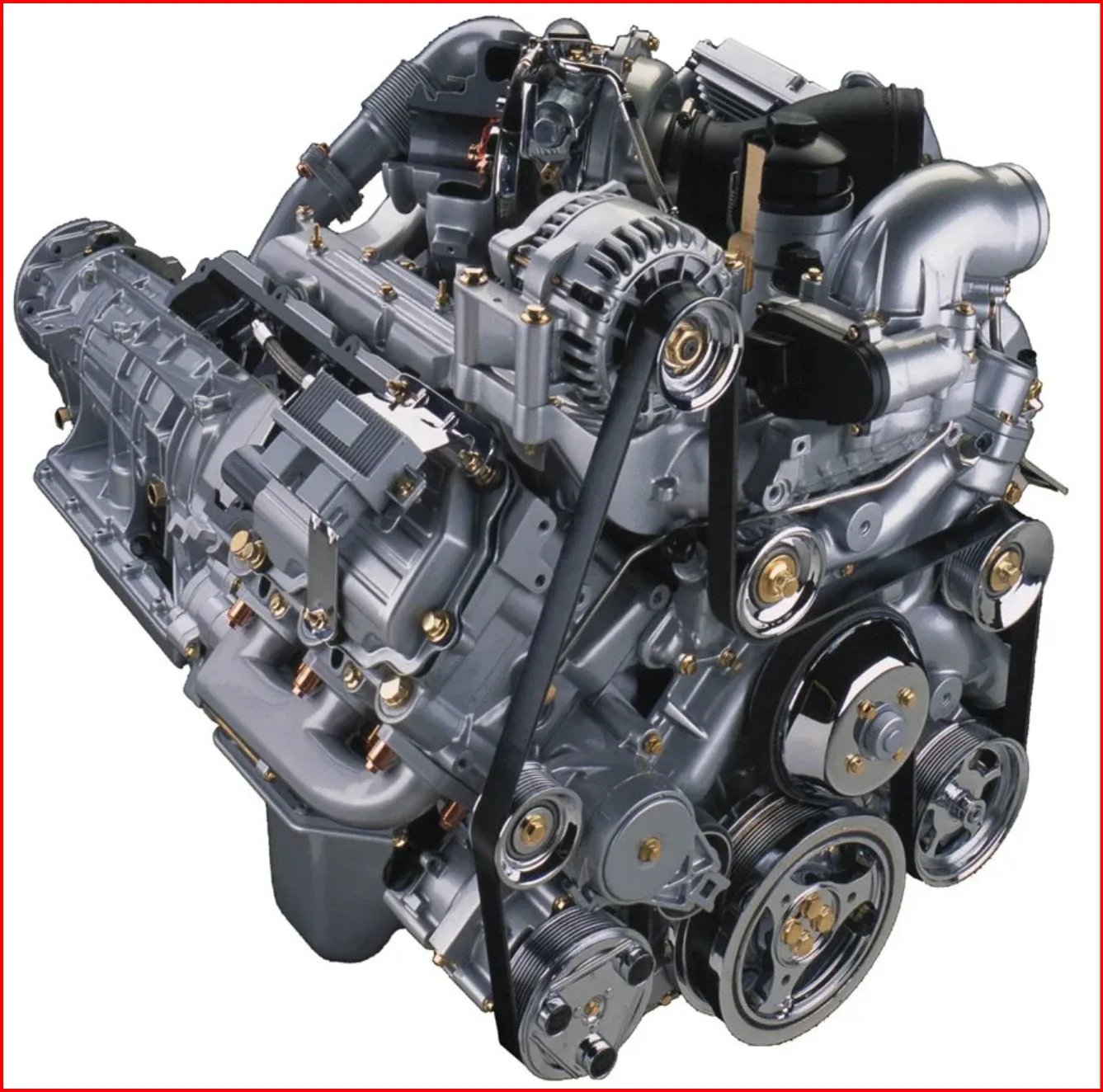
The 6.0L Power Stroke in 2003-2007 Super Dutys and 2004-2010 E-Series vans has a deserved reputation, but almost every failure traces back to a handful of known weak points: a clogging oil cooler, a rupturing EGR cooler, stretched head bolts, a failing injector control module, and a few high-pressure oil system parts. All of them are fixable, and a sorted 6.0 is a genuinely good engine. This guide explains what actually goes wrong, what repairs typically cost in Alberta, and where "bulletproofing" is worth the money versus where it is hype.
Symptoms, from first warning to failure
Hard starts on cold mornings
Long cranking or a no-start on the first cold start of the day, improving once things warm up, is the classic first sign of a failing FICM (fuel injection control module). Cracked solder joints inside the module shrink apart in the cold. Alberta winters expose a marginal FICM long before summer does.
Slow coolant loss with no visible leak
The degas bottle level keeps dropping but there is no puddle and no smell. This is often an EGR cooler starting to seep coolant into the exhaust stream, or the very beginning of a head gasket problem. Do not just keep topping it up; find out where it is going.
Oil temperature running hotter than coolant temperature
On a healthy 6.0, engine oil temperature and coolant temperature should track within roughly 8°C of each other under load. A widening gap means the oil cooler's coolant passages are plugging with casting sand and coolant debris. This is the cheapest warning you will ever get on this engine.
Rough idle or a light miss until warm
A stumble that clears up as the engine warms often points to injector stiction, where the injector spool valves stick in old or wrong-spec oil, or to early FICM voltage sag. Fresh, high-quality oil sometimes improves it noticeably, which is itself a diagnostic clue.
White, sweet-smelling smoke from the exhaust
Steamy white exhaust with a sweet coolant smell, especially after idling or right after startup, means the EGR cooler is passing coolant into the exhaust. This is the signature 6.0 failure. Driving on it risks worse damage, including coolant pooling in the intake.
Coolant pushing out of the degas bottle after hard pulls
If the cooling system pressurizes and burps coolant after towing or a long grade, combustion gas is likely leaking past a head gasket into the cooling system. The stretched-bolt head gasket problem usually announces itself exactly this way, under load, not around town.
Long cranking on hot restarts (2005-2007)
A truck that starts fine cold but cranks excessively when hot is showing the classic sign of a leaking STC fitting on the high-pressure oil pump, used on 2005 and later engines. It tends to get worse steadily, then fail completely without much notice.
Power loss, surging, or lazy throttle response
A variable-geometry turbo that has coked up from short trips and idling will stick, causing sluggish response, surging, or high exhaust temperatures. A sticking EGR valve causes similar complaints. Both are common on trucks that spend their lives idling on job sites.
Repeated overheating or coolant geysering from the degas bottle
Stop driving. This is late-stage head gasket failure, a ruptured EGR cooler, or both, and continuing to drive risks warped heads and a much bigger bill. On a 6.0, chronic overheating is never just a thermostat until proven otherwise.
Heavy white smoke at startup that will not clear
If a failed EGR cooler has let coolant pool in the intake overnight, the engine can swallow it on startup. Massive white smoke and rough running means stop cranking immediately; liquid does not compress, and a hydrolocked cylinder can bend a connecting rod and destroy the engine.
Sudden no-start, hot or cold
A blown-apart STC fitting or a failed high-pressure oil pump kills injection pressure entirely, and the engine will crank forever without firing. A dead FICM does the same. Diagnosis is straightforward for a shop with the right scan tool, so do not start throwing parts at it.
Affected models
| Model | Years | Notes |
|---|---|---|
| Ford F-250 / F-350 / F-450 / F-550 Super Duty | 2003-2007 | The 6.0L replaced the 7.3L partway through the 2003 model year, so early-build 2003 trucks exist with either engine. Rated up to 325 hp and 560-570 lb-ft. All years share the oil cooler, EGR cooler, head gasket and FICM issues; 2005-2007 trucks add the STC fitting concern but got a revised high-pressure oil pump and calibration updates. |
| Ford Excursion | 2003-2005 | The diesel Excursion switched from the 7.3L to the 6.0L during 2003 and kept it until the Excursion was discontinued after 2005. Same engine and same weak points as the pickups. |
| Ford E-350 / E-450 (E-Series vans and cutaways) | 2004-2010 | The vans ran the 6.0L three years longer than the pickups, detuned to 235 hp and 440 lb-ft, which helps head gasket life somewhat. Same core failure points, but the engine sits under the doghouse, so labour on big jobs runs meaningfully higher than on a pickup. Common in shuttle buses, ambulances and cube vans. |
| International VT365 (medium-duty trucks, school buses) | 2002-2007 | The same basic engine sold under International's own badge until Navistar moved to MaxxForce engines around 2008 — though Navistar kept building it for Ford's E-Series through 2010, which stretches the used-parts supply that late. Many hard parts interchange with the Ford version, which helps used-parts availability. |
What actually goes wrong
The 6.0L Power Stroke was built for Ford by Navistar (their VT365) and arrived mid-2003 as Ford's first diesel designed around modern emissions rules, with a variable-geometry turbo, exhaust gas recirculation, and HEUI injection that uses engine oil at extreme pressure to fire the injectors. It was rushed, and the early years were rough enough that Ford reportedly spent around a billion dollars on warranty repairs, sued Navistar over the costs in 2007, and eventually settled a consolidated US class action over the engine in 2013. None of that makes the engine junk. It means the failure points are thoroughly documented, and every one of them has a proven fix.
Almost everything starts with the oil cooler. It is a small stacked-plate heat exchanger buried in the engine valley, and its narrow coolant passages plug up over time with leftover casting sand from the block and gel-like debris from degraded coolant. As it clogs, oil temperature climbs above coolant temperature, hot oil stresses injectors and bearings, and, critically, the plugged cooler chokes off coolant supply to the EGR cooler sitting downstream of it. Watching the spread between oil and coolant temperature on a scan gauge is the single best early-warning check on this engine.
The EGR cooler is the famous failure. It uses coolant to chill exhaust gas that can run over 500°C (around 1,000°F), through thin brazed internal passages. Starve it of coolant and it boils what little is left, the thermal stress cracks the passages, and coolant escapes into the exhaust or pools in the intake. That is the white sweet smoke every 6.0 owner dreads. In the worst case, coolant collects in the intake overnight and the engine hydrolocks on startup, which can bend a rod and write off the engine. This is why a good shop never replaces a ruptured EGR cooler without testing or replacing the oil cooler that killed it.
Head gaskets fail for a different reason: clamping force. The 6.0 uses only four torque-to-yield head bolts per cylinder where the old 7.3L used six. Sustained high cylinder pressure from heavy towing, or from performance tuners cranking up boost, stretches the bolts past their limit, and once stretched they never clamp properly again. The head lifts microscopically, combustion gas pressurizes the cooling system, and coolant pushes out of the degas bottle after hard pulls. The proven fix is head studs (typically ARP) installed with new gaskets and machined heads, and it is a permanent one. On a stock, sanely driven truck this failure is far from guaranteed; tuned trucks are on borrowed time.
Then there is the electrical and high-pressure oil side. The FICM, a module bolted to the engine that steps battery voltage up to 48 volts to fire the injectors, suffers from factory solder joints that crack with heat cycling; weak batteries and cold weather finish it off, which is why hard cold starts are its calling card in Alberta. On 2005-2007 engines, the snap-to-connect (STC) fitting on the high-pressure oil pump wears and leaks, causing hot-start problems and eventually a total no-start; Ford's updated threaded fitting fixes it for good. Injectors themselves are sensitive to oil quality, since dirty or wrong-spec oil makes their spool valves stick (stiction), and the variable-geometry turbo cokes up and sticks on trucks that idle a lot. A cheap spring upgrade to the fuel pressure regulator (the blue spring kit) protects injectors on any year.
A word on "bulletproofing," since the term gets thrown around loosely. The honest version: genuinely worth doing are a quality EGR cooler and fresh oil cooler when either fails, head studs whenever the heads come off for any reason, the STC fitting update on 2005-2007 engines, the blue spring kit, FICM repair or replacement when it tests weak, and disciplined oil and coolant maintenance. Not worth doing is tearing down a healthy, stock engine to preemptively install all of it at once; you would spend head-gasket money on a truck that may never have needed it. And treat any for-sale ad claiming a truck is "bulletproofed" with suspicion until you see itemized invoices, because the phrase often means little more than an EGR delete, which is not legal for a road-driven vehicle in Canada and can create insurance and inspection problems.
The failures we see most
Real parts off our bench — and what each one actually does to the engine.
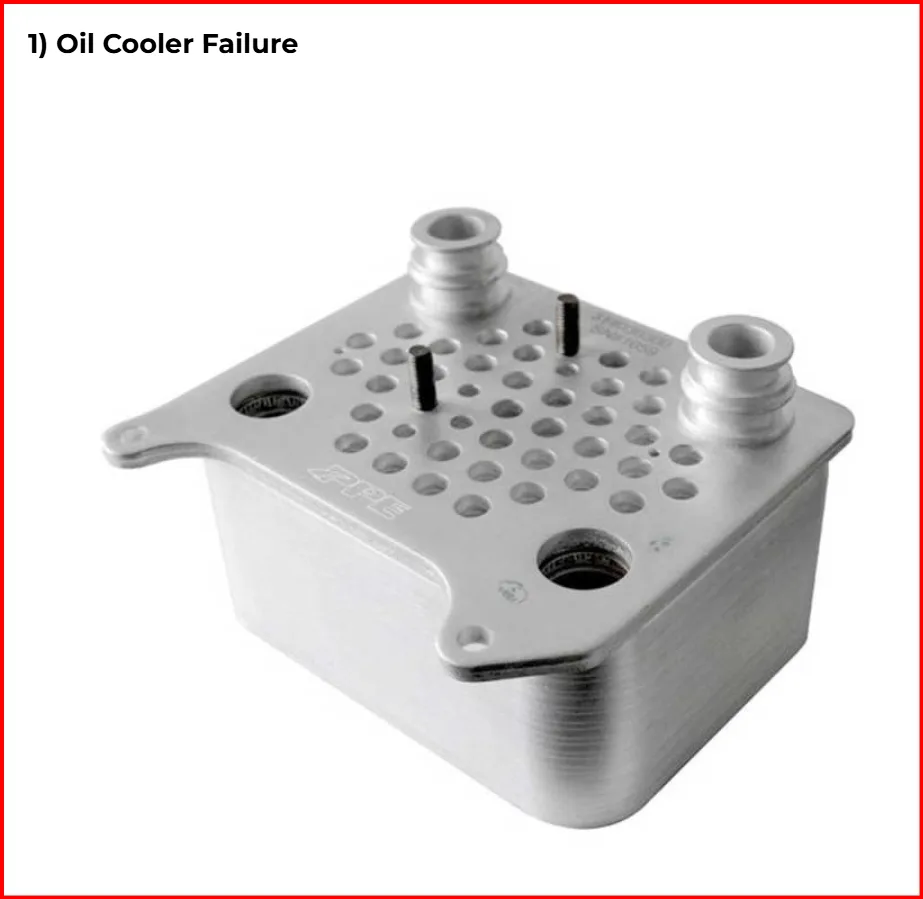
1. The oil cooler — where it usually starts
Coolant runs through the engine oil cooler before it feeds the EGR cooler, and the cooler's passages are narrow enough that casting sand and scale from the cooling system plug them up. As flow drops, oil temperature climbs away from coolant temperature — a widening oil-to-coolant split is the classic tell, and it can be measured before anything lets go. A plugged oil cooler then starves everything downstream of it, which is why the oil cooler and the EGR cooler almost always fail as a pair. We replace the cooler and properly flush the system, instead of swapping the part and handing the same problem back to you.
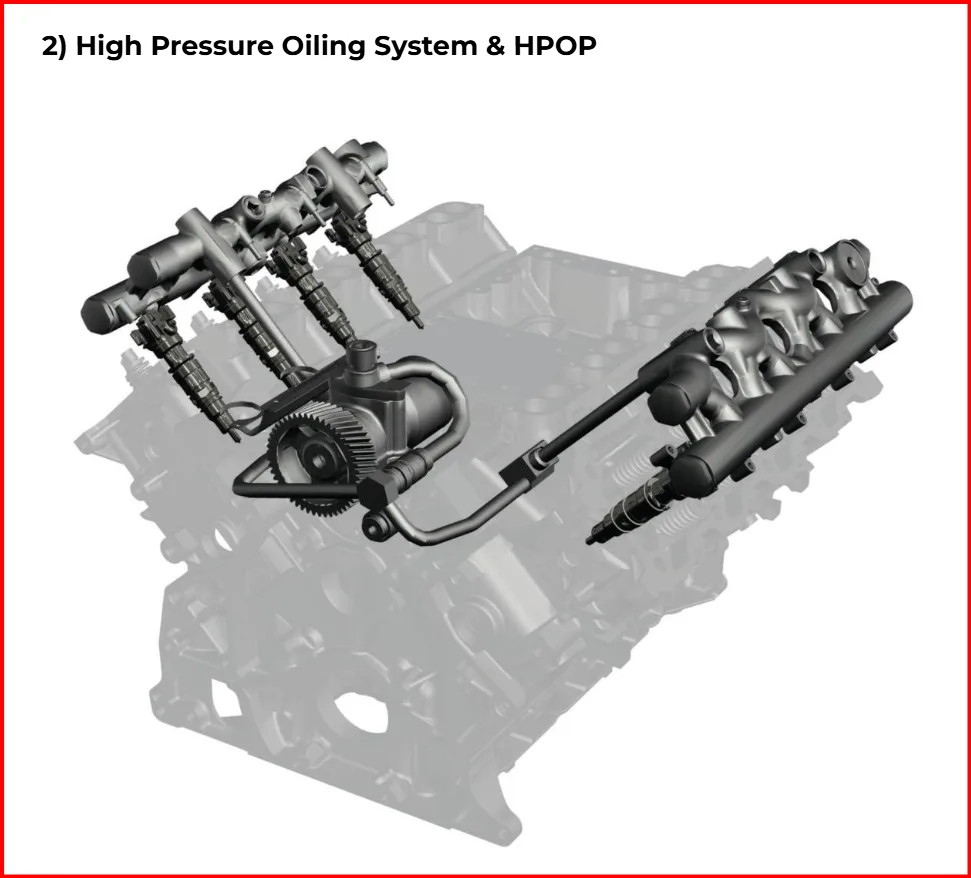
2. High-pressure oil system & HPOP
The 6.0 fires its injectors using high-pressure engine oil, not just fuel pressure — so any leak in that circuit shows up as long cranking, a hard start, or a no-start, and it is always worst when the engine is cold. The usual leak points are the STC fitting on the high-pressure oil pump, the branch tube connections, and o-rings that have gone hard with age and heat. This one gets misdiagnosed as a fuel problem constantly. The right approach is to actually test the high-pressure oil circuit and find where pressure is escaping before anyone starts replacing injectors.
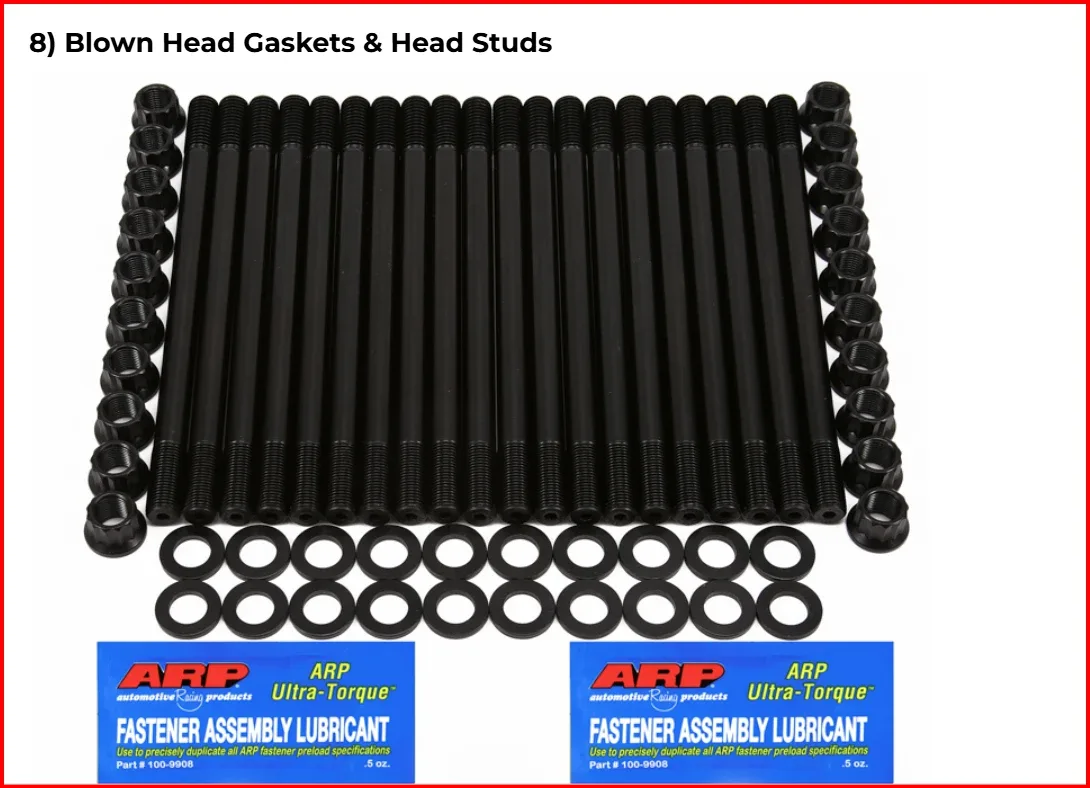
3. Blown head gaskets — and the fix that lasts
The factory head bolts are torque-to-yield: they stretch once on installation and hold a fixed clamping load. Combine that with the cylinder pressure these engines make — plus the overheating a plugged oil cooler and a failed EGR cooler cause — and the head lifts just enough to push combustion gases into the cooling system. You see coolant loss with no visible leak, white smoke, and bubbling in the degas bottle. Doing it once means pulling the heads, having them checked and machined, and installing ARP head studs, which hold substantially more clamping force than the stock bolts and are the difference between a repair and a repeat.
What it costs to fix
Typical ranges in Canadian dollars — every vehicle is quoted individually.
Proper diagnosis and health check
$180-$400 CAD
Scan for injector and FICM codes, test FICM output voltage, run an oil-versus-coolant temperature comparison under load, and pressure-test the cooling system. On a 6.0 this hour or two of testing routinely saves thousands in parts guessed at and replaced for nothing.
Blue spring kit and STC fitting update
$300-$800 CAD each, installed
Two cheap, permanent fixes using Ford's own updated parts. The blue spring raises fuel pressure to protect the injectors on any year; the STC fitting update ends the hot-start and sudden no-start risk on 2005-2007 engines. Both are worth doing proactively.
FICM repair or replacement
typically $500-$1,500 CAD
Board-level repair services are the budget route; a replacement or upgraded module with programming sits at the top of the range. Fixes hard cold starts and rough running when the module tests below spec. Replace weak batteries at the same time or the new module will suffer the same fate.
Oil cooler and EGR cooler job
typically $3,000-$5,500 CAD
The signature 6.0 repair: both coolers live in the engine valley and are done together, with a cooling system flush. An upgraded EGR cooler adds roughly $800-$1,500 in parts over a factory-style unit and is usually money well spent, since the factory design is the part that failed.
Injector replacement
$600-$1,000 CAD per injector installed; $5,500-$8,500 for a full set
Failed or sticking injectors are usually replaced individually after cylinder-contribution testing. A full set only makes sense on a high-kilometre engine already apart for other work. Quality reman injectors are fine; bargain-bin ones are a false economy.
Head gaskets with ARP studs
typically $7,000-$12,000 CAD
The definitive fix for lifted heads: cab off or engine out, heads machined, studs installed, new gaskets. The range depends on whether the heads can be machined or must be replaced, and what else is found. Bundling the oil cooler, EGR cooler and STC fitting while it is apart pushes a full package to roughly $12,000-$18,000 but does everything once.
Genuine OEM replacement engine (through Eskimo Auto & Truck Parts)
engine typically $3,500-$7,000 CAD; $9,000-$15,000 installed
When a hydrolock, spun bearing or cracked block takes out the bottom end, a tested low-kilometre genuine OEM takeout engine is the more reliable choice than rebuilding a damaged core, and it is exactly what Eskimo Auto & Truck Parts stocks. Plan for studs and cooler updates on the replacement engine while it is on the floor, since it will have the same factory weak points.
Remanufactured engine
reman long block from roughly $7,000-$12,000 CAD; $16,000-$25,000 installed
The full-replacement route. Quality Canadian remans often come with studs and updated coolers already built in, plus a real warranty. Only sensible on a truck whose body, frame and driveline justify it, which many clean western trucks do.
Repair it, or replace it?
If the truck has under roughly 250,000 km, a straight body and a solid frame, fix the specific failure and keep driving. Individual repairs on a 6.0 almost always cost less than replacing the truck with anything comparable.
A head gasket and stud job at $7,000-$12,000 sounds brutal against an old truck's book value, but a properly sorted 6.0 Super Duty consistently sells for more than book, and nothing you can buy for that money tows like it. The math usually favours the repair if the rest of the truck is sound.
Once the bottom end is damaged, from hydrolock, a spun bearing or a cracked block, stop putting money into that core. A tested genuine OEM engine installed for $9,000-$15,000 is normally the better play than a $16,000-$25,000 reman unless you plan to keep the truck another decade.
On E-Series vans, engine access drives labour up on every big job, so the balance tips earlier toward pulling the engine and swapping in a complete genuine OEM unit rather than doing head work in the chassis.
At typical Alberta fleet mileages of 300,000-400,000 km, judge the whole truck, not just the engine: if the transmission is tired, the cab mounts and box are rusting, and the front end is loose, the repair bill rarely stops at the engine. A clean western truck is worth fixing; a rough one is a parts donor.
Do not pay for full preemptive bulletproofing on a healthy engine. Do the cheap protective updates now (blue spring, STC fitting, maintenance) and save the studs and coolers for whenever the engine is legitimately apart.
How we fix this in Edmonton
Engine Repair & Replacement in Edmonton
A bad engine doesn't automatically mean a new vehicle. We diagnose before we condemn — and then we can fix it every way there is: rebuild it in-house, install a remanufactured ATK engine, or fit a genuine OEM engine sourced through our sister company, Eskimo Auto & Truck Parts.
See the service →Diesel Truck Repair in Edmonton
We fix light-duty diesel pickups — Power Stroke, Duramax and Cummins — and we diagnose them before anyone starts condemning $4,000 parts. Heavy highway trucks belong in a heavy-duty shop and we will tell you so, and we do not hold a CVIP facility licence. Everything else gets tested, quoted in writing, and explained in plain language before we start.
See the service →Heating, Cooling & A/C in Edmonton
In Edmonton a working heater is safety equipment — it's what keeps your windshield clear at -30. We fix the whole climate system: cabin heat, engine cooling and A/C, with the diagnosis done before the parts go on.
See the service →The genuine OEM parts option
If the repair math points to a replacement engine or major parts, our sister company Eskimo Auto & Truck Parts in Edmonton regularly dismantles 2003-2010 Super Duty pickups and E-Series vans, which means complete tested genuine OEM 6.0L takeout engines, cylinder heads, turbochargers, FICMs, wiring harnesses and TorqShift transmissions, alongside the body panels, doors, boxes and axles these trucks eventually need too. We will be straight with you about what makes sense: a compression-tested genuine OEM takeout engine or a good set of heads is often the right-part-for-the-job, while wear items like injectors and oil coolers are usually better bought new. Every part is pulled, inspected and warrantied by people who work on these engines, and we ship across Canada and the USA.
Browse inventory at Eskimo Auto & Truck Parts →How to make yours last longer
- Change the oil on time, every time, with a quality diesel-rated 15W-40 (or 5W-40 synthetic for winter) and don't stretch intervals; the HEUI injection system fires injectors with engine oil, so old, sheared-down oil directly causes stiction and injector wear.
- Maintain the cooling system like it matters, because on this engine it does: use the correct coolant, never mix types, test and flush on schedule, and chase down any coolant loss immediately. Degraded coolant is half of what plugs the oil cooler.
- Monitor oil and coolant temperatures with an inexpensive scan gauge. A spread wider than about 8°C under load means the oil cooler is plugging, and catching it there is a $3,000 problem instead of a $12,000 one.
- Keep both batteries strong and load-test them every fall. Low cranking voltage is the number-one killer of marginal FICMs, and Alberta cold snaps will find yours. Plug in the block heater below about -15°C.
- Do the blue spring fuel pressure update and, on 2005-2007 engines, the STC fitting update before they cause trouble. Together they are a few hundred dollars of genuine insurance.
- Give the truck regular highway runs under load. Variable-geometry turbos and EGR valves coke up and stick on trucks that idle all day and never see boost.
- Warm the engine before working it hard, and avoid lugging it up grades in too high a gear; sustained peak cylinder pressure is what stretches the factory head bolts.
Frequently asked questions
What years of the 6.0 Power Stroke are affected?
All of them share the same core weak points. The 6.0L ran in F-250 through F-550 Super Dutys from mid-2003 to 2007, in the Excursion from 2003 to 2005, and in E-350/E-450 vans from 2004 through 2010. Later engines (2005-2007) got a revised high-pressure oil pump and calibration improvements but added the STC fitting problem. There is no trouble-free year, only trucks whose weak points have or have not been addressed.
What does "bulletproofing" a 6.0 actually mean?
The term comes from an aftermarket vendor and has no fixed definition, which is why ads abuse it. In practice it means addressing the known weak points: an upgraded EGR cooler, a fresh or relocated oil cooler, ARP head studs, a repaired or upgraded FICM, the blue spring fuel pressure update, and on 2005-2007 engines the STC fitting fix. A truck is only as bulletproofed as the invoices prove, so always ask to see them.
Is bulletproofing worth it, or is it hype?
Parts of it are absolutely worth it, at the right time. Studs whenever the heads are off, a quality EGR cooler whenever the factory one fails, the cheap blue spring and STC updates on every truck. What is hype is tearing down a healthy stock engine to do it all preemptively, spending $12,000-plus to prevent a failure that a stock, well-maintained truck may never have. Maintain it properly, watch the oil-to-coolant temperature spread, and fix weak points as the engine comes apart anyway.
How do I know if my EGR cooler is failing?
The early sign is unexplained coolant loss with no visible leak. The unmistakable sign is white, sweet-smelling steam from the exhaust, worst after idling or on startup. A shop can confirm it by pressure-testing the cooling system and inspecting for coolant in the intake or exhaust. If it has failed, insist the oil cooler be tested or replaced at the same time, because a plugged oil cooler is what starves and kills EGR coolers in the first place.
Why does my 6.0 start hard when it's cold?
The most common cause in a cold climate is a failing FICM, the module that steps voltage up to 48 volts to fire the injectors. Its factory solder joints crack, and cold weather pulls them apart just enough to drop voltage below what the injectors need. Weak batteries make it worse and shorten the module's life. A shop can read FICM voltage in minutes; repair or replacement typically runs $500-$1,500 CAD, far cheaper than the injectors people often replace first by mistake.
How much does it cost to fix the common 6.0 problems in Canada?
Typical Alberta ranges: FICM repair or replacement $500-$1,500; blue spring and STC fitting updates a few hundred each; the oil cooler and EGR cooler job $3,000-$5,500; injectors $600-$1,000 each installed; head gaskets with studs $7,000-$12,000; a full bulletproofing package around $12,000-$18,000; a genuine OEM engine installed $9,000-$15,000; a reman engine installed $16,000-$25,000. All depend on what is found once it is apart, so treat quotes tighter than that with suspicion.
Was there ever a recall or lawsuit over the 6.0 Power Stroke?
The big-ticket failures were never the subject of a safety recall. Ford absorbed enormous warranty costs, sued engine builder Navistar over them in 2007, and a consolidated US class action over the 6.0L settled in 2013, but that settlement covered US-market vehicles and its claim deadlines passed long ago. These engines are now 16 to 23 years old; there is no factory or goodwill coverage left, so buy and repair accordingly.
Can I just delete the EGR cooler instead of replacing it?
Removing or disabling emissions equipment on a road-driven vehicle is illegal in Canada, and it can complicate insurance claims and out-of-province inspections. It is also unnecessary: modern upgraded EGR coolers with welded internals have solved the factory design's weakness, and fixing the oil cooler that starves them addresses the root cause. Deletes belong on dedicated off-road and competition trucks, not a work truck you licence and insure.
Is a 6.0 Power Stroke truck still worth buying in 2026?
A good one, yes. These are the cheapest way into a diesel Super Duty, and one with documented cooler, stud and FICM work is arguably more dependable than its reputation suggests. Budget realistically: assume a $3,000-$5,000 repair is coming unless invoices prove otherwise, get a pre-purchase inspection that includes FICM voltage and an oil-versus-coolant temperature check, and walk away from any "bulletproofed" claim without paperwork.
Should I rebuild my 6.0 or swap in a genuine OEM engine?
It depends on what died. Head gaskets, coolers, injectors and the FICM are all repairs, not engine replacements. But once the rotating assembly or block is damaged, from hydrolock or a spun bearing, a tested low-kilometre genuine OEM engine is usually the sensible fix at $9,000-$15,000 installed, versus $16,000-$25,000 for a reman. Whichever engine goes in, do the studs, coolers and small updates while it is out of the truck.
Dealing with this problem right now?
Edmonton and area: bring it in and we'll confirm the diagnosis before any work. Anywhere else in Canada or the USA: our sister company ships the genuine OEM parts to your shop.