Brakes don't fix themselves, and Edmonton winters are hard on them. We inspect first, show you the measurements, and quote the work before a wrench touches your vehicle. If your brakes are fine, we'll tell you that too.
Edmonton is a rough town for brakes. Road sand and salt pack into the calipers all winter, freeze-thaw cycles rust the rotors, and vehicles that sit outside overnight grow a layer of surface rust on the braking surfaces by morning. The most common brake problem we see here isn't worn pads — it's seized caliper slide pins and rusted rotor edges after a couple of winters. Pads are the part everyone thinks about, because pads are the part you can see through the wheel. That is why a proper brake job in this city is more than slapping on new pads: the hardware and the caliper service decide whether the new pads wear evenly or one of them is scrap in a year.
What a Brake Inspection Actually Measures, and Why You See the Numbers
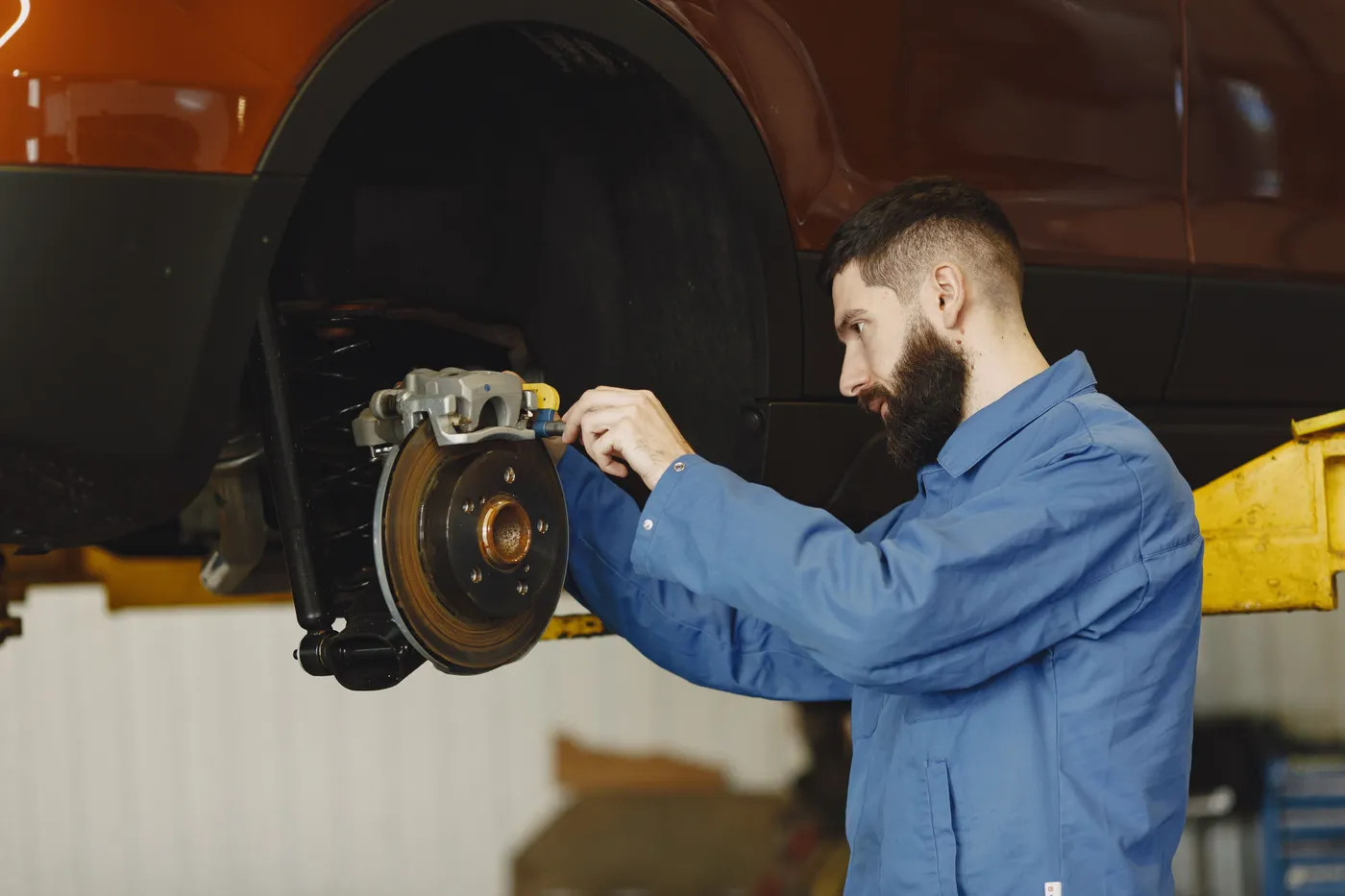
Where the vehicle is safe to drive, a brake inspection starts with a road test, because a noise under braking, a noise while rolling and a noise while turning point at three different parts. Then the wheels come off. We measure pad and rotor thickness, work the slide pins and pistons by hand instead of eyeballing them, and check the calipers, hoses and hard lines for seizing, leaks and rust, along with the hardware, the fluid and the parking brake. Then we walk you through it on the hoist, and you get a written quote before any work happens, with what needs doing now separated from what can wait. We don't sell brake jobs to people who don't need them — worn-out brakes come back on their own schedule, and so do customers who were treated straight.
Brake Repair Cost in Edmonton: What Moves a Job Above $150
Brake work starts at $150 per axle. That is the starting point for a straightforward pad job on a common car or SUV, not a package price. What moves a vehicle above it is the parts it takes rather than the labour rate, and on a salted vehicle those additions are predictable: rotors that have gone past the discard spec, a caliper that will not free up, a seized bleeder, a rounded caliper bolt, a rotten hard line, or parking brake shoes found seized once the rotor is off. The biggest single swing is whether rotors go on with the pads, because on most vehicles a pair of rotors costs more than the pads that run against them. A brake inspection is its own flat charge, quoted when you book rather than billed by the hour. A front-end shakedown for a clunk, or electronic diagnosis of a brake or ABS warning light, is diagnostic time at $120 per hour instead, because those are different inspections from a brake inspection. Book both on one visit and they show up as two lines on the quote, so you can see exactly what each one covers.
Rotor Minimum Thickness: When Rotors Can Be Reused and When They Can't
Every rotor carries a minimum thickness cast or stamped into the hat, and that discard spec is a limit rather than a suggestion. A rotor above it, running true and not badly scored, can be reused, and when yours measure healthy we keep them and the money stays in your pocket. Machining a rotor — turning it on a lathe to clean the faces up — removes metal and moves it toward that limit, and modern rotors leave the factory thin enough that there is often nothing to give. It also does nothing about the two things that actually finish rotors here: cooling vanes corroding from the inside, and a rust-jacked outer edge that lifts the rotor out of true. We measure yours and tell you whether they can be reused. In Edmonton the rust usually decides for you after a few winters.
Seized Caliper Slide Pins and Rust-Jacking: The Edmonton Failure
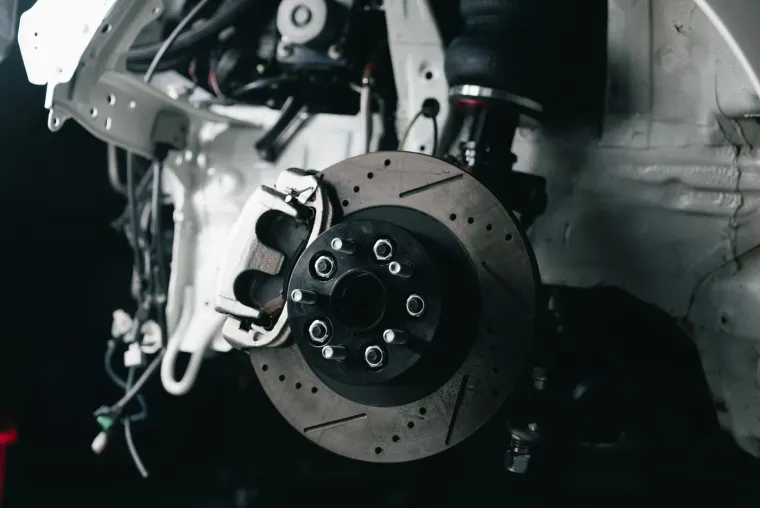
A floating caliper has to slide on its pins to clamp both pads evenly, and in this city it stops sliding. Salt-laden water works its way under the pin boots and behind the piston seals, and the corrosion it leaves binds the moving parts solid, so one pad ends up carrying the whole corner. Rust-jacking is the other half of it. Iron oxide takes up more room than the steel it grew from, so corrosion spreading under a pad's friction material cracks it off the backing plate, and corrosion on the hub face lifts the rotor out of true. That runout is the real cause of most pedal pulsation blamed on warped rotors. A brake job done properly cleans the hub face back to bare metal before the new rotor goes on, replaces the abutment clips where the old ones are rusted, and frees and relubricates the slide pins — skip that and the new pads wear the way the old ones did.
Brake Fluid, Rusted Brake Lines and Flex Hoses: The Parts You Never See
Brake fluid is hygroscopic: it pulls moisture out of the air through the reservoir and the rubber hoses over years, and water lowers the boiling point. That is why fluid carries a dry rating and a wet one, and DOT 4 has to meet roughly 230 C dry and 155 C wet to carry the rating at all. Boiled fluid is a pedal that sinks toward the floor on a long descent, or when a dragging caliper cooks one corner. The steel hard lines rot the other way, from the outside in under salt spray, worst where moisture sits trapped and never dries: along the frame rail, over the rear axle and under the body clips. A hard line can pass a glance and split under a hard stop eight weeks later. Rubber flex hoses fail differently again, collapsing internally and holding one caliper applied so that corner drags.
Truck Brakes, Trailer Loads and Parking Brakes Seized Inside the Rotor
Truck brakes are not car brakes scaled up in price alone. Bigger rotors, more pad material, heavier hardware and sometimes multi-piston calipers mean the labour is similar and the parts are not, which is why a half-ton costs more per axle than a Civic. Heat is the second half of it, because brakes turn motion into heat, and a loaded three-quarter-ton or a trailer behind a half-ton puts far more of it through the same corner. That is what cooks fluid and heat-checks rotors. Many trucks and SUVs also run a drum-in-hat parking brake, where the shoes live inside the rotor hat. They can only be inspected with the rotor off, and salt seizes them, which is why a parking brake that won't release after a cold night so often turns up on a truck. Older and lighter vehicles still run rear drums, with wheel cylinders and self-adjusters that seize the same way.
How to Check Your Own Pad Thickness Through the Wheel
You can check your own pad life through the wheel spokes. Look at the outer pad and judge the friction material against the steel backing plate it is bonded to. New pads generally start around 10 to 12 mm of material, and replacement is usually the call somewhere around 3 mm, though we go by what your pads actually measure rather than a number off a chart. Run a fingertip down the outer rotor edge as well, because a pronounced lip means the face has worn away beneath it. Both checks have an honest limit: a sticking slide pin wears the inner pad first, and you cannot see that pad through the spokes, so what you can see tells you to book, never that you are fine. A squeal by itself is no reason to replace rotors that measure fine, and our guide at /problems/grinding-brakes sorts out what each brake noise means.
Hard-to-Find Brake Parts for Older Vehicles in Edmonton
Our sister company, Eskimo Auto & Truck Parts, is one of Edmonton's largest parts operations, and on brakes that matters most on older vehicles. Wear items are new here: pads, rotors, hoses, hardware and fluid. What gets hard to find is the rest of the corner on a vehicle the manufacturer has stopped supporting — a caliper bracket, a backing plate, a drum-in-hat parking brake assembly, or an ABS sensor that only ever came as part of a hub. Those parts are either discontinued or priced like a down payment, and on a fifteen-year-old truck they decide whether the vehicle is worth keeping on the road at all. A recycled genuine OEM piece often turns that decision around. Call (780) 482-2424 and we'll tell you which route your vehicle is looking at.
Signs you need this service
- Squealing or screeching when you brake — the wear indicators are doing their job
- Grinding metal-on-metal noise, which means the pads are gone and the rotors are next
- A soft or spongy pedal, or a pedal that slowly sinks at a stoplight
- The vehicle pulls to one side when braking — often a seized caliper
- Pulsation or vibration through the pedal or steering wheel at highway speed
- A burning smell from one wheel after driving, another seized-caliper giveaway
- The brake or ABS warning light is on
- The parking brake sticks or won't release after sitting in the cold
- A wet spot on the inside of a wheel, with the pedal going further than it used to
What's included
- Full brake inspection with pad and rotor measurements, in writing
- Brake pad and rotor replacement, with rotors reused when they measure within spec
- Caliper service and replacement, including cleaning and lubricating slide pins
- Brake fluid testing and flushes
- Rusted brake line and hose repair — common on Alberta vehicles
- Parking brake service, including cables seized from winter slush
- ABS and brake warning light diagnosis
- Road test before and after, where the vehicle is safe to drive
- Written quote before any work starts
Frequently asked questions
How much does a brake job cost in Edmonton?
Brake work starts at $150 per axle. Rotors as well as pads, a seized caliper, rusted hardware or a brake line adds to that, and trucks and vehicles with bigger brakes cost more. We inspect, show you the measurements and quote before doing anything, so the number you approve is the number you pay.
Do you charge for a brake inspection?
Yes, and it is a flat charge quoted when you book, not an hourly one. It covers the road test, all four wheels off, and pad, rotor, caliper, hose, line, fluid and parking brake measurements in writing. What is billed hourly is diagnostic time at $120 per hour, which is a different job: electronic diagnosis of a brake or ABS warning light, or a front-end shakedown for a clunk or a wander. Tell us what the vehicle is doing when you call and we'll tell you which one it needs.
If I need new rotors, do I need new pads too?
Yes, and both go on across the whole axle rather than one corner. Pads bed into the surface they live against, so used pads on fresh rotors waste both, and mismatched friction left to right makes a vehicle pull. On parts, a quality aftermarket rotor is a perfectly good repair on most vehicles, while on some European cars the OEM piece is worth the difference. Where both make sense we quote both.
How long do brake pads last?
Typically somewhere between 40,000 and 80,000 km, but driving style and conditions swing that number a lot. City stop-and-go, towing, and gravel driving wear pads faster. Rear pads on newer vehicles sometimes wear faster than fronts because of how the stability control applies them. The only way to know is to measure, which we do with every inspection.
My brakes grind for the first few stops in the morning. Is that bad?
Usually not. A film of surface rust forms overnight on a vehicle parked outside, and the first few stops scrape it off. What matters is whether the noise leaves. A grind that clears within a block or two is the rust; a grind on every stop is not, and it gets more expensive every week you drive on it. Our guide at /problems/grinding-brakes goes through each brake noise and what it means.
Can you fix a seized caliper, or does it have to be replaced?
Often it can be serviced. Seized slide pins are one of the most common brake problems in Edmonton, and cleaning and relubricating them fixes it. If the piston itself is seized or the caliper body is badly corroded, replacement is the right repair, and we'll show you why before recommending it.
How often should brake fluid be changed?
Go by your manufacturer's interval, commonly somewhere in the two-to-three-year range, and by what the fluid actually tests at. We test it with the inspection, and if it's fine, it stays. The reason it is on the list at all is corrosion as much as pedal feel: moisture carried in old fluid attacks caliper bores, steel lines and the ABS modulator from the inside, and a modulator is a far larger bill than a flush.
Why did my brake line rust through?
Because a steel line rusts from the outside in, and it spends its whole life a few millimetres off the road getting coated in brine. The wall thins while the outside still looks like a brake line, and there is no warning stage the way a worn pad squeals. It holds full pressure until a hard stop splits it, and then the pedal drops and the brake light comes on because a circuit has lost pressure. Patching one spot only moves the failure down the run, so we replace the run.
Can you do just the front axle?
Yes. Brakes are measured, quoted and replaced by axle, and the fronts do most of the stopping, so fronts needing pads while the rears still have life left is completely normal. What we won't do is replace one side of an axle and leave the other, because mismatched friction across an axle makes a vehicle pull. We measure all four corners anyway, so you can plan for the rears instead of being surprised.
Known problems we repair
Deep guides on the failures we see most — symptoms, honest costs, and repair options.
Related services
Book your brake repair & service
Call for a straight answer on cost and timing, or book online.