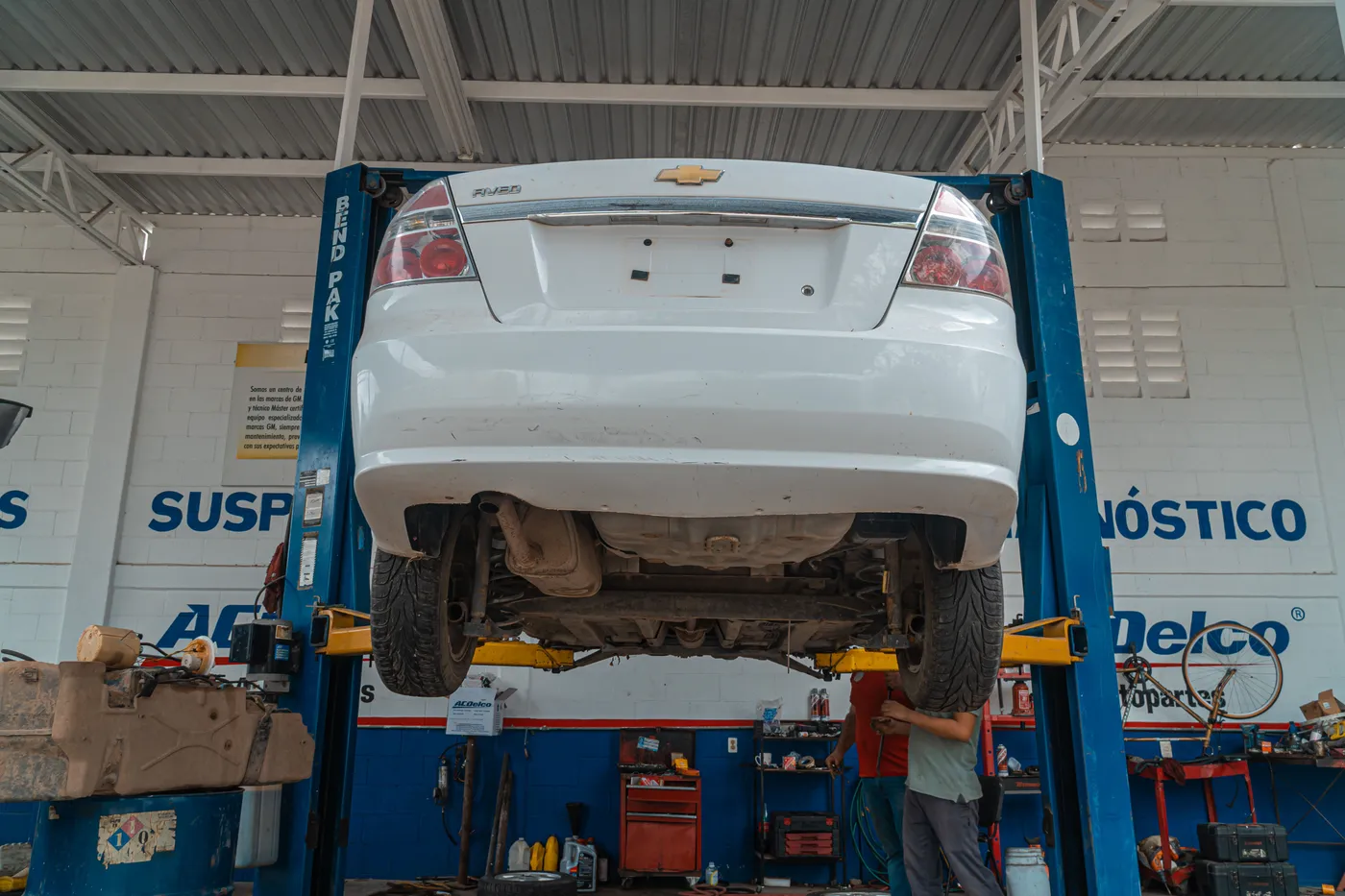
Alignment is the cheapest way to protect the most expensive wear item on your vehicle — the tires. We measure all four wheels on the rack, hand you the before-and-after printout, and tell you straight if the real problem is a worn tie rod, a seized caliper, or a bad tire instead. If your alignment is already in spec, we'll show you the numbers and stop there.
An alignment doesn't make your vehicle faster or quieter. What it does is set the angles your wheels sit at so all four tires roll straight instead of dragging sideways down the road — and on a set of winter tires that runs a thousand dollars or more, a half-degree of toe error will feather the tread and cost you a real chunk of a set's life in a single season. That's the real argument for it: alignment is the cheapest thing you can do to protect the most expensive wear item on the vehicle. We put it on the rack, measure every angle on all four wheels, and hand you a printout of the before and after readings. If everything is already in spec, we show you the numbers and stop there — no adjustment invented to justify the visit.
Camber, Caster and Toe — What a Wheel Alignment Actually Adjusts
Three angles do the work, and they're simpler than the names suggest. Toe is whether the tires point in or out when you look down from above — think of standing pigeon-toed. It's the angle that destroys tires fastest, because even a small error means the tread is scuffing sideways the entire time it's rolling. Camber is the lean of the tire when you look at it head-on, the top tipped in or out; too much of it wears one edge bald while the rest of the tread still looks new. Caster is the tilt of the steering axis — it's what brings the wheel back to centre after a corner and keeps you tracking straight on the highway. Toe is adjustable on virtually every vehicle. Camber is on some and not on others — plenty of strut-front cars need aftermarket camber bolts or plates before it can be moved at all. Caster often isn't adjustable, and when caster is out, something is usually bent.
Why Edmonton Potholes, Freeze-Thaw and Gravel Roads Wreck Your Alignment
Alignment doesn't drift on its own — something knocks it out. In Edmonton, that something is usually a pothole. Freeze-thaw works water into the pavement all winter, and by March the roads open up; one hard edge-on hit at 60 km/h is enough to shift a tie rod, tweak a strut, or bend a rim. Winter adds curb strikes hidden inside snow windrows, and anyone running gravel or lease roads gets the same damage in slow motion, with washboard hammering the steering linkage loose over months. Road salt makes the repair harder too. The cam bolts and adjuster sleeves an alignment has to turn seize solid after a few Alberta winters, so on an older vehicle a real chunk of the labour is heat, penetrating oil and patience before a single reading changes.
Do I Need an Alignment? When to Get One in Edmonton, and What It Costs
Get one when you buy new tires — putting fresh rubber on a vehicle that's out of spec is the most expensive way to find out it was out of spec. Get one any time steering or suspension parts are replaced: struts, tie rod ends, ball joints, control arms, a rack. Get one after a hard pothole or curb strike, and get one if the steering wheel sits crooked while you're going straight, the vehicle pulls, or you see feathered or one-edge tire wear. Otherwise, once a year or at your seasonal tire swap is plenty for most Edmonton drivers. On cost, a four-wheel alignment typically runs somewhere between about $120 and $200 for most cars and SUVs. Lifted and heavy-duty trucks, and vehicles needing camber bolts or shims, run higher — we quote that once it's on the rack.
Four-Wheel vs Front-End Alignment, and Why Worn Parts Get Fixed First
A front-end alignment sets front toe and camber only. A four-wheel alignment measures the rear as well and calculates thrust angle — the direction the rear axle is actually pointing — then sets the front to match it. That matters, because a rear axle that's off is why some vehicles track slightly crab-wise with a crooked steering wheel that no front-end adjustment will ever straighten. We do four-wheel on anything that will take it. What we won't do is align a front end with play in it: a loose tie rod end or worn ball joint means the readings move every time the wheel does, and the alignment won't survive the first pothole. Those parts get replaced first, and with our sister company Eskimo Auto and Truck Parts — one of Edmonton's largest parts operations — we can usually have the right genuine OEM piece in hand the same day.
Signs you need this service
- The steering wheel sits off-centre or cocked to one side when you're driving straight
- The vehicle pulls, and you're holding steady pressure on the wheel to stay in your lane
- Feathered tread — run your hand across a front tire and it's smooth one way, sharp the other
- One edge of a tire is worn bald while the rest of the tread still looks close to new
- Tires squeal or chirp on slow corners and in parking lots — that's rubber scrubbing sideways
- You just hit a pothole, a curb, or a frozen chunk of windrow hard enough to make you wince
- New tires are going on, or steering and suspension parts were just replaced
- The vehicle wanders on the highway and needs constant small corrections, worse on gravel
What's included
- Four-wheel alignment on a computerized rack — camber, caster, toe and thrust angle measured at every corner
- Printed before-and-after readings so you can see exactly what was out and what was changed
- Pre-alignment shakedown of tie rods, ball joints, wheel bearings, struts and bushings for play
- Tire pressure and tread wear check first — a low tire and a conicity pull both mimic an alignment problem
- Rear toe and thrust angle correction on vehicles that allow rear adjustment
- Seized cam bolts and adjuster sleeves freed with heat and penetrant — routine work on salted Alberta vehicles
- Camber bolts, shims and correction hardware supplied when a vehicle genuinely needs them
- A straight answer if your alignment is already in spec, or if the real fault is a brake, tire or worn part
Frequently asked questions
How much does a wheel alignment cost in Edmonton?
For most cars and SUVs, a four-wheel alignment typically runs somewhere between about $120 and $200, depending on the vehicle. Lifted or heavy-duty trucks, dual-rear-wheel one-tons, and anything that needs aftermarket camber bolts or shims run higher, and seized adjusters on an older salted vehicle add labour to free them up. If we find worn steering or suspension parts that have to be replaced first, we stop and quote that separately before touching anything. You get the number in writing before work starts, and the before-and-after printout when it's done.
How do I know if I need a wheel alignment?
Three easy checks you can do yourself. On a flat, empty stretch of road, ease off the wheel for a second — if the vehicle drifts hard one way, something is off. Look at the steering wheel while you're going straight; if the badge sits cocked to one side, the toe is out. Then run your hand across the tread of each front tire, inward and outward — smooth one direction and sharp the other is feathering, and feathering is toe wear. Any of those, or a fresh pothole hit, is worth having checked.
My car pulls to one side. Is it always the alignment?
No, and it's worth saying out loud, because plenty of pulls get "fixed" with an alignment that never needed doing. A seized brake caliper drags one wheel and pulls the same way — usually with a hot wheel and a faint burning smell after a drive. A tire with a shifted belt or conicity pulls on its own; swap it side to side and the pull follows the tire. Uneven pressures do it too. We check tires, pressures and brakes before we start turning adjusters, because an alignment fixes none of those.
Do I need an alignment when I get new tires?
We recommend it, and we'll tell you when you can skip it. If the tires coming off wore evenly right across the tread, your alignment was doing its job and you're probably fine. If they're feathered, worn on one edge, or the vehicle has had suspension work or a hard pothole hit since the last alignment, get it checked — new tires on an out-of-spec vehicle can lose a noticeable amount of tread in one season, which costs far more than the alignment does. Straight seasonal swaps between summer and winter sets don't need one every time.
Why do worn tie rods or ball joints have to be fixed before an alignment?
Because otherwise the alignment won't hold. The angles only mean something if the parts holding the wheel are tight. A worn tie rod end or ball joint lets the wheel move on its own, so the readings we set on the rack shift the first time you hit a bump, and you're right back where you started with a bill to show for it. We shake down the front end before the vehicle goes on the rack, show you any play we find, and quote the repair. That's not an upsell — it's the difference between an alignment that lasts and one that doesn't.
Four-wheel or front-end alignment — which does my vehicle need?
Four-wheel, in almost every case. It measures the rear axle as well as the front and works out thrust angle, which is the line the vehicle actually tracks along. Align the front to the body instead of to the rear and you can end up with a perfectly straight set of front wheels and a steering wheel that still sits crooked. Front-end-only alignments still make sense on some older solid-rear-axle trucks with no rear adjustment, and we'll tell you if that's your vehicle. Either way, you leave with the printed readings.
Known problems we repair
Deep guides on the failures we see most — symptoms, honest costs, and repair options.
Related services
Book your wheel alignment
Call for a straight answer on cost and timing, or book online.