
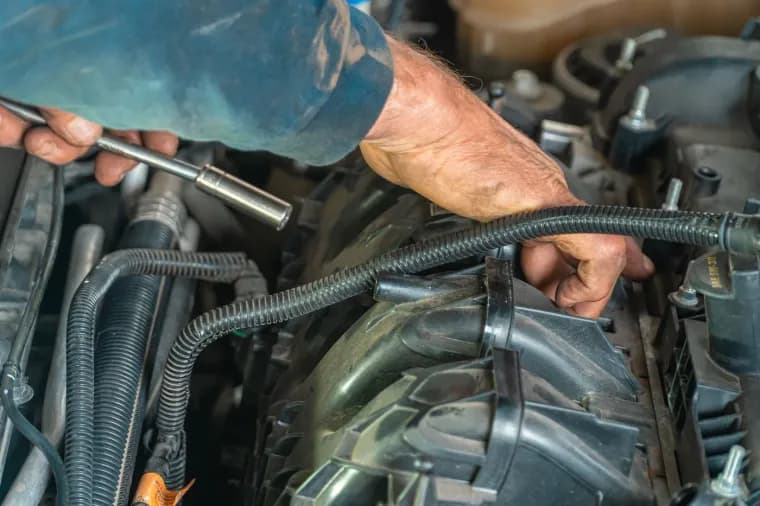
The engine is condemned and now you have to decide what goes back in. On a vehicle worth keeping, a remanufactured unit is often the answer: we supply and install ATK engines, and the 4-year no-fault warranty is included in the price rather than sold on top of it. Full terms on this page.
'Remanufactured' gets used loosely, so here is what it actually means: a remanufactured engine has been completely disassembled, cleaned, machined and rebuilt back to the original manufacturer's specifications — or better — with new wear components and updated parts where the factory design had a weakness. It is not a used engine pulled from a wrecked vehicle, and it is not a quick reseal. We supply and install ATK remanufactured engines at 12940 53 Street NW, and because we do the installation too, one shop answers for both the engine and the work. The engine also carries a 4-year no-fault warranty on gas, non-commercial engines, included in the price rather than sold on top of it; the full terms, including what the labour cover does not pay for, are in the two sections below. Eskimo Auto Repair is AMVIC licensed, and the quote you get covers the engine and the installation together rather than the engine now and the labour later.
The 4-Year No-Fault Warranty, Included in the Price
Every ATK remanufactured gas engine we install in a non-commercial vehicle carries a 4-year no-fault nationwide warranty. That is ATK's Gold cover, and it is included in the engine price rather than sold as an upgrade at the bottom of the invoice. ATK's own standard cover is three years, parts only. We include the upgrade at no charge, because the warranty is part of what you are buying. There is no kilometre limit and no deductible. The term starts the day the engine is installed, not the day it was built or the day it shipped. No fault means there is no investigation into the cause of the failure, and that is the part worth understanding: on most warranties the first thing that happens after a failure is an argument about why it failed, and here that step does not exist. Diesel engines and vehicles in commercial use are quoted on different terms, so ask us for those before you commit.
What the Warranty Covers, What It Doesn't, and How a Claim Works
Labour is covered, with limits you should know before you need them. Warranty labour is paid to $95 per hour, and only for the remove-and-replace hours Mitchell publishes for your vehicle. That $95 is the rate the warranty pays, not necessarily a shop's full posted rate, so we go through exactly what a claim would cover on your vehicle before you commit. Diagnostic time is not covered. Fluids are not covered. Gaskets are not covered. Towing is not covered. Anyone telling you a reman engine warranty is bumper to bumper is selling you something. Proof of professional installation is required, which is the other reason to buy the engine and the labour together: having us install it satisfies that requirement, and your invoice is the proof, so file it somewhere you will still find it in four years. The claims path is short. You call us at (780) 482-2424, we file with ATK, and ATK pays, so you are not assembling paperwork for a manufacturer you have never dealt with.
Why a Complete Unit With a Manufacturer's Warranty
A remanufactured engine is the only replacement that shows up finished. It is built in volume to a published specification rather than assembled around whatever your own block measures at, so the parts inside it, the clearances and the updates for that engine family's known weak points are all decided before it is crated. That has two practical consequences in a shop. The first is time: your vehicle is only down for the swap, because the unit is complete when it lands on the floor instead of being measured, machined and waited on in pieces. The second is that the number does not move once the job starts, because there is no teardown on the new engine to turn up a surprise halfway through. And the cover behind it belongs to the company that built it rather than only to the shop that assembled it, which is what makes a 4-year no-fault warranty possible at all. Weighing a rebuild or a used unit against this? Our engine rebuild page runs all four options side by side.
Supplied and Installed: What the Complete Engine Swap Includes
Once diagnosis has confirmed the engine is finished — $120 per hour, and we say so when it is not — a proper swap is far more than dropping in the long block. A reman unit arrives as a long block, so everything that made it your engine comes off the old one and goes onto the new one: intake manifold, accessory brackets, alternator, power steering pump, air conditioning compressor, sensors, wiring harness, flywheel or flexplate. Anything tired that goes across takes its problem with it, so we replace rather than move what is cheap now and expensive later: thermostat, water pump where the design buries it, seals and gaskets, belts, filters and every fluid. Motor mounts and a worn clutch get done while the access is free, because either one afterwards means pulling the engine a second time. The vehicle is then road tested and re-inspected for leaks and torque, you come back for a follow-up check, and the quote covers the complete job before we start.
What a Remanufactured Engine Costs Installed in Edmonton
As a rough range, a remanufactured-engine job on most cars and light trucks lands somewhere between about $5,000 and $9,000 all-in, depending on the engine, the labour your vehicle demands, and the while-in-there parts — diesels and harder-to-reach engines run higher. Three things move that number. The unit itself, which varies by what engine it is far more than by anything we do. The 10 to 20 hours of labour your vehicle takes to get an engine out and back in: a transverse V6 that comes out with the subframe under it is not the same job as a pickup with room around the block. And the parts it would be foolish to leave old while the engine is on the floor, a few hundred dollars now against a second engine removal later. The 4-year cover sits inside that price rather than on top of it, so when you set our quote beside a cheaper one, ask what warranty the cheaper one includes and who pays the labour on it. We will not quote an engine over the phone, because the engine is the part of this bill that varies least and the labour is the part that varies most.
Ford 5.4 Triton Cam Phasers and When Repair Costs More Than Replacement
Some engines arrive as a repair and leave as a replacement, and the reason is usually arithmetic rather than damage. Theta II bottom ends in Hyundai and Kia four-cylinders and GM 5.3 lifter failures are the two we replace most; our engine rebuild page explains why neither is usually worth repairing. The one worth working through here is Ford's 5.4 Triton three-valve, because it fails as a set, not as a part. The cam phasers rattle on a cold start, the chains and the plastic guides behind them are worn by the same kilometres, and the tensioners gave up whatever slack they had. Quoting the rattle alone is dishonest, because all of it shares the same labour and the same cause: on a high-kilometre F-150 or Expedition, an honest quote for the whole job lands close enough to a replacement engine that you should see both numbers. Our job is to say where repair stops being the cheaper answer. And if the body is rusting out, the transmission is slipping and the vehicle owes you nothing, a remanufactured engine is money into a hole — we would rather talk you out of the job than sell you one you regret.
Your Old Engine Goes Back as a Core, and Cores Have Conditions
Remanufacturing runs on cores. Your old block is the raw material for somebody else's engine, so a reman quote is written on the basis that the old one goes back, and that value is already inside the price you were quoted. Two things follow from it. The first is that a core has to be returnable: complete, not cracked through, not missing the head or the crank, and not arriving in pieces in the back of a truck. An engine that let go badly enough to destroy the block can be refused, and that changes the number, so we tell you when we can see it coming rather than after the fact. The second is timing, because cores go back on a schedule and your old engine cannot live in the corner of the shop for a month while you think about it. If you want to keep it, for a project or because you want somebody to take it apart and show you what let go, say so before the job starts and we will quote it that way. Either way you get to see what came out of your vehicle.
Lead Time, Break-In and Keeping the Warranty Intact
Availability is the one thing we will not put a number on in advance, because some units sit on a shelf and others are built to order, so we check yours and quote the timeline with the job rather than publishing a figure that would be wrong for half the vehicles reading it — inquire for lead time and you will get a real one. Once the engine is in, the first few hundred kilometres matter more than the next twenty thousand. Drive it gently, stay off sustained high load, and follow the break-in and first-service instructions that ship with the engine; the first oil change on a fresh engine comes earlier than your vehicle's normal schedule, and it is there to carry assembly debris out. We go through that paperwork with you at pickup. Then keep the records: the invoice is the proof of professional installation the warranty requires, and a file with the break-in service in it is what keeps a claim simple years later.
Signs you need this service
- Diagnosis confirms the engine is finished and replacement is the right call
- Coolant in the oil, or a compression test that fails on more than one cylinder
- Low oil pressure at idle with a knock that gets louder under load
- The engine has been repaired once already and the same failure is back
- A used engine with the right kilometres isn't available for your make and model
- You would rather pay for predictable condition than gamble on a used engine's unknowns
- The vehicle is sound and worth investing in for the long term
- A warranty backed by the engine's manufacturer, with one shop answering for the install
- A known engine-killer took yours out and repair now costs most of a replacement
What's included
- Honest diagnosis first — we confirm the engine is done before recommending replacement
- ATK remanufactured engines built to OE specification or better
- 4-year no-fault ATK Gold warranty included in the engine price — unlimited kilometres, no deductible, gas non-commercial engines
- Warranty labour covered to $95/hr on Mitchell remove-and-replace hours (diagnostic time, fluids, gaskets and towing are not)
- Claims filed by us with ATK — you call the shop, we do the paperwork
- Complete removal and installation, with the accessories, brackets and harness transferred off your old engine
- New fluids, filters, thermostat, seals and the sensible while-in-there parts
- Motor mounts and a worn clutch replaced while the engine is out and the access is free
- Your old engine handled as a core, with the return conditions explained before the job starts
- Road test, post-installation leak and torque inspection, and a follow-up check
Frequently asked questions
What does the 4-year no-fault engine warranty cover, and is it an extra charge?
It is not an extra charge. It is included in the engine price: ATK's own standard cover is three years, parts only, and we include the upgrade at no charge. The 4-year cover runs from the date of installation on gas, non-commercial engines, with unlimited kilometres and no deductible, and no fault means there is no investigation into the cause of the failure. Labour is covered to $95 per hour and only for the remove-and-replace hours Mitchell publishes, so diagnostic time, fluids, gaskets and towing are not. Proof of professional installation is required, which is why you keep the invoice. You call us, we file with ATK, ATK pays.
Does the warranty cover my diesel or my work truck?
The 4-year no-fault warranty is for gas engines in non-commercial use, so a diesel or a vehicle in commercial service is quoted on its own terms. There is no published number for those and we will not invent one. Call (780) 482-2424 and we will get the actual terms for your engine and the way you use the vehicle. We still supply and install those engines; what changes is the cover, and you should know exactly what it is before you commit.
How much does a remanufactured engine cost installed in Edmonton?
As a rough guide, most car and light-truck reman jobs run somewhere between about $5,000 and $9,000 all-in, depending on the engine, the labour involved, and the parts replaced while the engine is out. Diesel and hard-to-access engines cost more, and they are quoted on their own warranty terms rather than the 4-year no-fault cover. We quote the complete job up front, engine and installation together, so the number you approve is the number you pay.
A reman engine arrives as a long block — what comes off my old engine and goes onto the new one?
The long block is the block, crank, pistons, heads and valvetrain. Everything bolted to the outside of it is yours and has to move across: intake manifold, accessory brackets, alternator, power steering pump, air conditioning compressor, sensors and the wiring harness, plus the flywheel or flexplate. That is where a swap goes right or wrong, because anything tired that goes across takes its problem with it. We replace rather than transfer the parts that are cheap now and expensive later, including the thermostat, seals and gaskets, belts, filters and the water pump where the design buries it, and all of it is on the quote before we start.
How long does it take to get a remanufactured engine?
Inquire for lead time — availability depends on the engine, because some units are on a shelf and others are built to order, so any blanket answer would be wrong for half the vehicles asking. We check availability for your specific engine and give you a realistic timeline with the quote, before you commit to anything. Once the engine is here we won't rush the installation details that decide whether the swap lasts.
What does remanufactured actually mean?
The difference from a rebuild is the process behind it. A rebuild is your own engine, taken apart and put back together to suit your vehicle. A remanufactured engine is built in volume to a published specification: the same machining, the same new wear parts, and the same updates for the failures that engine family is known for, whether or not yours had them. What you get back is a finished unit with a build record, not a repair. It is not a used engine, and it is not a reseal.
Are ATK remanufactured engines any good?
They are built to a published specification with new wear parts and the design updates that engine family needs, and the warranty is the part we would look at hardest as a buyer. A builder that pays remove-and-replace labour for four years, with no kilometre limit and no investigation into why an engine failed, is making a statement about how often it expects to pay. That is why we supply ATK units and why we install them ourselves. If a different route suits your vehicle better, we will tell you before you spend anything.
What happens to my old engine?
It goes back as a core, and the price you were quoted already assumes that. A block that came apart badly enough to be unreturnable changes the number, so we flag it as soon as we can see it rather than afterwards. If you would rather keep your old engine, tell us before the job starts, because it has to be quoted differently and cores go back on a schedule. Either way we will show you what came out of your vehicle and what failed inside it.
Known problems we repair
Deep guides on the failures we see most — symptoms, honest costs, and repair options.
Ford 5.4L Triton 3-Valve V8 (2004-2014 F-150, Super Duty, Expedition, Navigator)
Ford 5.4L Triton Cam Phaser Failure: The Cold-Start Rattle Explained, and What Fixing It Really Costs
Hyundai/Kia Theta II 2.4L GDI & 2.0T GDI (2011–2019)
Hyundai/Kia Theta II Engine Failure (2011–2019): Rod Knock, Seizure, and What It Actually Costs to Fix in Canada
Related services
Book your remanufactured engines
Call for a straight answer on cost and timing, or book online.