A real job from our Edmonton shop
Land Rover LR4 transmission rebuild — 2014
2014 Land Rover LR4 · 8-speed automatic transmission
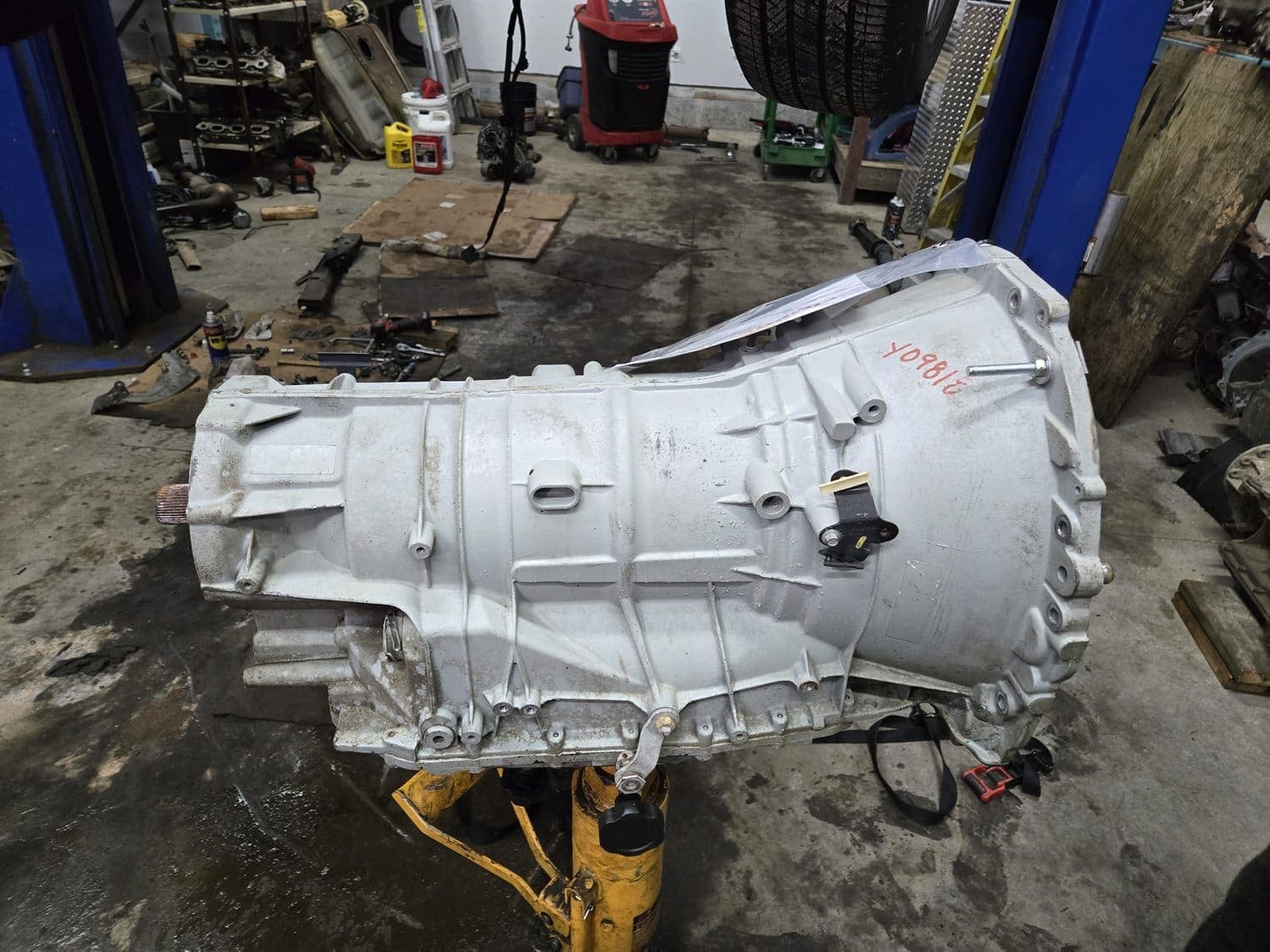
What came in
A 2014 LR4 whose 8-speed automatic needed to come out — exactly the kind of European driveline job most Edmonton shops farm out rather than take on.
What we found
The transmission needed to be removed and gone through, not patched around.
What we did
Pulled the 8-speed, went through it in-house, and put it back in — no sending the job away.
The outcome
European driveline work kept under one roof and under our control. If a shop just told you your Land Rover needs a transmission, it's worth a second opinion from us first.
Background
What to know about the 8-speed automatic transmission
General background on this engine family — not findings from the job above.
Why the LR4's eight-speed is not a conventional automatic
The eight-speed automatic behind an LR4 is a ZF 8HP-family unit, an architecture used under a long list of European and North American vehicles, which means the design is well understood by anyone who works on transmissions, even though the internals and control calibration are specific to the application. What separates it from an older domestic automatic is where the intelligence lives. The control electronics sit in the mechatronic unit: a valve body with its solenoids and the transmission control module combined into one assembly that sits inside the pan, running in the fluid. Shift feel is governed by electronically commanded clutch fill pressures rather than hydraulics alone, so a control-side fault produces symptoms that feel mechanical. When one of these comes in shifting badly, the control side has to be ruled out before the clutches are blamed: a lazy solenoid, a sticking pressure regulator or a speed sensor reporting badly can imitate worn clutches closely enough that only a scan with live data and a road test separates them. On most of these the filter is built into the pan, so a filter change means a complete pan assembly rather than a paper element, worth confirming for the application.
Adaptive shift learning on a ZF eight-speed, and why a relearn matters
These transmissions do not shift at high kilometres the way they did new, because they are adapting the whole time. The controller measures how long each clutch takes to fill and lock, then trims pressure and timing to hold the shift crisp as friction material wears and seals age. You get years of smooth shifting out of that, and the trade is that adaptation hides the decline: by the time a shift feels wrong the correction range may already be used up, which is why an eight-speed can seem to go from fine to poor over a short stretch. Adaptation matters just as much after any repair. Values learned against worn parts, left in place over fresh clutches or a different mechatronic unit, give harsh or flaring shifts that then get blamed on the work. The adaptations have to be cleared with a capable scan tool and relearned over a deliberate drive cycle, and a replacement mechatronic generally has to be programmed to the vehicle before any of that means anything.
No dipstick: how the fluid level is actually set on these eight-speeds
You will not find a dipstick on one of these. The level is set through a standpipe in the pan with the engine running and the fluid held inside a narrow temperature window, which means a scan tool watching sump temperature. Overfilled, the fluid aerates and clutch pressures go soft; underfilled, the pump pulls air on grades and hard corners. Both read to a driver as a tired transmission. The oil is a specific low-viscosity synthetic to the maker's spec, not a generic multi-vehicle ATF, and an adaptive transmission is sensitive to what it is shifting through. The factory called the fill lifetime, which meant the design service life the maker assumed rather than the life of the vehicle as you would measure it; the transmission maker publishes a fluid and filter interval in the eighty to one hundred and twenty thousand kilometre band depending on duty cycle, sooner for towing, heavy loads or steady city driving. On a unit already well past that with no service history the question becomes a judgement call: fresh fluid over stale adaptations can expose clutch wear the old fluid was masking, and that is a conversation to have before the pan comes off.
What Edmonton winters and short trips do to a Land Rover automatic
Many of these installations warm the transmission through a heat exchanger with a thermostatic bypass, so the fluid reaches working temperature quickly. Over a run of short Edmonton trips the unit may never get there at all, and two things follow. Moisture drawn in through the breather on cool-down never cooks off, and the torque converter clutch is held out by design until the fluid warms, so a vehicle that only ever does short trips spends a disproportionate share of its running with the converter slipping rather than locked. If your driving is a few kilometres at a time all winter, a longer steady run now and then is worth more to the transmission than it sounds. Road salt is the other tax. Cooler lines and their fittings, pan hardware, crossmember bolts, and the transfer case and driveshaft hardware that has to come apart to drop the unit all corrode, and a rotten cooler line is a slow fluid leak in its own right. None of that changes how one of these units is repaired, but in a salt climate it adds labour to any job that drops a transmission, so budget for hardware that does not come out cleanly.
Why the mechatronic changes the repair-or-replace math on a ZF eight-speed
On an eight-speed like this the control hardware is not buried in the gear train. The mechatronic is a discrete assembly that can be replaced on its own, and that is what makes the inexpensive outcome on these a genuinely separate repair rather than a partial teardown. Whether it is open to you depends on the condition of the clutches underneath, which is worth establishing before you accept a quote for a complete unit. Electronics and gearsets also do not travel the same way: a replacement assembly arrives with an internal history nobody watched, and its mechatronic has to be programmed to the vehicle and then adapted to it before any comparison of prices means anything. Matched genuine OEM units are generally sourced used, and Eskimo Auto & Truck Parts, a separate company at the same address and one of Edmonton's largest parts operations, is one such source. Repair, in-house rebuild, remanufactured and genuine OEM is the framing used for engines; a transmission has its own version of that set, and which parts of it are on the table is a diagnosis question rather than a price-list one.
If you run one of these
- A fluid and filter service on these means a complete pan assembly, not a paper element, so plan the job that way.
- Service the fluid on kilometres from the start; a first service on a neglected high-kilometre unit is a judgement call, not automatic.
- Insist the level be set through the standpipe at the specified fluid temperature, and ask what temperature it was set at.
- Whenever this transmission is opened or a mechatronic is changed, the adaptations have to be cleared and relearned, or shifts can feel worse afterwards.
- Ask whether any replacement mechatronic was coded to your vehicle, because an uncoded unit will not shift the way it should.
- On short winter trips the transmission may never fully warm, so give it a longer steady drive now and then.
The background on this failure
Transmission Won't Shift in Edmonton: Cold-Weather Shifting, Slipping, Limp Mode, and Honest Costs
Read the full guide — symptoms, causes and what it costs →More jobs from our bays
See every job →
Got a job like this one?
Engine or transmission trouble — call (780) 482-2424 for a straight answer, or send us the details.