
A real job from our Edmonton shop
Front-end noise: front axle U-joints, fluids and seals — 2019 Jeep Wrangler
2019 Jeep Wrangler · Front axle / 4x4 driveline
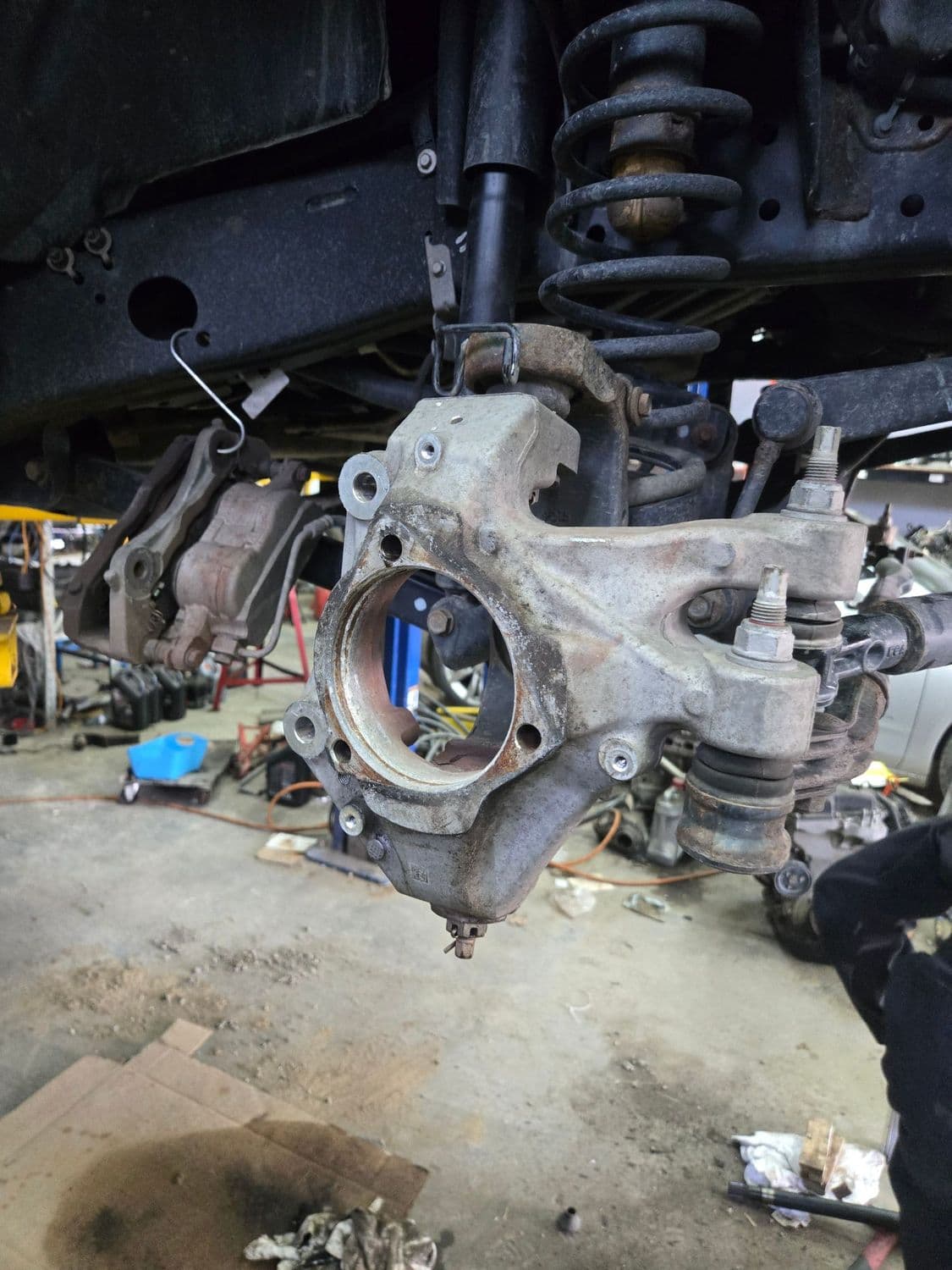
What came in
Noise from the front end — the complaint that covers everything from a worn joint to a failing hub, and that costs money when it is guessed at instead of inspected.
What we found
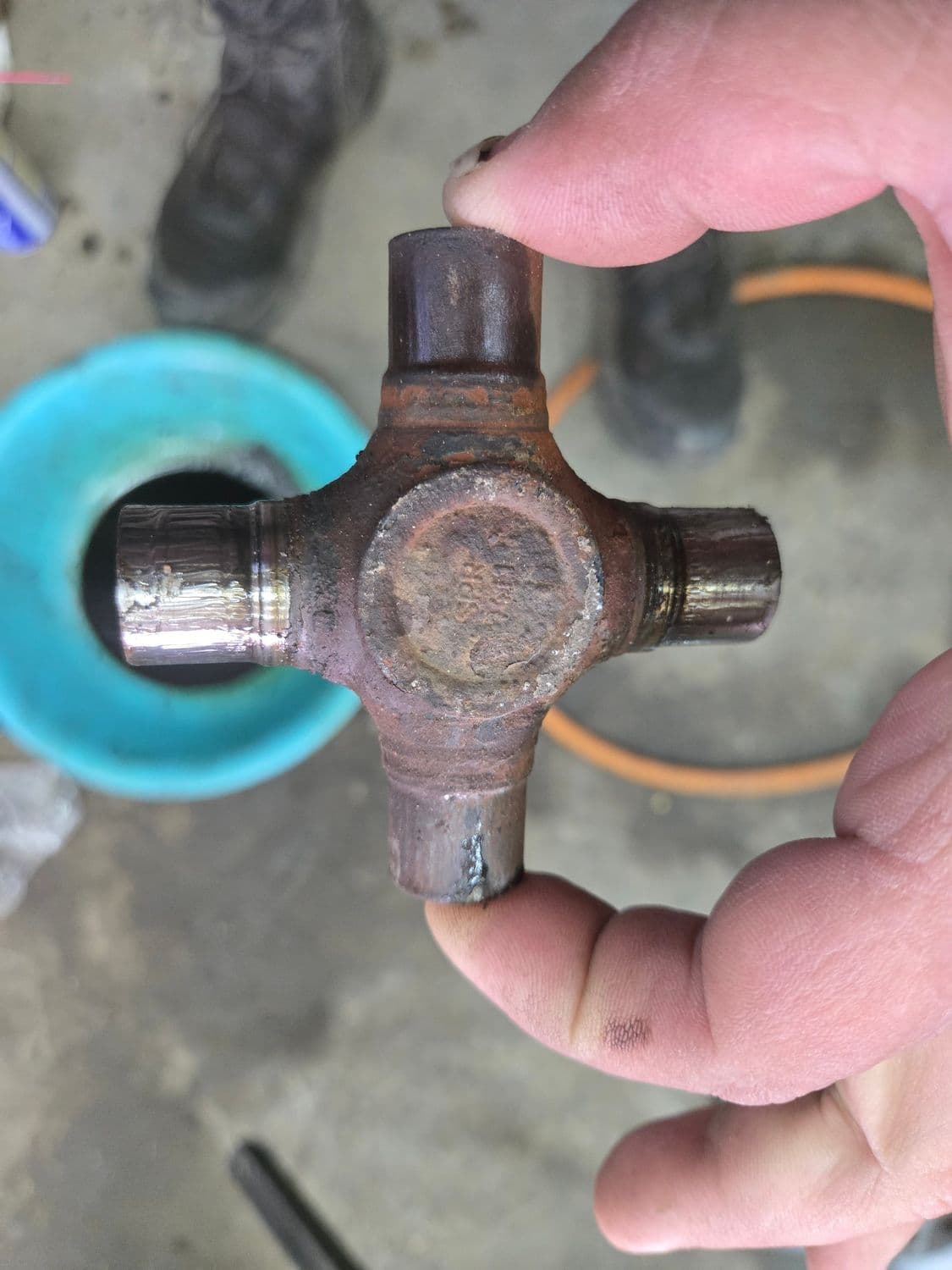
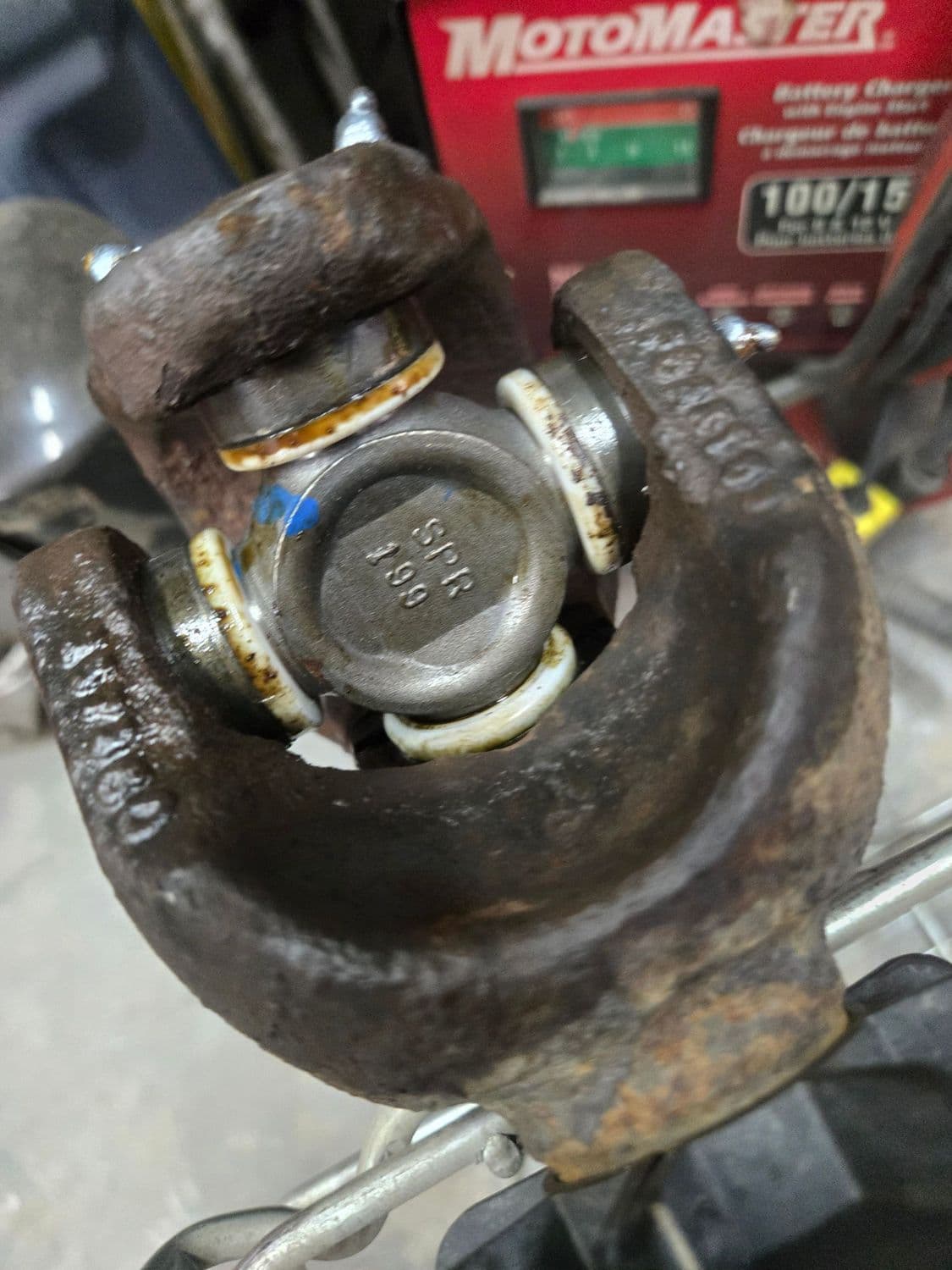
The front axle shaft U-joints were worn. The wear was not even: of the four trunnions on the cross, two were still serviceable and two were scored and hammered out, which is the pattern a joint shows when it has been driven and steered at the same time for a long while.
What we did
Replaced the front axle shaft U-joints, and with the axle shafts already out, renewed the axle seals and serviced the differential fluid at the same time. Inspected the wheel hubs and left them in place — they were in good condition and did not need replacing.
The outcome
The noise gone, the front driveline back to full service, and two other jobs done inside labour that had already been paid for once rather than twice.
Photos from the job
Our own bays, our own bench — no stock photography.
Background
What to know about the Front axle / 4x4 driveline
General background on this engine family — not findings from the job above.
Why a front axle U-joint works harder than any other joint on the vehicle
A universal joint lets rotation carry on through a bend. It is a cross with four trunnions, each one running in a cup of needle rollers, and the pairs of trunnions let the two halves pivot against each other while still passing torque. In a driveshaft that bend is fixed — set by where the transmission sits relative to the axle — and it only changes a little as the suspension moves. A front axle shaft asks far more. Its joint sits inside the steering knuckle and has to pass drive torque while the wheel is also being steered, so the angle changes constantly and sharply, from almost straight ahead to full lock in a parking lot. The hardest moment is also the most common one: turning tightly, at low speed, with the front axle driving. On a solid-axle 4x4 that same joint is additionally moving through the axle's articulation. That is why these wear out when driveshaft joints on the same vehicle do not, and why larger tyres and a lift — which increase both the torque through the joint and the angles it works at — bring the wear forward.
What even wear looks like, and what these did not
A cross should wear evenly. Four trunnions, four cups, all four seeing broadly the same duty over time, so when a joint is opened up they should look like each other. When they do not, the pattern tells you something. The failure mode to look for is not smooth wear but damage to the bearing surface — scoring, galling, and the small flats that get left where rollers stopped rolling and started skidding and hammering instead. That happens when grease has thinned, been displaced, or escaped past a seal, and once the rollers stop rotating freely they beat themselves into the trunnion rather than running on it. From there the joint develops play. Play is what you feel and hear. On this one, two of the four trunnions were still passable and two were hammered out, which is uneven duty showing up as uneven damage. One more point worth making: when one joint is this far gone, the other side has usually done the same mileage under the same conditions, which is why they are replaced in pairs rather than one at a time.
What front-end noise actually narrows down to
Front-end noise is a symptom, not a diagnosis, and the useful work is in separating the candidates. The questions that matter are when it happens and what changes it. Noise that appears or worsens in tight low-speed turns, especially with the front axle driving, points toward the axle shaft joints. A steady drone or hum that rises and falls with road speed rather than with steering, and that often changes when the vehicle is loaded side to side, points toward a wheel bearing. A clunk felt on taking up drive or changing direction points toward driveshaft joints or driveline slack. Knocking over bumps rather than under power points at the suspension — ball joints, track bar, sway bar links, control arm bushings — rather than the driveline. A click or grind that follows wheel rotation at low speed can be a brake or a bearing. None of these are reliably told apart from the driver's seat, which is the whole argument for having it on a hoist with someone's hands on it before parts are ordered. On a 4x4 the list is longer than on a two-wheel-drive vehicle, because there is a driven axle under the steering as well.
Why the seals and the fluid get done at the same time
There is a category of work where the part is minor and the access is everything, and almost all driveline work is in it. Getting to a front axle shaft U-joint means the wheel comes off, the brake comes off, the hub and knuckle come apart, and the axle shaft comes out. Every one of those steps is also what stands between a shop and the axle seal — so once the shaft is out, the seal is right there, and replacing it costs the part and a few minutes. Differential fluid is in the same position. Doing either of them as a separate job later means paying the whole access a second time. This is the part owners should push on when comparing quotes: not whether the price is low, but whether the things that are nearly free right now are included, because they will not be nearly free again.
Wheel hubs: when they go, and when leaving them alone is right
A wheel hub assembly on a modern 4x4 carries the bearing, usually the wheel speed sensor, and the mounting for the brake. It is also already apart at this point in the job, so it is the obvious thing to add to the bill, and the honest answer is that it depends entirely on what it measures. A hub that is noisy, that has play when the wheel is rocked top to bottom with the suspension unloaded, that feels rough when the hub is turned by hand, or that has been setting wheel speed sensor faults, is worth doing while everything is open. A hub that checks out does not become worn because the vehicle happened to be in the shop. On this Wrangler they were in good condition and were left in place. The cost of being wrong is not symmetrical, though, and that is worth knowing: a hub that is genuinely marginal and gets left will have to be reached again through the same teardown, so a borderline one is a real judgement call rather than an automatic no. The test is condition, and it should be shown to you rather than asserted.
What Edmonton roads and winters do to a front axle
Everything in a front axle that fails early fails because of what got into it or what got out of it. Grease stays where it is meant to be only as long as its seal does, and the seals on a steering joint live directly in the spray from the road — water, grit, and in this city six months a year of salt and brine. Once a seal is compromised the grease is diluted and washed out, water takes its place, and the bearing surfaces rust between uses. A 4x4 that is used off pavement adds abrasive dust and the occasional deep water crossing, which pushes water past seals that would have coped with spray. The other local factor is cold: grease is at its stiffest on a January morning, so the first few minutes after a cold start are when a marginal joint is working hardest with the least lubrication, and that is often when the noise is loudest and most noticeable. None of it is avoidable, but it does make the case for having the front end looked at as part of regular service on a 4x4 here, rather than waiting until it is audible from inside the vehicle.
If you run one of these
- Note WHEN the noise happens — tight slow turns, steady speed, over bumps, or taking up drive. That one detail narrows the list more than anything else.
- Noise that shows up in tight low-speed turns with the front axle driving points toward the axle shaft joints.
- U-joints get replaced in pairs. The other side has done the same mileage in the same conditions.
- Ask whether the axle seals and differential fluid are included. The shaft is already out, so they are nearly free now and expensive later.
- Do not let hubs be added automatically — or refused automatically. Ask to be shown the play or the noise that justifies it.
- Bigger tyres and a lift increase both the torque through these joints and the angles they work at, so inspect them more often.
- If your 4x4 has stopped pulling at the front, have it looked at rather than driven on; a joint that fails completely can take more with it.
More jobs from our bays
See every job →
Got a job like this one?
Engine or transmission trouble — call (780) 482-2424 for a straight answer, or send us the details.