A real job from our Edmonton shop
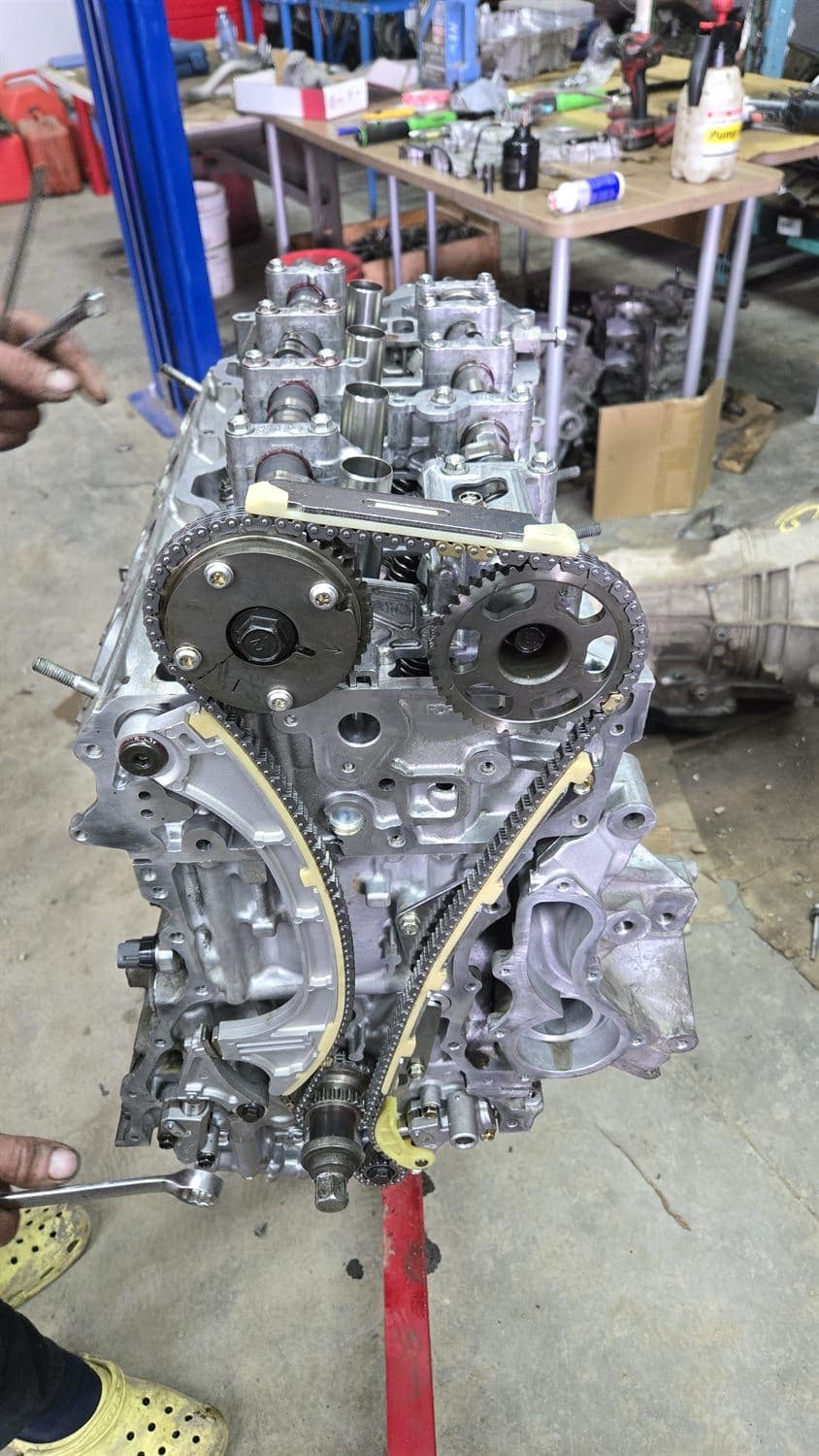
Remanufactured 5.7 HEMI swap — Dodge / Ram
Dodge / Ram · 5.7L HEMI V8 (remanufactured)
What came in
A tired 5.7 HEMI too far gone to rebuild economically — and an owner who wanted a warrantied fresh engine without the wait.
What we found
When the old engine isn't worth machining, a remanufactured long block is the answer: professionally rebuilt to spec, with warranty coverage.
What we did
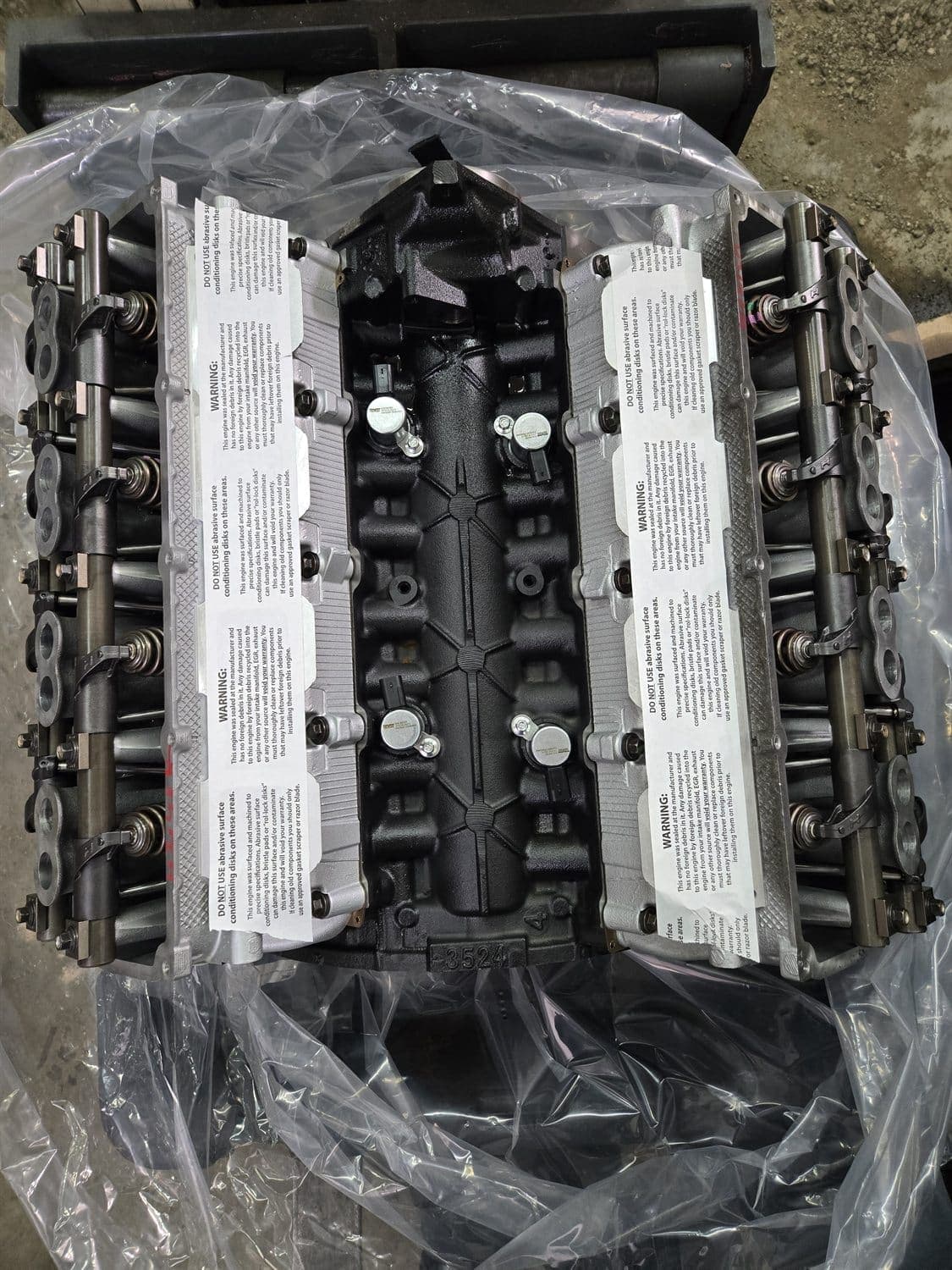
Sourced a factory-sealed remanufactured 5.7 HEMI long block — machined and assembled to spec by the remanufacturer — and installed it.
The outcome
A fresh, warrantied start for the truck. Reman is the third of the four ways we fix an engine, alongside genuine OEM, an in-house rebuild, and new — we source it, install it, and stand behind the work.
Background
What to know about the 5.7L HEMI V8 (remanufactured)
General background on this engine family — not findings from the job above.
Why a 5.7 HEMI ends up replaced rather than repaired
What pushes any engine past economical repair is the line between parts and machine work. On a 5.7 the trouble that gets it there usually starts in the valvetrain rather than the bottom end, in the camshaft and its lifters, but that is not what decides the question. Once the block, the crank or the heads need machining rather than components, the bill starts climbing toward the price of a complete engine, and on this V8 it arrives sooner than owners expect. Machine shop time is billed much the same whatever badge is on the engine, and a V8 gives you plenty of it to buy: eight bores, two heads, a crank. So a 5.7 crosses that line ahead of a four-cylinder, where there is far less machining to pay for and cheap parts argue for keeping the engine instead. That cuts in the owner's favour too. Chrysler built this V8 across Ram pickups, Durangos, Grand Cherokees, Chargers, Challengers and 300s for well over a decade, so complete engines stay plentiful and competitively priced, and a genuine OEM one is easy to find.
What a 5.7 HEMI shows an owner on the way out
A 5.7 rarely announces the end in one event. The noise is what owners fixate on, and the 5.7 has more than one noise available to it, which is why a tick on its own is not a condemned engine and why the diagnosis comes before the quote. The symptoms that move the conversation toward replacement are the ones that say the oil system has been involved: oil pressure that sags once the engine is hot and recovers when you raise the idle, a knock that deepens under load rather than staying light and rhythmic, oil consumption climbing between changes on an engine that leaves nothing on your driveway, or a misfire that stays on one cylinder after plugs and coils have been swapped. On a 5.7 those are not separate complaints. The lifters are hydraulic and fed by the same oil, so the valvetrain is both where a 5.7 usually fails and the first thing to suffer when hot oil pressure drops. Two or three of those together on a high-kilometre engine is normally where the question stops being which part.
Matching a replacement 5.7 HEMI long block to the truck it goes into
A long block is the engine's core: block, crank, pistons, heads, camshaft, lifters and timing set. On a HEMI the problem is almost never finding one. It is configuration, because the replacement has to match the engine your truck was built with. Engines from 2009 on carry variable valve timing and the phaser that runs it. MDS blocks carry deactivating lifters and the valley hardware to feed them; non-MDS blocks do not. A non-MDS long block can still go into an MDS truck, but only as a deliberate conversion rather than a substitution: camshaft, lifters, lifter guides, solenoid ports and PCM calibration all change together, which is the job the Ram 1500 MDS delete case study on this site walks through. Order the mismatch by accident, leave the calibration alone, and the controller keeps commanding a circuit the engine no longer has. Trigger wheels and sensor provisions have to be what that controller expects, since the sensors themselves come off the old engine. On an eTorque truck the belt-driven motor generator lives on the front of the engine, so the bracketry has to line up. Suppliers also differ on the oil pan, covers and oil filter adapter.
Remanufactured, in-house rebuild, or a genuine OEM 5.7 from a donor vehicle
Once a targeted repair is off the table on a high-kilometre 5.7, three routes are left. A remanufactured long block arrives with new lifters and a camshaft that has never been run, which is the part of a 5.7 most likely to have put one on a bench in the first place, and it arrives finished, so the day it lands is the day the work starts. An in-house rebuild keeps your own block and the configuration that already matches your truck, and it is the only route where the valvetrain decisions get made deliberately instead of inherited from whatever a supplier chose to build. A tested genuine OEM 5.7 from a donor vehicle, through Eskimo Auto & Truck Parts, the separate parts company that shares this address, comes as a complete unit rather than a long block, and the 5.7's donor pool is deep enough that documented kilometres are worth holding out for. Warranty cover differs by builder and by route, so read the terms rather than the headline: term, kilometre limit, what labour it pays, what it excludes, and who files the claim.
What an Edmonton winter asks of a 5.7 HEMI, fresh or not
A fresh engine does not change the parts of a cold start that were never in the crate. At thirty below the oil is thick and a battery has lost much of its cranking capacity, so a fresh engine turns over no faster than a worn one, and if anything new rings and tight bearings add drag. The battery, cables, starter and a block heater element and cord that actually work decide how a first winter after an engine swap goes. That first minute matters more on a 5.7 than most, because the 5.7's hydraulic lifters are fed by oil at its thickest and slowest right then, and the valvetrain is where the 5.7 already fails. Short trips compound it: an engine that never reaches full operating temperature collects fuel and moisture in the oil, which matters most during break-in. Cycling between thirty-five below and thirty above is hard on the plastic and rubber in a cooling system, and a long block arrives with none of it. Road salt and years of heat cycling handle the rest: exhaust manifold bolts on a 5.7 snap rather than seize, and the time to deal with them is while the engine is out.
If you run one of these
- Confirm whether the replacement is an MDS or non-MDS long block, and if it is a conversion, that the calibration changes with it.
- Ask for the long block's parts list in writing: suppliers differ on the oil pan, covers, oil filter adapter and oil cooler plumbing.
- Budget for exhaust manifold bolts on a 5.7; they snap rather than seize, and the engine being out is the cheap time.
- Ask which HEMI generation and configuration your core has to be for the supplier to accept it, before the old engine leaves.
- A fresh engine cranks on the same battery, cables and starter you already have, and tight new internals do not turn over easier.
- Get warranty terms in writing before ordering: term, kilometre limit, what labour it pays, what it excludes, and who files the claim.
More jobs from our bays
See every job →
Got a job like this one?
Engine or transmission trouble — call (780) 482-2424 for a straight answer, or send us the details.