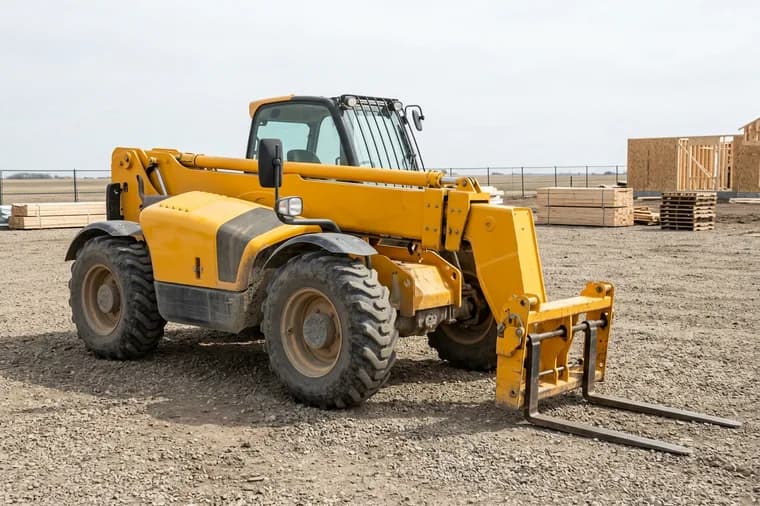
A forklift or telehandler down is a warehouse or a job site that stops moving. We repair masts and carriages, hydraulics, propane, diesel and electric drivetrains, transmissions, brakes and steering — in our bays or at your yard. $150 to $230 an hour, quoted before we start.
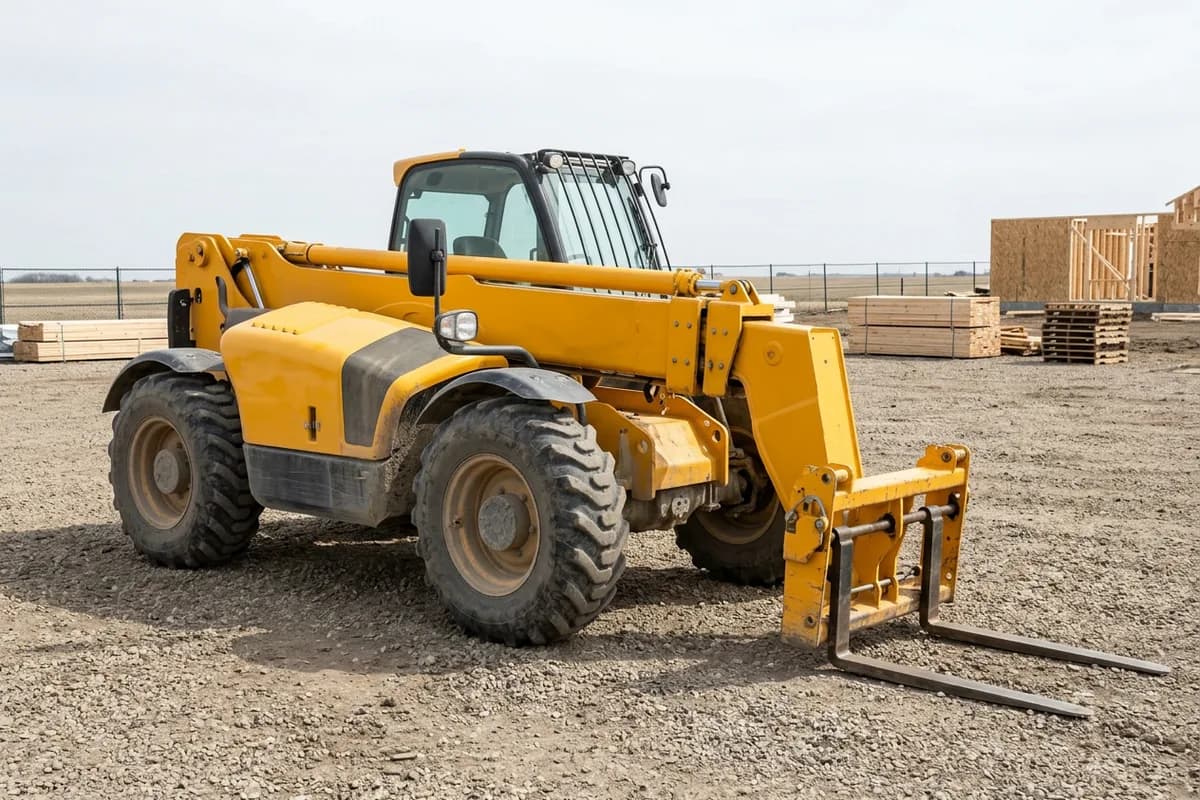
Forklifts and telehandlers are the machines a site notices immediately when they stop: the warehouse quits moving, the lumber yard cannot load a truck, the framing crew has no way to get a bundle up to the second floor. We repair both — sit-down counterbalance and rough-terrain forklifts, and telehandlers — for the warehouses, building-supply and lumber yards, farms, contractors and rental fleets around Edmonton. Brands we see most are Toyota, Hyster, Yale, Crown, Clark, Cat, Komatsu and Doosan on the forklift side, and JCB, Genie, JLG, SkyTrak, Cat, Case, New Holland and Manitou on the telehandler side. Same approach as everything else we fix: find the fault, quote it in writing, then repair it.
Masts, carriages, chains and forks
The mast is where a forklift does its work and where the wear shows. Lift chains stretch with use and have to be measured rather than eyeballed; mast channels, rollers and bearings wear and make a load hunt and shudder on the way up; the carriage, the backrest and the hoses and sheaves that run up the mast all take a beating. Forks themselves are a wear item people forget — heel wear thins the steel where the blade meets the shank, and a cracked or thinned fork is the failure nobody wants to see happen with a load in the air. We measure chains and forks, service the mast and carriage, and repair side-shifts and fork positioners.
Hydraulics, lift cylinders and telehandler booms
Hydraulics are the second half of it. A mast that settles under load, lifts slowly, or drifts down on its own usually means worn cylinder seals or a control valve passing internally rather than a dead pump — and the cheap causes get checked first. We repair pumps, control valves, lift and tilt cylinders, hoses and fittings, and the auxiliary circuits that run attachments. On telehandlers the same systems are bigger and add the boom: extend and retract cylinders, boom wear pads that need shimming before they gouge the boom sections, the quick attach, stabilizers, and frame levelling.
Propane, diesel and electric forklifts
Engines come in three flavours and each fails its own way. Propane forklifts live and die by the fuel system — regulators, vaporizers and lock-off valves that cause hard starting, stalling and poor running, plus the tank and its fittings. Diesels bring the Tier 4 problem in its worst form: a lift truck that spends the day idling and lifting never gets the exhaust hot enough to regenerate, so soot loads up and the machine derates. Electrics are a battery-and-charger business — a pack that will not hold a shift, a charger that will not start, corroded connectors, contactors and controllers — and in an unheated Edmonton warehouse or an outdoor yard, cold makes all of it worse.
Transmissions, axles, brakes and steering
Underneath, it is drivetrain and chassis work: powershift and hydrostatic transmissions, torque converters, drive axles and differentials, wet and drum brakes, park brakes, and the rear steer axle with its kingpins and bushings that goes vague and wandery when it wears. Tires get checked as part of any service, because a forklift on flat-spotted or chunked-out cushion tires beats the rest of the machine apart, and on rough-terrain units and telehandlers the four-wheel-steer modes and the axles that carry them are their own job.
Mobile service — we come to your warehouse or yard
We come to you. Forklifts, telehandlers, manlifts, loaders, skid steers, backhoes and other heavy equipment all get mobile service — at your warehouse, your yard or the job site, rather than a trailer ride across the city. For a forklift that is down in the middle of a shift that is usually the difference between losing an afternoon and losing a day. Tell us the machine, the fault and any code on the display when you call, and we will tell you straight whether it is a job we can finish on site or one that has to come into the shop.
What forklift and telehandler repair costs
Equipment work runs $150 to $230 an hour and we confirm the rate for your machine when you book; diagnosis is billed at the same rate. Parts are quoted separately before anything is ordered, and for masts, booms and attachments we order by the machine's serial number, because the same model takes different parts from year to year. Telehandlers are heavy-duty work. Rental fleets, yards and contractors with more than one machine can set up a commercial account.
Signs you need this service
- The mast lifts slowly, shudders on the way up, or settles under load
- The mast or carriage drifts down on its own
- Lift chains look stretched, or the forks are worn thin at the heel
- A propane truck is hard to start, stalls, or runs rough
- A diesel lift truck is derating, or will not finish a regen
- An electric truck will not hold a shift, or the charger will not start
- The transmission slips, will not shift, or the truck creeps in neutral
- Steering has gone vague, or the rear axle wanders
- A telehandler boom will not extend, retract or level, or the stabilizers leak down
What's included
- Mast, carriage and chain service — measurement, rollers, bearings, sheaves and hoses
- Fork inspection and replacement, side-shifts and fork positioners
- Hydraulic repair — pumps, control valves, lift and tilt cylinders, hoses and auxiliary circuits
- Telehandler boom repair — extend and retract cylinders, wear pads, quick attach, stabilizers and frame levelling
- Propane fuel systems — regulators, vaporizers, lock-offs and tank fittings
- Diesel engine repair, Tier 4 regeneration and derate faults, and cold starts
- Electric trucks — battery packs, chargers, connectors, contactors and controllers
- Transmissions, torque converters, drive axles, brakes and steer axles
- Mobile service at your warehouse, yard or job site — forklifts, telehandlers, manlifts and other heavy equipment
- $150 to $230 an hour, quoted in writing before work starts
Frequently asked questions
How much does forklift repair cost in Edmonton?
Equipment work runs $150 to $230 an hour and we confirm the rate for your machine when you book; diagnosis is billed at the same rate. A propane running problem or a charger fault is usually a short job, while a mast rebuild, a transmission or a boom cylinder is mostly parts — and parts are quoted separately before anything is ordered. You get the whole number in writing before the work starts.
Do you come to our warehouse or yard?
Yes. Forklifts, telehandlers, manlifts, loaders, skid steers, backhoes and other heavy equipment all get mobile service — at your warehouse, your yard or the job site. Tell us the machine, the fault and any code on the display when you call, and we will tell you whether we can finish it there or whether it has to come into the shop. Either way you get that answer before anyone is dispatched.
My forklift mast drifts down with a load on it. Is that serious?
It needs looking at before the truck is used again — a load that settles on its own is a load that can settle on someone. The usual causes are worn lift-cylinder seals or a control valve passing internally, and sometimes a hose or fitting rather than either. We test the circuit under pressure to find which, then quote the repair. Do not keep running a truck that will not hold a load.
How do I know when lift chains or forks need replacing?
Both are measured, not guessed at. Chains stretch with use and are checked against the manufacturer's wear limit; forks wear thinnest at the heel, where the blade meets the shank, and get measured there and checked for cracks and bending. Both are the kind of thing an inspection fails a truck for, and both are cheap next to what happens when one lets go with a load up. We measure them as part of a service and show you what we found.
Do you work on propane, diesel and electric forklifts?
All three. Propane problems are usually the regulator, vaporizer or lock-off; diesel lift trucks that idle all day get Tier 4 regeneration and derate faults; electric trucks come down to the battery pack, the charger and the connectors and controllers between them. Tell us which you have and what it is doing when you call.
Book your forklift & telehandler repair
Call for a straight answer on cost and timing, or book online.