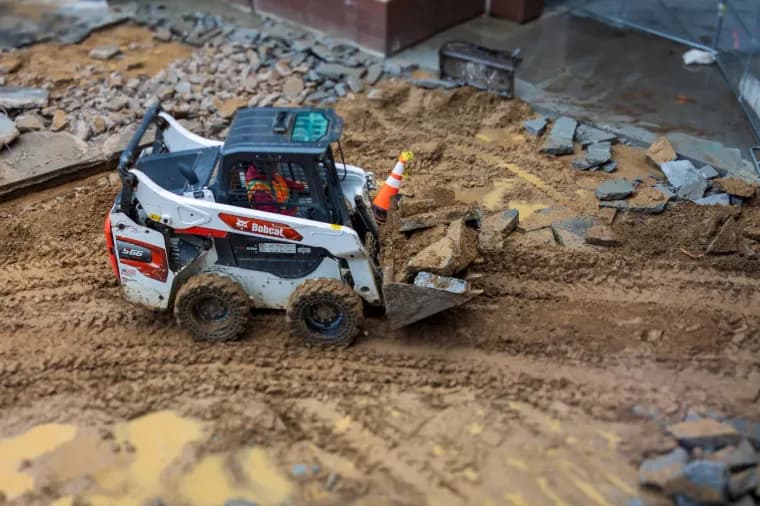
When a skid steer or loader goes down, the whole job stops. We diagnose the hydraulics, drive, diesel and controls before we condemn anything — then quote the repair in writing at our heavy-duty rate of $150 to $230 an hour. All makes, from Bobcat and Cat to John Deere, Case and Kubota.
When a skid steer or compact track loader goes down, the whole job stops — the dirt doesn't move, the snow doesn't get cleared, and the crew stands around while the machine sits. We service all makes, from Bobcat and Cat to John Deere, Case, Kubota, New Holland, Takeuchi, Gehl, Wacker Neuson, and ASV, and we work the way a busy operator needs us to: diagnose the actual fault first, then quote the repair in writing before anything comes apart. Edmonton runs a lot of these machines — construction and excavation crews, landscapers, acreage and farm operators, and snow-removal fleets that lean on them all winter — and most of what fails on them is predictable once you know where to look.
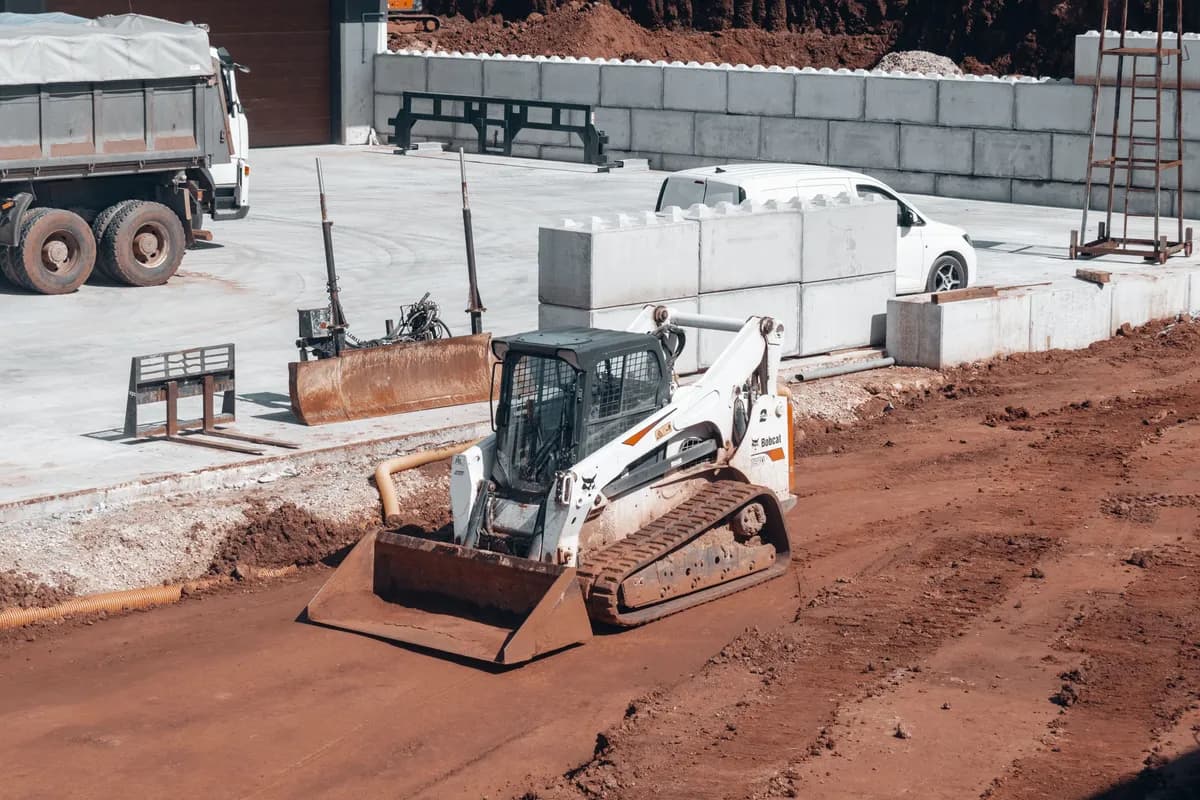
Skid steer hydraulic & hydrostatic drive repair
Hydraulics are the heart of the machine, and they're where most of the expensive trouble lives. A skid steer that drifts to one side when you mean to travel straight has lost power to one drive circuit — but before anyone condemns a drive motor or hydrostatic pump, we check the cheap stuff first, because a parking brake that isn't fully releasing on one side mimics exactly that symptom for a fraction of the cost. Weak or jerky lift and tilt, slow response that's worse when the oil is cold, overheating, and whining under load usually trace back to low or contaminated fluid, worn pump seals letting the system bypass internally, a clogged filter forcing the system into bypass, or a plugged cooler. The one finding we never ignore is metal in the filter or the oil: that means the hydrostatic system is grinding itself up, and it has to come apart for inspection and cleaning before the debris destroys both pumps and both drive motors. We handle the full range — pumps, drive motors, cylinders, control valves, hoses, fittings, seals, and drive belts — and we chase down the leaks that quietly drain a reservoir before they leave you stranded in a field.
Diesel engines, cold starts & Tier 4 emissions
The diesel engine and its emissions system are the second big category, and Alberta's cold makes both worse. Hard starting, long cranking, and white smoke on a cold morning usually point at glow plugs, a tired battery, or fuel problems — and fuel is a big one here, because untreated diesel starts to cloud and wax below about -9 C and can gel solid — plugging filters and lines — on a -30 morning. We service glow plugs, fuel and water separators, injectors, and the cold-weather starting aids these machines depend on. On newer Tier 4 units the emissions system is its own headache: skid steers and track loaders often run at light load and low exhaust temperature, so the DPF never gets hot enough to burn off soot, regeneration doesn't complete, and eventually the machine forces a regen or drops into a power-limited derate mode until it's dealt with. We diagnose DPF regeneration faults, DEF dosing and quality problems on the larger units equipped with SCR, and the sensor and soot-loading errors that trigger derates — and, worth knowing, plenty of the mid-size Bobcat machines don't use a DPF at all, so the right first step is always finding out what your specific engine actually has.
Tracks, undercarriage, controls & attachments
The rest of what we see splits across a few areas. On compact track loaders the undercarriage is the single biggest wear item — rubber tracks typically last somewhere between 1,200 and 2,000 hours on abrasive surfaces like concrete and gravel, longer on soil and grass, and they wear out alongside the rollers, idlers, and sprockets they run on. A five-minute weekly track-tension check saves real money: too loose and a track de-tensions and throws, too tight and it chews through rollers early. Wheeled units trade all that for tires, flats, and wheel-motor issues instead. On the electrical side, no-crank and no-start complaints often come down to the operator-presence safety system — the seat switch, the seat-bar or lap-bar switch, and the interlocks that keep the machine locked until you're seated and belted in — along with joysticks, sensors, and wiring. The attachment end has its own quirks too: quick couplers that won't connect are almost always trapped residual pressure rather than a real failure, and worn couplers, quick-attach plates, and auxiliary-hydraulic circuits all get repaired here. For common wear and service parts — filters, hoses, fittings, belts, batteries — our sister company, Eskimo Auto & Truck Parts, one of Edmonton's largest parts operations, gives us the supplier relationships to source parts fast and keep fleets moving. We take fleet and commercial accounts, and every job gets a written quote before the work starts.
Compact wheel loader & backhoe loader repair
Bigger loaders use the same building blocks at a larger size, and we work on the ones contractors, landscapers, acreage owners and snow crews actually run: compact wheel loaders and backhoe loaders from Case, Cat, John Deere, JCB, Kubota and Volvo. On a wheel loader the wear shows up at the pins — the articulation joint and the loader-arm and bucket pins and bushings loosen until the machine clunks and the bucket has slop in it, and a daily grease is what stretches them out. Steering cylinders, the transmission, the axles and the brakes round it out. Backhoes add a second circuit: swing, boom, dipper and bucket cylinders, stabilizers that leak down, and a loader end and a backhoe end that both need their pins kept tight. Full-size quarry and mining loaders are a different class of machine — if that is what you run, call and we will tell you straight whether it is a fit before you haul it anywhere.
Mobile service — we come to your yard or job site
We come to you. Loaders, skid steers, backhoes, telehandlers, manlifts, forklifts and other heavy equipment get mobile service at your yard or job site, which beats loading a dead machine on a trailer and hauling it across the city — and for a fleet it means the rest of the yard keeps working while we are there. Tell us the machine, the fault and any code on the display when you call and we will tell you straight whether it is a job we can finish on site or one that has to come into the shop. Cars and light trucks are shop work; this is for equipment.
What skid steer & loader repair costs
Equipment work is billed at our heavy-duty rate — $150 to $230 an hour — and diagnosis runs at the same rate. Parts are quoted separately before anything is ordered — on a hydrostatic pump, a drive motor or a set of tracks the parts are most of the bill — and you get the whole number in writing before the machine comes apart. If a job grows once it is open, we call you before going past what you approved.
Signs you need this service
- The machine pulls or veers to one side when you mean to travel straight
- Lift, tilt, or drive is slow, weak, or jerky — and worse when the hydraulic oil is cold
- Hydraulic oil leaking at hoses, cylinders, or fittings, or an oil-soaked undercarriage
- The diesel won't start, cranks a long time, or blows white smoke on cold mornings
- A regen or DPF warning, a check-engine light, or the machine dropping into low-power derate mode
- Tracks throwing off, cracking, or worn smooth — or a track that won't hold tension
- No-crank or no-start with the seat bar down, or controls that won't enable
- Attachment couplers won't connect, or the auxiliary hydraulics have quit
- Clunking or slop in the loader arms, the bucket, or a wheel loader's articulation joint
- Backhoe swing or stabilizers drifting, or cylinders leaking down
What's included
- Full diagnosis of the hydraulic, hydrostatic drive, engine, emissions, and electrical systems before any verdict
- Hydraulic and hydrostatic drive repair — pumps, drive motors, cylinders, control valves, hoses, seals, and drive belts
- Hydraulic oil and filter service, contamination cleanup, and cooler cleaning
- Diesel engine repair — glow plugs, hard starts, fuel and water separators, injectors, and cooling
- Tier 4 emissions diagnosis — DPF regeneration, DEF dosing and quality faults, and derate/limp-mode codes, on units so equipped
- Undercarriage and track service — tracks, tension, rollers, idlers, and sprockets — plus tires and wheel motors on wheeled units
- Electrical and control diagnosis — joysticks, sensors, operator-presence interlocks, wiring, and no-start faults
- Quick-attach, coupler, and auxiliary-hydraulic repair, plus scheduled preventive maintenance
- Compact wheel loader and backhoe loader repair — pins and bushings, articulation joints, steering, transmissions, axles and backhoe cylinders
- Mobile service at your yard or job site for loaders, skid steers, backhoes, telehandlers, manlifts and forklifts
- Heavy-duty labour at $150 to $230 an hour, with a written quote before any work starts and fleet and commercial accounts welcome
Brands we service
Our Red Seal–certified technicians work on all makes — including:
- Bobcat
- Caterpillar
- John Deere
- Case
- Kubota
- New Holland
- Takeuchi
Manufacturer names are used for identification only. Eskimo Auto Repair is an independent shop and is not affiliated with, or an authorized dealer of, these manufacturers.
Frequently asked questions
Do you work on Bobcat, Cat, John Deere, and other skid steer brands?
Yes — we service all makes of skid steer and compact track loader, including Bobcat, Caterpillar, John Deere, Case, Kubota, New Holland, Takeuchi, Gehl, Wacker Neuson, and ASV. The hydraulics, hydrostatic drives, diesel engines, and undercarriages across these machines share the same core systems and the same failure patterns, so the diagnostic approach carries across brands. If yours is a newer model that needs manufacturer-specific software for a particular fault, tell us the make and model when you call and we'll confirm we can cover it before you haul it in.
Do you repair wheel loaders and backhoes, or just skid steers?
Both. Along with skid steers and compact track loaders we repair compact wheel loaders and backhoe loaders — Case, Cat, John Deere, JCB, Kubota and Volvo among them. The common jobs are worn pins and bushings, articulation joints, steering and transmission faults, backhoe cylinders and leaking stabilizers, plus the same hydraulic, diesel and Tier 4 work as a skid steer. Full-size quarry and mining loaders are a different class of machine, so call first if that is what you run.
Do you come to our yard, or does the machine have to come to you?
We come to you for equipment. Loaders, skid steers, backhoes, telehandlers, manlifts, forklifts and other heavy equipment get mobile service at your yard or job site — call with the machine, the fault and any code on the display and we will tell you whether we can finish it there or whether it needs the shop. Cars and light trucks are shop work.
How much does skid steer and loader repair cost in Edmonton?
Equipment work is billed at our heavy-duty rate — $150 to $230 an hour — and diagnosis runs at the same rate. A hose or a fitting is a short job; a hydrostatic pump, a drive motor or a set of tracks is mostly parts, and those are quoted separately before anything is ordered. We find the actual fault first and give you the whole number in writing before the machine comes apart — never a figure invented over the phone.
My skid steer pulls to one side or the drive feels weak — is that a big repair?
Not always, and this is exactly why we diagnose before condemning. Veering to one side can be a worn hydrostatic pump or drive motor — genuinely expensive — but it's just as often a parking brake dragging on one side, which is a fraction of the cost. Weak or sluggish drive is frequently low or contaminated hydraulic fluid, a clogged filter, or an overheating cooler rather than a failed pump. We test the system properly and check the cheap causes first, so you don't pay for a drive motor you didn't need.
How long do compact track loader tracks last, and can you replace them?
Rubber tracks typically last somewhere between 1,200 and 2,000 hours on abrasive surfaces like concrete, crushed rock, and gravel, and longer — often 2,500 hours or more — on softer ground like soil and grass. How you tension and maintain them matters as much as the hours. When they're due we can replace the tracks and service the undercarriage they run on, since worn sprockets and rollers will eat a new set of tracks fast if they're ignored. We'll show you what's worn and quote it before doing the work.
Can you sort out Tier 4 DPF regen problems and machines that won't start in the cold?
Yes — both are among the most common calls we get from Alberta operators. Tier 4 machines that spend the day at light load often can't get the exhaust hot enough to regenerate, so soot builds up and the machine forces a regen or derates; we diagnose the DPF, DEF, and sensor side of that. Cold no-starts usually come down to glow plugs, batteries, and gelled or waxed fuel below about -9 C. We'll get the machine starting and running right, and point you at the fuel treatment and cold-weather habits that keep it that way through a -30 stretch.
From our repair blog
Related services
Book your skid steer & loader repair
Call for a straight answer on cost and timing, or book online.