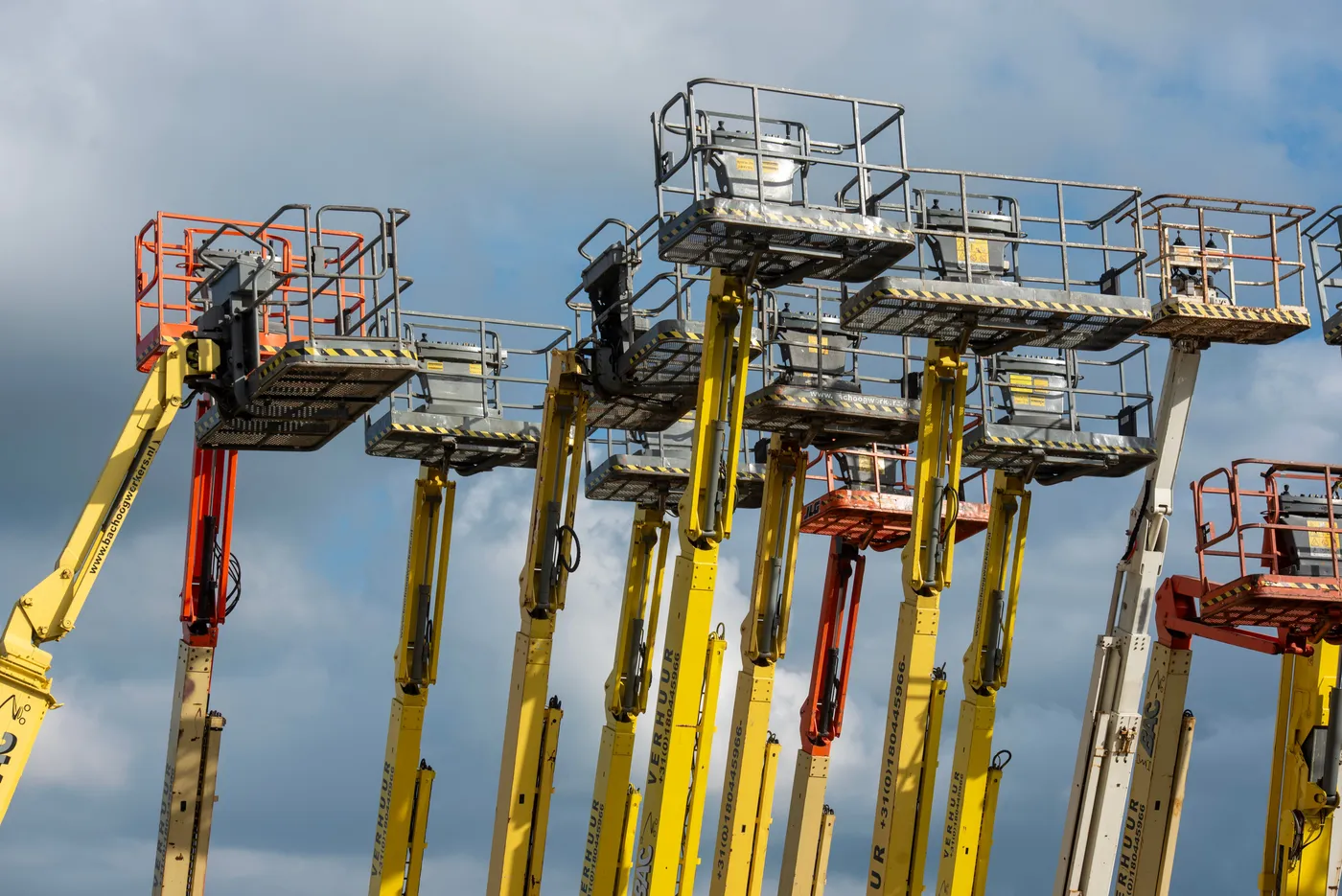
A manlift that won't go up is a crew standing on the ground. We repair scissor lifts and boom lifts — hydraulics, batteries and chargers, engines, drives and the fault codes that lock a machine out — at our heavy-duty rate from $150 an hour, quoted in writing before we start. We fix what is wrong; we never bypass a safety system to get a lift moving.
Manlifts are rented, owned and worked hard all over the Edmonton region — on construction sites, in warehouses and plants, on the industrial yards out along Highway 16A, and in the rental fleets that supply all of them. When one goes down, the work at height stops, and a rental unit sitting broken is a unit that isn't earning. We repair both kinds: slab and rough-terrain scissor lifts, and articulating and telescopic boom lifts, from the brands Canadian fleets actually run — JLG, Genie, Skyjack, Snorkel, Haulotte and MEC. The approach is the same as everything else we fix: find the actual fault first, quote it in writing, then repair it — at our heavy-duty rate, starting at $150 an hour.
Electric scissor lifts: batteries, chargers & drive
Most slab scissor lifts are battery-electric, and in Edmonton the battery is where the trouble starts. Lead-acid batteries lose a large share of their usable capacity in the cold, a lift parked flat over a long weekend can refuse to charge at all, and a battery left discharged on a cold night can freeze and crack its case — where a fully charged one survives the same night. So before anyone condemns a motor or a controller, we load-test the pack, check the charger and the interlock that stops the machine driving while it is plugged in, and look for the corroded cable end or loose terminal that drops voltage under load. From there we work through the drive motors, brakes, steer cylinder, the controller and the fault codes it reports, and the pothole-protection bars that cut drive at height when they don't deploy.
Why a lift won't go up — or won't come down
“It won't lift” is the most common call, and it is rarely the lift cylinder. A scissor or boom that refuses to raise is usually being told not to: a platform overload sensor, a tilt alarm on a machine that isn't level, an emergency stop that has been bumped, a foot switch or enable button, or battery voltage below the point the controller will operate at. Those systems exist to keep someone from falling, so we find out why the machine thinks it is unsafe rather than defeating the sensor — and when a sensor or switch has genuinely failed, it is replaced and the function tested before the lift goes back out. A lift that creeps down on its own, or won't lower, points the other way: a lowering or holding valve that is contaminated or worn, a leaking cylinder, or an emergency-lowering system that needs attention.
Boom lifts: hydraulics, engines & the turntable
Boom lifts add a lot more machine. On articulating and telescopic booms we repair the hydraulic pump, control valves, cylinders and hoses; the jib and platform-rotator circuits; the proportional controls at the platform and at ground level; the turntable and its drive; and the wear pads and hose carriers inside the boom. Rough-terrain units bring an engine too — diesel, gas or dual-fuel — with the same cold-start problems every machine has here: glow plugs and batteries on a -30 morning, fuel that clouds and gels, and on Tier 4 diesels the regeneration and derate faults that come from a machine idling most of the day. Four-wheel-drive booms also carry oscillating axles with lockout cylinders that have to hold when they are supposed to, and we test that they do.
What we won't do: bypass safety systems or weld structure
Two lines we hold on every lift. We don't bypass a tilt alarm, overload sensor, pothole guard, foot switch or any other interlock to get a machine moving — a lift that has been made to work by defeating its safety system is worse than one that doesn't work. And cracked welds or bent structure in the scissor arms, the boom sections or the platform are not a weld-it-and-send-it-back repair; that damage needs a manufacturer-approved repair, and we will tell you plainly when that is what you are looking at rather than patching it.
Annual inspections
Manlifts need a documented annual inspection by a qualified person, done to the manufacturer's requirements, and your employer or rental agreement will expect the paperwork. We don't issue those inspection certificates, and we won't pretend to. What we do is repair what an inspection turns up, service the machine so it is ready for one, and tell you when something we have found is going to fail it.
What manlift repair costs
Equipment work is billed at our heavy-duty rate, starting at $150 an hour, and diagnosis runs at the same rate. Parts are quoted separately before anything is ordered — for lift-specific components we order by the machine's serial number, because the same model can take different parts from one year to the next. You get the whole number in writing before the machine comes apart, and we check in before going past what you approved. Rental companies and contractors running more than one machine can set up a commercial account.
Signs you need this service
- The platform won't raise, or raises partway and stops
- The lift creeps down on its own, or won't lower from the platform controls
- A tilt, overload or fault alarm sounds and the machine locks out
- It won't drive, or drives only when stowed — or the pothole guards won't deploy
- Batteries won't take a charge, or run flat long before the end of a shift
- Hydraulic oil leaking from cylinders, hoses or the boom
- A rough-terrain lift won't start in the cold, or drops into derate
- Jerky or dead platform controls, or a jib or platform rotator that has quit
What's included
- Scissor lift repair — slab and rough-terrain, electric and engine-powered
- Articulating and telescopic boom lift repair
- Battery testing and replacement, and charger and charger-interlock repair
- Hydraulic repair — pumps, control valves, lowering and holding valves, cylinders and hoses
- Drive, steer, brake and oscillating-axle repair
- Controller fault codes, platform and ground controls, and safety-system diagnosis with function testing
- Diesel, gas and dual-fuel engine repair, cold starts and Tier 4 emissions faults
- Repair of the defects an annual inspection turns up, and service before one
- Heavy-duty labour from $150 an hour, quoted in writing before work starts
Frequently asked questions
How much does manlift repair cost in Edmonton?
Our heavy-duty rate starts at $150 an hour, and diagnosis is billed at the same rate. A dead scissor lift is very often batteries, a charger or a switch — a short job — while a pump, a drive motor or a cylinder is mostly parts, and those are quoted separately before anything is ordered. We find the fault first and give you the full number in writing before the work starts.
Do you work on JLG, Genie and Skyjack lifts?
Yes — along with Snorkel, Haulotte and MEC. The hydraulic, electrical and drive systems across these brands follow the same principles, so the diagnosis carries over. When you call, have the make, model and serial number from the data plate and any fault code on the display: the serial number decides which parts fit, and a fault code often tells us where to start before we see the machine.
My scissor lift won't go up — what's wrong with it?
Usually nothing expensive. A lift that won't raise is most often being told not to: the battery is below the controller's cut-off voltage, the machine isn't level enough for the tilt sensor, the platform reads as overloaded, an emergency stop is pressed, or a foot switch or enable is faulty. Check that the batteries are charged and the machine is on level ground first. If it still won't lift, we trace which interlock is holding it and fix the cause — we don't bypass the sensor.
Can you do the annual inspection on our lifts?
We don't issue annual inspection certificates. That inspection has to be done and documented by a qualified inspector to the manufacturer's requirements. What we do is service the machine so it is ready, and repair whatever the inspection finds — so a unit that failed goes back into service properly fixed.
Why do our lift batteries die so fast in winter?
Cold cuts how much energy a lead-acid battery can deliver, so a pack that lasted a full shift in July runs out early in January — and one stored flat in an unheated yard can freeze and crack. Keep lifts on charge whenever they are parked, store them warm where you can, and have tired packs tested before winter rather than after they strand you. We test the pack and the charger and tell you which one is actually the problem.
Related services
Book your manlift, scissor lift & boom lift repair
Call for a straight answer on cost and timing, or book online.